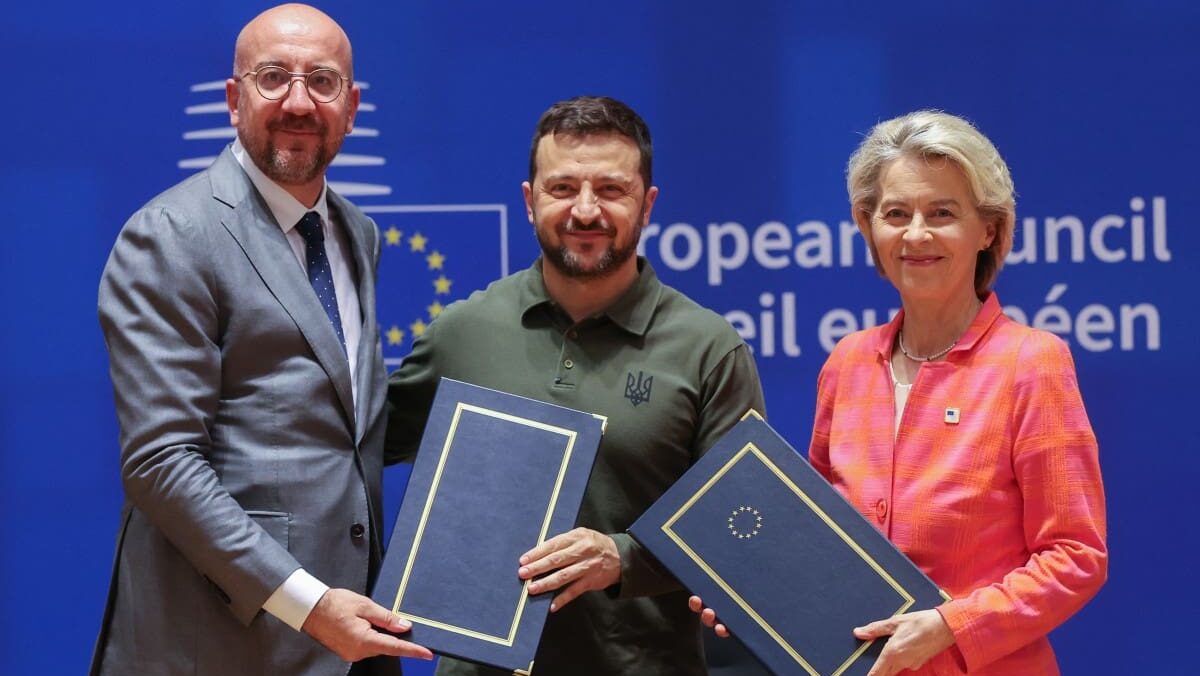
European Council President Charles Michel, Ukraine’s President Volodymyr Zelensky, and European Commission President Ursula von der Leyen pose during a signature ceremony of security agreement during the European Council Summit at the EU headquarters in Brussels on June 27, 2024. Michel and von der Leyen have both instructed the EU institutions they chair to make life difficult for the Hungarian presidency because of their opposition to Hungarian President Viktor Orbán’s peace mission to end the Russo-Ukraine war.
Photo: Olivier HOSLET / POOL / AFP
As the impartial and responsible executive it is, the European Commission decided to join the big member states’ boycott of the events organized by the EU Council’s Hungarian presidency to protest the conservative government’s stance on the war in Ukraine.
Unnamed sources told Politico on Monday, July 15th, that Ursula von der Leyen’s European Commission has asked its commissioners—the highest-level officials responsible for overseeing legislation in each policy portfolio in Brussels—to skip the specialized policy events traditionally organized in the country holding the Council’s rotating presidency. Instead, they should send lower-level bureaucrats.
The Commission’s childish antics, which will undoubtedly hinder the constructive legislative process, are meant to send a ‘clear message’ to Budapest that its ‘rogue’ diplomacy is not acceptable to Brussels.
“The EU is an international organization constituted by its member states,” while the Commission is just “an institution of the EU,” Budapest’s permanent representative to the EU, János Bóka, wrote on X in response. “The EU Commission cannot cherry-pick institutions and member states it wants to cooperate with.”
MEP Kinga Gál—from Hungary’s ruling Fidesz party and First Vice President of the newly founded Patriots for Europe group—was even more direct in her criticism, accusing Commission President Ursula von der Leyen of boycotting Hungary only to pander to the leftist parliamentary groups to ensure her re-election.
“We have become used to [von der Leyen] using the EU institutions, especially against Hungary for political blackmail and pressure,” she said. “This is unacceptable and goes against the very essence of European cooperation.”
The @EU_Commission announced that it will boycott the Hungarian Presidency of the Council. This is clearly a part of @vonderleyen’s election campaign. We have become used to her using the EU institutions, especially against #Hungary for political blackmail and pressure. This is…
— Kinga Gál (@kingagalMEP) July 15, 2024
This is yet another decision to deliberately undermine the work of the Hungarian EU presidency. Formally, it looks like a response to Hungarian PM Viktor Orbán’s ‘peace mission,’ which included bilateral meetings with leaders on both sides of the Ukrainian war—including Zelensky, Putin, Xi, Erdogan, and Trump—during which he urged all relevant parties to strive for ceasefire negotiations.
While the Brussels elite acts like Hungary’s pro-ceasefire stance is a betrayal of everything the West holds sacred, it ignores polling showing that it is also the most popular position among Europeans in most EU member states. Even President Zelensky is slowly embracing it, recently repeating his earlier statement that he was ready to invite Moscow to the next tranche of peace negotiations later this year in Switzerland.
Despite this, the Commission is only the latest body to join the coordinated effort to discredit and isolate Budapest for its pro-peace stance. Several countries, including Germany and France, have conspired with Josep Borrell—the EU’s foreign affairs chief—to force others into boycotting Hungary even if they don’t plan to by organizing a mandatory “counter-meeting” on the same date as a planned Budapest foreign affairs summit in August.
Other informal events of the Hungarian presidency are also being boycotted by many member states choosing to send lower-level officials instead of ministers. Twenty countries participated in the coordinated snub during the first ministerial meeting in Budapest last week, for instance.
Furthermore, PM Orbán was also prevented from addressing the European Parliament during this week’s plenary, as it would be customary with incoming EU presidencies. The Parliament’s excuse was not having enough time to squeeze in one more speech, so it chose to delay Orbán’s address until September.
Meanwhile, many in Brussels are working to find a way to avoid giving the premier a platform altogether.