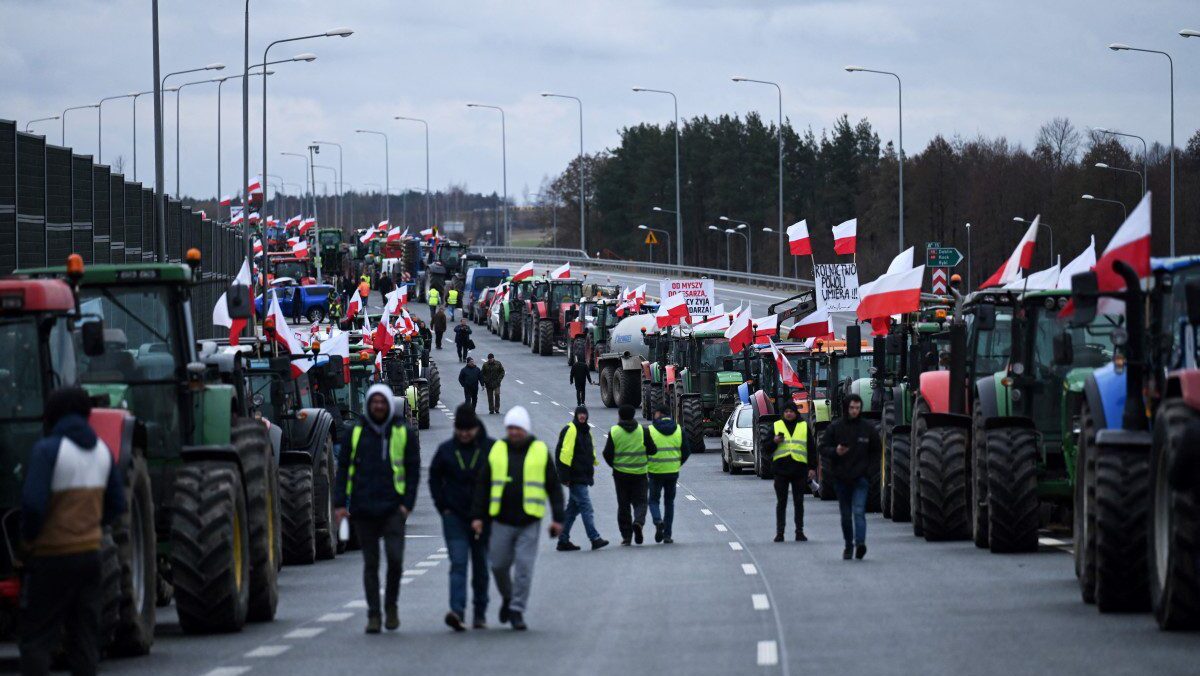
Polish farmers with their tractors and vehicles block the highway linking Warsaw and Lublin outside the town of Ryki, Lublin region, during a protest of farmers across the country againts EU climate measures on February 20, 2024.
Photo: Sergei GAPON / AFP
Farmers in Poland totally blockaded all traffic at border crossings with Ukraine on Tuesday, February 20th. They are protesting once again against EU regulations and cheap Ukrainian grain imports, in an unprecedented show of strength.
Today, a general farmers' strike is taking place in Poland again. Farmers are blocking main national roads and cities. A strike of several thousand people is to take place in Warsaw today. Farmers from Poland are to be joined by farmers from Germany, France, Belgium and the… pic.twitter.com/qh2c871yVZ
— Short Reports (@ShortReportOnX) February 20, 2024
By closing ports and motorways, farmers are restricting the movements of passenger cars, in addition to the trucks and other haulage vehicles targeted by earlier demonstrations. Tractors will also head to the capital, Warsaw, to put further pressure on the government. While military aid to Ukraine will be allowed through, all civilian traffic is blocked.
Farmers across the whole of Europe have been protesting EU and national regulations—especially the EU’s Green Deal, an ideologically driven set of measures to tackle climate change. By constraining farmers, it threatens to destroy their livelihood and way of life. Rising costs and unfair competition from Ukraine is also placing a heavy burden, not only on farmers but also truckers, who have voiced their discontent by blockading Ukrainian borders. Polish farmer associations have demanded Poland withdraw from the Green Deal altogether.
As Piotr Bórawski, an expert in the field of agricultural economy, told PAP news agency:
The prices of some agricultural products have fallen by as much as 50 percent. We have an oversupply of products from Ukraine, which the EU market is not able to absorb. These products are very often of much lower quality.
While Poland has been one of Ukraine’s staunchest allies since the invasion by Russia almost two years ago, ties between the two countries became strained last year: Ukrainian grain imports into Poland have undercut local prices and led the country’s former conservative government—alongside Slovakia and Hungary—to ban Ukrainian grain imports after EU restrictions ended last September.
Tak wygląda teraz protest rolników z Żuław, którzy zablokowali krajową S7-kę w Kmiecinie koło Nowego Dworu Gdańskiego. Słup dymu z palonych opon jest widoczny z kilku kilometrów. Policja prowadzi auta na objazdy drogami lokalnymi, są spore korki. @RadioZET_NEWS pic.twitter.com/jp9FAWFbBx
— Maciej Bąk (@MaciejBk1) February 20, 2024
Liberal Polish Prime Minister Donald Tusk, who likes to present himself as one of the most pro-European leaders, will have to show which side he comes down on as he attempts to reconcile the interests of Polish farmers with his campaign promises to improve Poland’s relationship with the EU by adhering to the edicts of Brussels
The opposition conservative Law and Justice (PiS) party has demanded he protect the farmers. “If Donald Tusk has at least a little bit of Polishness in him, he should make decisions quickly so that farmers do not have to block the Polish border. It is necessary to act effectively,” former Minister for Agriculture, Robert Telus tweeted.
💬 Poseł PiS @RobertTelus: W Unii Europejskiej trzeba o swoje sprawy walczyć bardzo mocno i stanowczo. 15 kwietnia ubiegłego roku zatrzymaliśmy granicę, wprowadziliśmy embargo po to, aby negocjować z Ukrainą. Wtedy dopiero Unia Europejska otworzyła oczy i zauważyła, że jest… pic.twitter.com/ShdiULb6a5
— Prawo i Sprawiedliwość (@pisorgpl) February 19, 2024
Seventy-seven percent of Polish voters support the farmers, according to a recent survey, polling numbers which the left-liberal government of Poland will have to take into account as it prepares for local elections in April.
Ukraine, however, says its agricultural exports have not damaged EU markets, and that the blockades are affecting its defence capability and helping Russia’s aims. President Volodymyr Zelensky called the blockade of the borders “unacceptable.” He said “the real issue is not the grain, but rather the politics.”
Tensions increased when social media footage appeared to show Ukrainian grain being spilled onto a train track from a goods wagon at the Medyka crossing, prompting an angry response from Vasyl Zvarych, Ukraine’s ambassador to Poland.
Polish Agriculture Minister Czesław Siekierski has previously stated he is negotiating with Ukraine and that a deal limiting imports could be reached by the end of March. He said that the national ban on imports of wheat, rapeseed and sunflower seeds, as well as some processed products such as wheat flour, bran and oilcake to Poland will remain in force. Farmers, however, are demanding the import ban be expanded to include products like sugar, eggs, and poultry.