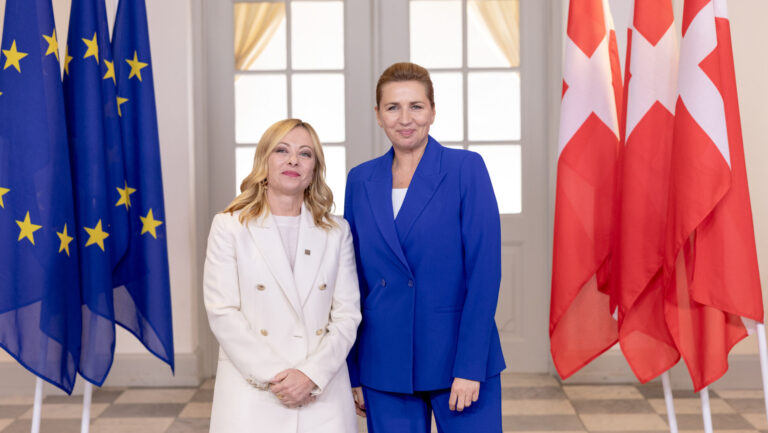
Italy’s conservative prime minister and Denmark’s centre-left leader said tighter returns policies alone are “not enough”, arguing that respect for European laws must go hand in hand with respect for European values.
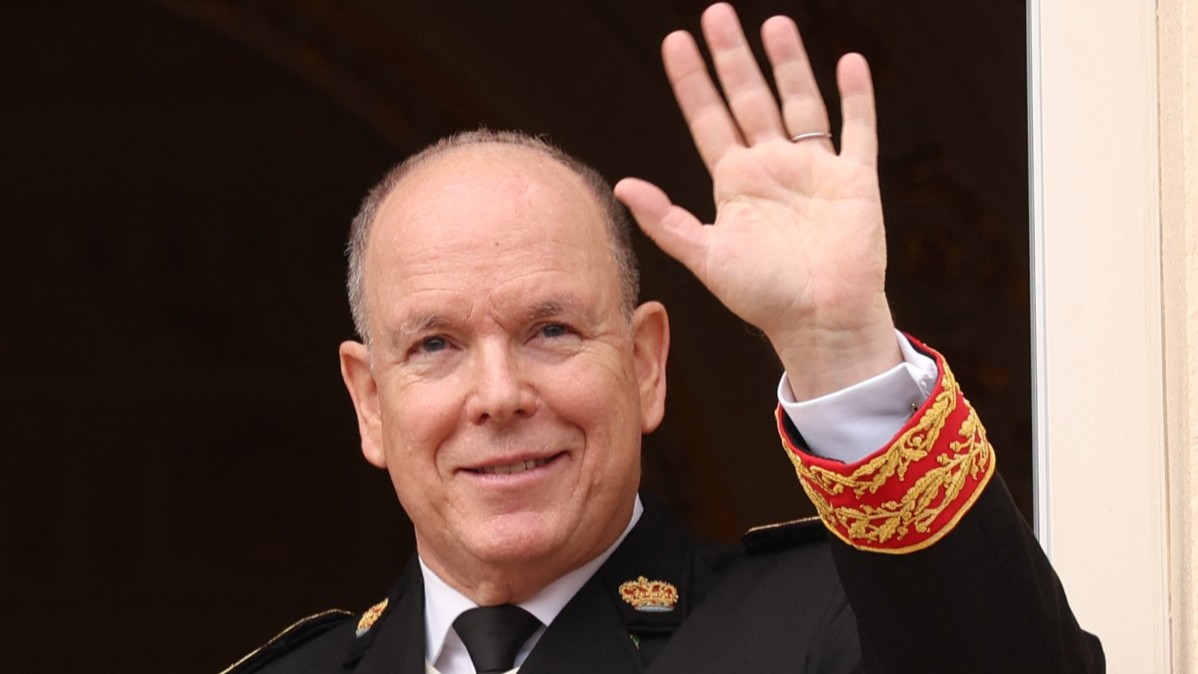
Prince Albert II of Monaco waves from a balcony of the palace during a ceremony marking ‘National Day in Monaco’, in Monaco on November 19, 2025.
Valery Hache / AFP
In a sovereign decision, H.S.H. Prince Albert II of Monaco decided last week to maintain the current legislation that considerably restricts access to abortion in his small principality, citing the Catholic identity of the land which his family has reigned since the 13th century.
In Monaco, a city-state and constitutional monarchy located on the French Riviera, which enjoys special agreements with the French state, Catholicism has the status of state religion. Abortion is prohibited there, although a change in the law in 2009 allows it in a few rare cases: in cases of rape, danger to the life of the mother, or foetal malformation. Furthermore, since 2019, performing an abortion is no longer punishable by criminal sanctions.
For several years, pressure has been mounting on the ‘Rock’, as the Principality of Monaco is sometimes nicknamed, to change its legislation. In May, the principality’s National Council adopted a bill by 19 votes to 2 that would allow abortion up to 12 weeks, extend the time limit in cases of rape from 12 to 16 weeks, and lower the age of access to abortion without parental consent from 18 to 15. In an interview published on November 18th in Monaco-Matin, one of Monaco’s leading newspapers, Prince Albert signalled his opposition to the bill—a form of veto that is permitted under the principality’s constitution.
While he said he understood “the sensitivity of this subject,” the sovereign believes “that the current framework respects who we are in terms of the place of the Catholic religion in our country, while guaranteeing safe and more humane support.” Indeed, Article 9 of the Monegasque constitution not only stipulates that the Catholic faith is the state religion, but also that it constitutes “the foundation of public institutions and laws.”
In the spring, the Archdiocese of Monaco expressed its concerns about the possible change in legislation. In March, Archbishop Dominique Marie David said he feared a major anthropological shift: “This would mean that the Principality would no longer recognise itself in the social values of Catholicism.”
Although the Principality of Monaco is linked to France by a whole series of diplomatic and administrative agreements, the same rules do not apply there. The prelate emphasised that, while France is based on secularism as a common principle, “in Monaco, it is the Catholic faith,” and did not hesitate to assert that “without Catholicism, the Principality no longer has its full DNA.”
For elective abortions, women still have the option of travelling to France, usually to Nice. The proposed reform sought to give Monegasque women the option of having the procedure locally, but the prince’s refusal maintains the legal structure as it stands.
Representatives of local feminist associations have expressed their disappointment. The decision is above all symbolic: travelling to Nice, located 20 km from Monaco, in a region with excellent transport links, for a generally affluent population, is by no means an insurmountable obstacle. But as pressure mounts across Europe for ever greater liberalisation of abortion, Monaco stands out more than ever as an exception.
The decision had been communicated to the minister of state two weeks earlier and is expected to be accompanied by “new support measures,” not yet disclosed, for women facing unwanted pregnancies.