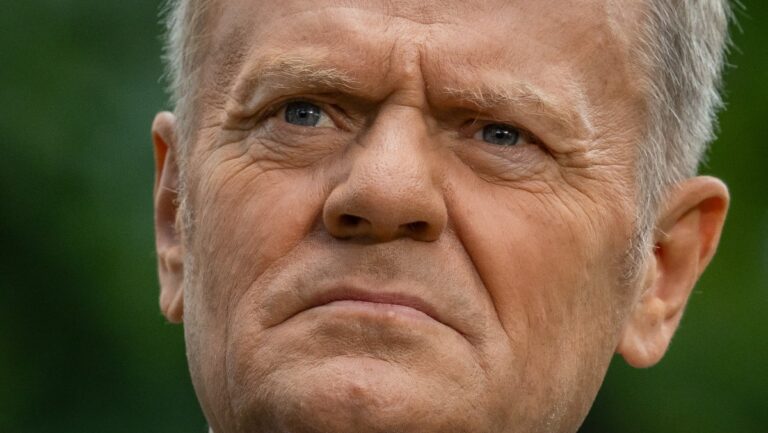
Hungary’s Prime Minister Viktor Orbán reacts during a press conference at the end of the European Council meeting in Brussels, Belgium on December 19, 2025.
Nicolas Tucat / AFP
Following Thursday’s EU Summit, where EU heads of state and government reached an agreement on a 90-billion-euro joint loan to finance Ukraine, criticism came quickly from the European Right. The critics highlighted that the agreement deepens financial risks for Europe while effectively undermining efforts to end the war in Ukraine.
Hungarian Prime Minister Viktor Orbán described the overnight negotiations as an effort to hold back mounting war pressure from Brussels. Orbán said Hungary had “managed to avert the immediate risk of war” by blocking the use of frozen Russian assets, arguing that such a move would have amounted to “a declaration of war on Russia” and impose an enormous financial burden on Hungary.
Orbán did not appreciate either the decision to move forward with a large joint loan for Kyiv. He warned that “24 member states decided to grant a war loan to Ukraine,” stressing that if Ukraine is unable to repay it, “those European countries will have to cover the repayment.”
Slovakia and the Czech Republic worked closely with Hungary, achieving an opt-out from the deal, meaning that the three Visegrád countries will be exempt from the burden of the joint loan.
Milan Uhrík, Slovakian MEP, questioned how the EU could “lend” Ukraine €90 billion “that it doesn’t even have,” arguing that the EU had “clearly decided to go bankrupt because of Kyiv.” He added bluntly: “Not a single cent more to Zelensky from Slovakia!”
Czech Prime Minister Andrej Babiš likewise stressed national safeguards rather than collective enthusiasm. While confirming that EU leaders agreed on “further support for Ukraine “ in the form of a loan, Babiš emphasized that he had “ensured that the Czech Republic will not guarantee the loan,” saying this fulfilled his earlier promises.
Criticism poured in from other parts of Europe as well. In the Netherlands, PVV leader Geert Wilders echoed concerns about joint borrowing, calling the €90 billion package “insane” and describing it as “disguised eurobonds, money we’ll never see back again.” He contrasted the opt-outs secured by Hungary, the Czech Republic, and Slovakia with the Dutch government’s stance, accusing Prime Minister Dick Schoof of trailing behind “those europhiles.”
From Germany, criticism focused on the burden placed on citizens. Alice Weidel, leader of the opposition Alternative for Germany (AfD), stated that with the mega loan, Chancellor Friedrich Merz is exporting “his irresponsible debt policy to the EU.” “In the end,” she said, “the German taxpayer will have to foot the bill again.”
Similar concerns were raised in the European Parliament by Croatian MEP Stephen Nikola Bartulica, who said the agreement “must be openly criticized.” He warned that the money would “very likely never be repaid,” while “the war continues without a clear end.” According to Bartulica, the EU is “taking on even more debt” despite it having “no real impact on ending the war in Ukraine,” arguing that such decisions show how “detached European leaders are from reality and the consequences borne by citizens.”
What is clear is that with the giant loan, the EU is now shifting long-term financial liabilities onto European taxpayers, weakening fiscal responsibility, and remaining entrenched on a course that is prolonging the conflict rather than bringing it closer to an end.