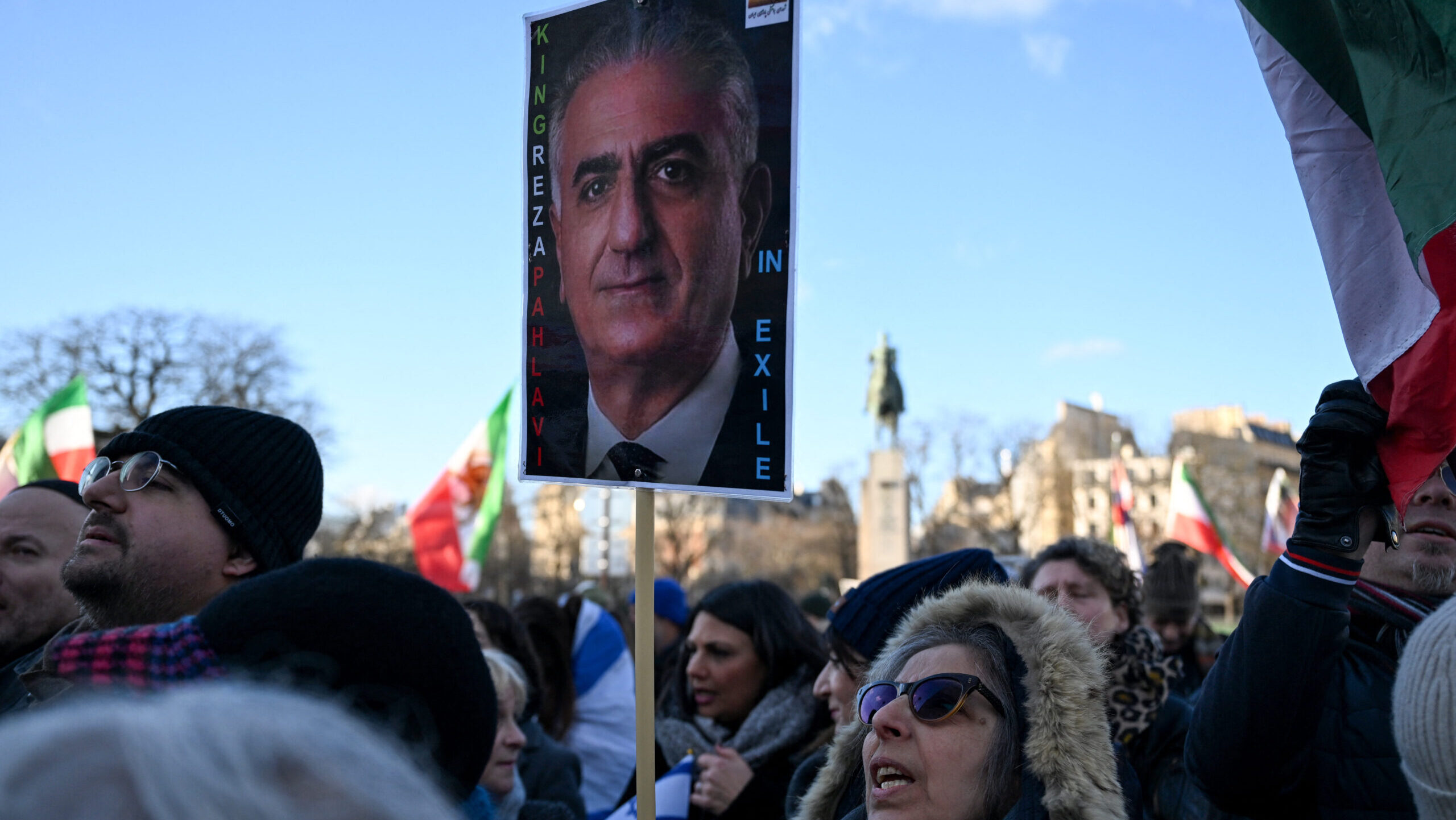
A protester holds a placard of Iranian opposition leader and son of the last Shah of Iran, Reza Pahlavi, during a demonstration in central Paris, on January 4, 2026
Blanca CRUZ / AFP
The Islamic Republic of Iran is facing one of the most serious crises in its history. Protests that have spread since late December across dozens of cities and provinces reflect deep economic and social exhaustion. They have also reopened debate—inside and outside Iran—over whether the regime can survive, and whether it could fall without the country sliding into civil war.
Unlike earlier protest waves, the current unrest brings several pressures together at once: an economy close to collapse, security forces under strain, sustained pressure from abroad, and, for the first time in years, open competition among opposition figures positioning themselves for a possible power vacuum.
Protests have now been confirmed in at least 17 of Iran’s 31 provinces, including areas long considered loyal to the regime, such as Qom and Mashhad. This sets the current unrest apart from the protests of 2009 or those that followed the death of Mahsa Amini in 2022. Discontent is no longer limited to big cities or younger Iranians; it has reached parts of the population that once formed the regime’s core support.
For now, the security forces remain loyal. But harsher repression carries risks for the regime itself. A sustained cycle of violence could trigger defections and weaken discipline within police and paramilitary units already under heavy financial pressure.
At the same time, tensions beyond Iran’s borders are rising. Israel sees the Iranian regime as a direct threat, not only because of its nuclear ambitions but also because of the network of armed groups Tehran supports across the Middle East. The United States has also toughened its stance under the Trump administration, increasingly treating the Iranian system as one that may be nearing its end.
Comments by Senator Lindsey Graham warning that Iran’s leaders would “pay with their lives” if repression continues have been taken seriously in diplomatic and security circles. Intelligence assessments point to a familiar strategy: economic pressure, diplomatic isolation, media backing for opposition figures, and covert efforts to keep unrest alive.
Senator Lindsey Graham:
— Open Source Intel (@Osint613) January 7, 2026
To the Ayatollahs: you need to understand, if you keep killing your people who are demanding a better life, Donald J. Trump is going to kill you.
Change is coming to Iran. It'll be the biggest change in the history of the Mideast to get rid of this Nazi… pic.twitter.com/lKb0Qk7RrS
This pressure is reinforced by increased U.S. military surveillance in the Persian Gulf and the Strait of Hormuz, including advanced reconnaissance aircraft and naval assets. Washington is watching developments closely and preparing for the risk of escalation.
The regime’s weakness has revived an old question: who could lead Iran if the Islamic Republic falls? In recent weeks, U.S. media have given renewed attention to Reza Pahlavi, son of the last shah. He has said he is ready to return to Iran and help guide a transition, presenting himself not as a future ruler but as a temporary figure overseeing a democratic process.
این پیامی مستقیم خطاب به نیروهای مسلح و امنیتی ایران است. pic.twitter.com/ygEabjCFwY
— Reza Pahlavi (@PahlaviReza) January 7, 2026
Pahlavi attracts support from parts of the Western political and business world, as well as from the Iranian diaspora, largely because he is seen as a symbol of stability and economic reopening. His main problem is practical rather than symbolic: he has no strong political organisation inside Iran, and his support on the ground remains unclear.
Facing him is the National Council of Resistance of Iran (NCRI), led by Maryam Rajavi. The group has an organised network, a presence both inside Iran and abroad, and years of experience lobbying Western governments. It has won backing from political figures in Europe and the United States, including former Vice President Mike Pence.
In simple terms, Pahlavi offers name recognition and international goodwill, while Rajavi brings organisation and a committed activist base. Their rivalry suggests that even a regime collapse would not automatically settle who takes power next.
Energy politics add another layer of risk. Washington’s recent move to secure access to Venezuelan oil is widely seen as a precaution, aimed at protecting global supply if conflict with Iran disrupts shipping through the Strait of Hormuz.
Warnings such as the Australian embassy’s call for its citizens to leave Iran reinforce the sense that Western governments are preparing for the possibility of rapid instability.
Iran now stands at a dangerous turning point. The regime is still in control, but its ability to restore order without paying a growing political and human price is shrinking. The key question is no longer whether the system is weakened, but whether it still has enough cohesion—and time—to survive what may be coming.