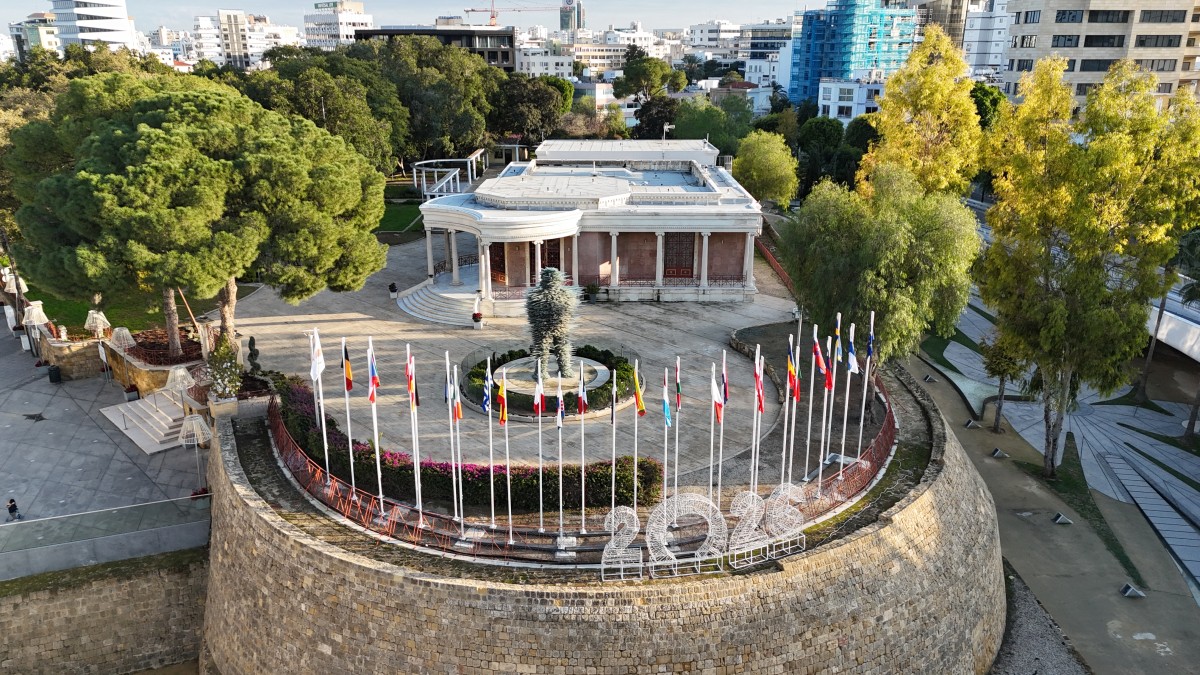
Flags of EU member states adorning a section of the Venetian Walls of the divided capital Nicosia, on the grounds of the old municipal palace at Eleftheria Square on January 2, 2026. The Republic of Cyprus will hold the Presidency of the Council of the European Union for the first half of 2026.
ETIENNE TORBEY / AFP
“There is no genuine desire for public debate. They do not want to persuade society. Instead, they identify ‘change agents’ who carry the ideology directly into institutions—bypassing parents, parliament, and public opinion.”
Starting on January 1, the Republic of Cyprus has begun a six-month presidency term for the Council of the European Union (from January to June 2026). Yet over 36% of the territory of Cyprus has been illegally occupied by Turkey, who is an EU candidate and NATO member nation.
In 1960, Cyprus gained independence from British rule and became an independent republic. 14 years later, in the summer of 1974, the Turkish military invaded Cyprus, violating international law, including the UN Charter of 1945, the Geneva Conventions of 1949, the European Convention on Human Rights of 1950, and other treaties adopted after World War II to prohibit aggression. The illegal Turkish invasion occurred in two phases—on July 20 and on August 14.
This military campaign was characterized by murders and the bombing of civilian targets (including hospitals), as well as the unlawful detention of both soldiers and civilians in what amounted to concentration camps. During the invasion, the systematic, summary execution of civilians, as well as torture and mistreatment, including rapes of Greek Cypriots, was commonplace. The European Commission on Human Rights has widely documented the rape of women and children aged 12 to 71, including those who were pregnant or mentally disabled.
Through these atrocities, the Turkish occupation forces terrorized Greek Cypriots in the north, causing approximately 170,000 to flee to the Cypriot government-controlled areas in the south. Their lands, homes, businesses, and other properties in the north were seized, looted, and distributed to members of the Turkish occupation army and illegal settlers from Turkey. Around 40,000 Turkish troops are still illegally deployed in the northern part of Cyprus.
Like the rest of the island, the northern part of Cyprus’s population was Greek majority until the 1974 invasion, which forcibly changed the demographic character of Cyprus. To this day, the Turkish occupying forces continue to impede Greek Cypriots from returning to their homes and property in the occupied area.
This forced displacement policy pushing indigenous Greek Cypriots out of the occupied north, as well as the destruction of the Greek cultural heritage and the illegal change of geographical place names from Greek to Turkish in the occupied part of Cyprus, all aim to eliminate the millennia-old Greek and Christian civilizations of Cyprus.
One of the most tragic consequences of the Turkish invasion of Cyprus in 1974 is the missing persons cases that remain open.
A new documentary, Where are they? (Που είναι?), directed and produced by Nikos Aslanidis, a prominent journalist, documentary filmmaker, and president of the Council of Honor and Ethics of the Editors’ Union of Macedonia-Thrace, sheds light on those that were forcibly disappeared during the Turkish military invasion of Cyprus in 1974.
According to the documentary’s synopsis,
Fifty years ago, Vassos lost his mother, his four sisters, and his nephew, who was only six months old… They were found dead in a mass grave. Next to the infant was his pacifier. Panagiotis lost his parents and his 8-year-old brother. He has been looking for them for 50 years, without any results.
In an interview with europeanconservative.com, Aslanidis said:
The total number of missing persons during the 1974 Turkish invasion of Cyprus was 1,619 individuals. Most of the missing were civilians, women, children, and elderly people.
I became involved with this issue from a young age, when I saw an elderly woman in the neighboring village where I lived searching for her son, who at that time was serving as a soldier in Cyprus. She would sit outside her house and ask anyone who passed by whether they had seen her son. This woman, whose name was Evangelia, was someone I later interviewed when I became a journalist. She showed me the suit she had prepared for her son’s wedding. She was certain that one day her son would return, but in the end, Mrs. Evangelia passed away. She was buried alongside her son’s suit.
Constantinos’s remains were found last year, 50 years after the invasion, and were buried in the same grave as his mother. This is the first story of my documentary, entitled ‘Where are they?’
Among the missing were also 36 children, aged from six months to 16 years old.
Today, 754 people remain missing, among them are 16 children. The parents have information suggesting that their children were adopted by childless Turkish families. In one case presented in the documentary, the child’s mother, Mrs. Myrofora, located her son in Ankara, but the Turkish authorities are not allowing her to undergo a DNA test to confirm his identity.
All these missing persons were arrested by Turkish soldiers and paramilitaries, Aslanidis said.
During that period, horrific crimes were committed in cold blood, murders, rapes, and torture. All of this is described in the documentary by eyewitnesses whom I interviewed in Cyprus and Greece. Only a very small number of those who were executed in occupied areas have been found, and their remains have been returned to their families. Most of them are buried in the occupied territories of Cyprus. The Turkish authorities refuse to conduct investigations, claiming that these are military zones.
The most tragic cases are those of the missing persons who were transferred from Cyprus to the interior of Turkey. After many years, 13 Greek and Greek Cypriot missing persons were located in the prisons of Bolu and Denizli. Eleven of them were in a comatose state, as they had been used by Turkey’s secret services in biochemical experiments.
Greek authorities were informed of this fact, but no official complaint was made in the name of the ‘Greek–Turkish friendship.
Turkey, however, has not cooperated with Cyprus to help locate Cypriot missing persons. The Republic of Cyprus and international bodies consistently state that Turkey’s lack of cooperation, particularly regarding access to military archives and occupied areas, hinders efforts by the Committee on Missing Persons (CMP). It is worth noting that the European Court of Human Rights has ruled and made ongoing appeals for full transparency on the missing persons.
Aslanidis said:
Turkey prohibits investigations in the largest part (over 70%) of the occupied areas, claiming that these are military zones. However, as the relatives of the missing denounce, in most cases these are not military areas at all, but rather parks, fields, and roads. Turkey persistently refuses to allow investigations because, if the remains of civilians are found, the crimes that were committed would also be revealed.
As shown in the documentary, in one case where investigations were carried out, the remains of a six-month-old infant were found with a bullet in its head. Next to the skeleton was the baby’s pacifier. You can understand the real reason why the Turkish authorities refuse to allow investigations to continue. These investigations reveal that the Turkish invaders committed brutal war crimes against civilians, small children, women, and the elderly. This is something the Turkish deep state does not want to be made public.
Meanwhile, Aslanidis was refused entry to Turkey on October 21 on the grounds that he is a “national threat” due to his documentaries about Cyprus and Turkey’s 1913-23 Pontic Greek Genocide. The Turkish authorities initially detained the journalist at a police station. He was eventually released with orders to return to Greece. Aslanidis said:
I was traveling together with 110 other journalists who were members of the Journalists’ Union of Macedonia and Thrace. We intended to go to Istanbul to meet with the Ecumenical Patriarch Bartholomew. However, when we arrived at the Turkish border post at Ipsala and I presented my identity card, the Turkish police denied me entry.
As I was told, I had been labeled ‘a threat to Turkey’s national security,’ and I was forced by a police patrol vehicle to return to Greece.
Turkish newspapers reported that I was characterized as ‘dangerous’ because I had produced documentaries about the genocide of the Greeks of Pontus and the missing persons of Cyprus. Greek members of the European Parliament raised the issue of my deportation.
Unfortunately, despite recommendations from the European Commission, the suspension of radio and television stations and newspapers, as well as the arrest of dozens of journalists in Turkey, continues, as they are considered ‘enemies of the regime.’
The World Press Freedom Index by Reporters Without Borders ranks Turkey as among the lowest positions worldwide. I do not know how long the ban on my entry into Turkey will remain in force.
For over 51 years now, the West has turned a blind eye to the fact that the northern part of the Republic of Cyprus has been under an illegal military occupation by Turkey, a candidate country for EU membership. Aslanidis noted:
Dozens of UN resolutions have been issued condemning the Turkish invasion and calling for the withdrawal of Turkish troops from Cyprus. Sadly, however, Turkish troops remain. They continue to bring settlers to Cyprus, who illegally settle in the homes of Greek Cypriots in the occupied areas.At the same time, information about the fate of the missing persons is concealed, and investigations in the occupied territories are not allowed, even when relatives obtain information about missing persons who were murdered there.
I believe that the EU, the United States, and the entire international community must realize as soon as possible the dangerous policy that Turkey is currently pursuing against all its neighboring peoples.
I hope that at some point they will put pressure on Turkey, and that eventually a regime will emerge in Turkey that will accept and reconcile with historical truths and develop genuinely friendly relations with its neighbors. Only then can a solution be found to the humanitarian issue of the missing persons, which remains an open wound 51 years later.