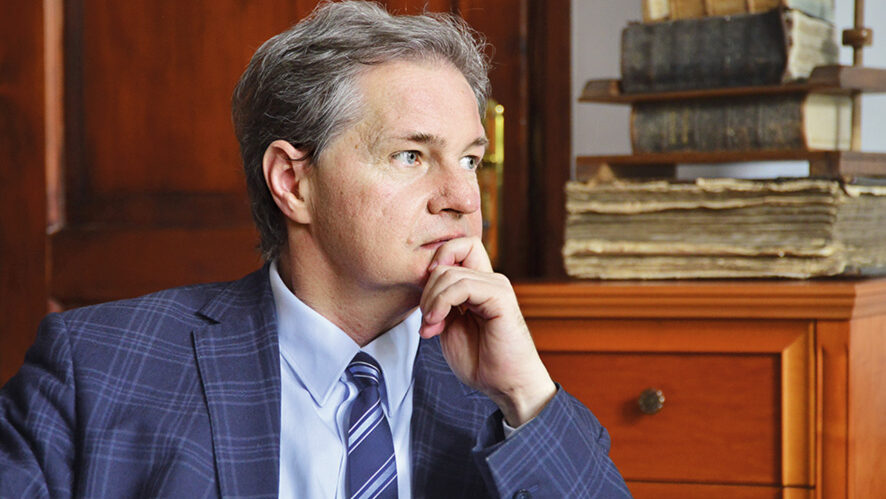
Professor Grzegorz Piotr Kucharczyk
Leszek Sosnowski, Public domain, via Wikimedia Commons
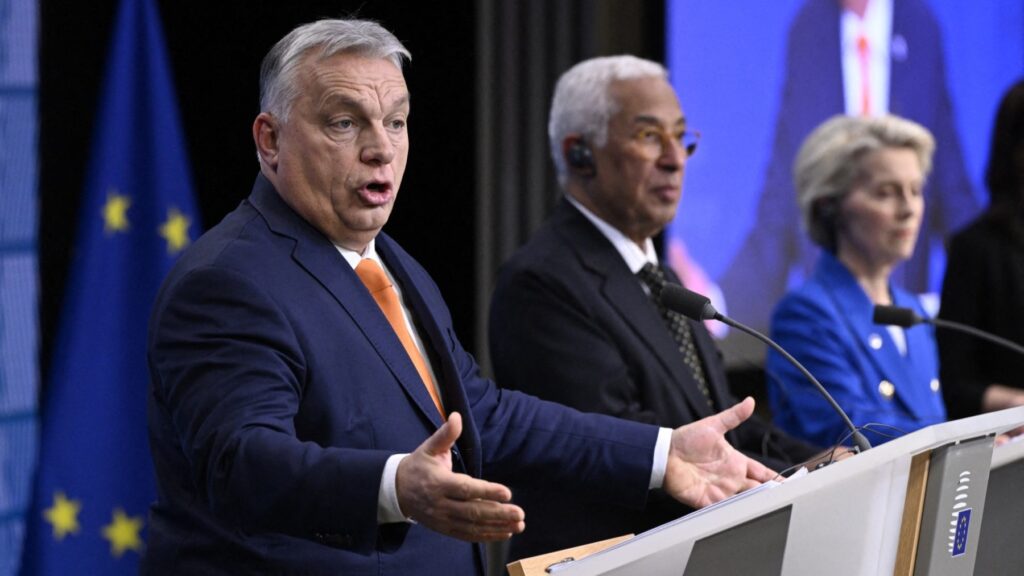
“If the European Union starts to consider democratically elected governments illegitimate simply because they do not share the dominant political line in Brussels, then the problem is no longer Viktor Orbán.”
Professor Grzegorz Piotr Kucharczyk is a distinguished Polish historian specialising in the history of Germany and Prussia, as well as Polish–German relations in the 19th and 20th centuries. He is also a prolific public intellectual, commentator, and populariser of history.
Put simply, civil society is a form of social organisation that fosters initiatives and movements independent of the state. It is a positive phenomenon—an expression of tangible, socially rooted liberty. A liberty that is both individual and collective and which manifests across many domains: in associations, cultural bodies, professional and religious organisations. The more vibrant and authentic this type of civil society is, the more one can speak of actual freedom.
Civil society, in the sense I describe, teaches a form of liberty bound to responsibility. It is a concrete liberty—referring to the ability of real communities, whether families or associations, to pursue their aims and address their needs. It is not an ideologised liberty, because it is inseparable from accountability. True civil society is free, but it also bears the burden of its deeds. It is therefore morally sound, just, and worthy of support. I must stress, we are speaking of an ideal model. Frequently, what is presented as civil society is but a façade—or, at best, a state-sanctioned approximation of genuine social reality.
That depends on the cultural context. In Poland, we trace a long tradition back to the republicanism of the First Polish Republic. In Russia or China, by contrast, this tradition is hardly embedded at all.
The concept of civil society has taken on different forms throughout history. For instance, Catholic social teaching promotes the principle of subsidiarity—that which can be done at a lower level of social organisation should not be commandeered by the state. Since 1989, we have witnessed a certain inflation in the use of the term ‘civil society.’ Typically, it is invoked by those who regard actual manifestations of it as dangerous.
The opposite is a directed society—one managed from above.
Undoubtedly. The drivers of such direction—whether national governments or international organisations, formal or informal—invoke ideology to justify their control. These are the propagators of new and not-so-new resets. We see such ambitions not only in Poland but across the globe.
Directed societies have their origin, in the European tradition, in the French Revolution. In France, the distinction is most clearly seen. A directed society is typically one constructed according to a predetermined blueprint. After 1789, the revolutionaries aimed to build a ‘new France’ and ‘new Frenchmen’ and would tolerate no rival initiatives. The War in the Vendée is a case in point: a rural uprising in 1793 brutally crushed by the centralised republican power in what was, in fact, an act of genocide.
Later, in Prussia, and then the German Empire after 1871, we see the same pattern. German liberals, supporting Bismarck, helped impose a top-down ‘modern’ society—through Kulturkampf and the harsh Germanisation of the Polish territories. But on the other side, there persisted a genuine civil society—through the Polish organic work movement and the resistance of Catholic communities in Bavaria and the Rhineland. These societies built networks of associations independent of the state and offered a real alternative to the centralising vision from Berlin.
Yes. A few years ago, in France, we witnessed this in the form of massive demonstrations defending the family—La Manif pour tous—an expression of civil society. Meanwhile, the central power pursued a top-down social engineering project culminating in the constitutional enshrinement of abortion—the legalisation of infanticide, in essence. Similar tensions have existed in Poland since 1989.
Indeed it is—and it is thoroughly disliked by the elites. This is typical of our time: the real and vibrant examples of civil society are despised by the political and media establishments, while the counterfeits are lavishly supported. I am referring here to so-called NGOs, many of which are in fact government-funded and serve not civil society but the interests of their patrons. In name, they are ‘non-governmental organisations’; in substance, they are little more than contractual extensions of state or supranational power. As the old saying goes, he who pays the piper calls the tune.
Recall what emerged when Donald Trump’s administration cut off funding to various leftist groups abroad: the sheer volume of money that had been flowing into NGOs in Poland was staggering.
They do operate either way. One cannot claim that they rely exclusively on NGOs. On the one hand, we have official policy executed through legal acts—wrapped, of course, in the garb of ‘freedom,’ meant to evoke all manner of positive associations. Take, for example, so-called equality legislation or the campaign against so-called hate speech. After all, who would openly defend hatred in public life? Better to fight it. In practice, however, it’s about introducing preemptive censorship.
Simultaneously, there is action through other channels—namely, the pseudo-NGOs, the imitations of civil society institutions—which create the illusion that political initiatives are responding to genuine grassroots demand. NGOs enjoy good PR; people associate them with humanitarian aid in Africa or with helping the victims of earthquakes. And yet, in the run-up to Poland’s presidential elections, it became evident that a number of such organisations—with pleasant-sounding names and vocabulary like ‘democracy’—had nothing to do with democracy and even less with civil society. They served as conduits for financial flows from foreign sources, funds that were meant to influence—and did influence—the electoral campaign in blatant violation of the law.
That influence is considerable. We are only seeing the tip of the iceberg. The web of links between Polish NGOs and foreign actors is vast. And let us not be naïve—Belarus, Russia, and China are no doubt also financing these so-called independent organisations. I do not pretend to know the full scale of it, but I believe what reaches public awareness is a mere fraction. Of course, not all NGOs are fake. But here is the test: does the initiative fund itself, or does it live on grants and external subsidies—even when openly declared? If the latter, then it cannot be said to be independent.