Marzieh Hamidi
Oliver O’Hanlon
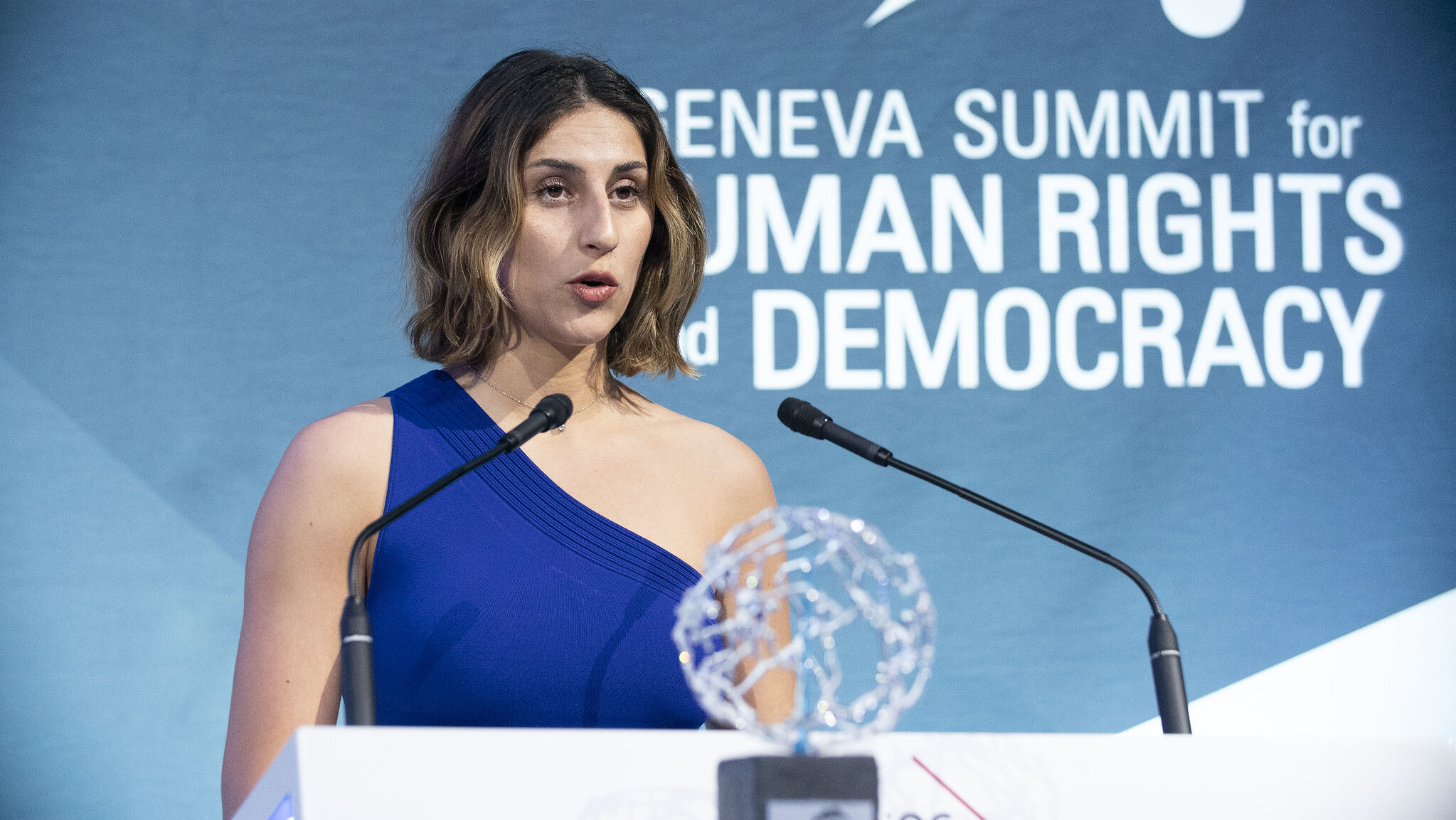
Marzieh Hamidi is an Afghan taekwondo athlete who left her country and sought refuge in France after the Taliban returned to power in 202. Committed to defending the rights of Afghan women, in October 2023 she received the National Assembly’s Medal of Honor. Barely a year later, she received thousands of death threats for posting a video on social media denouncing the Taliban regime’s violence against women and has been living under police protection ever since. In 2025, she published a book, Ils n’auront pas mon silence (They Will Not Have My Silence). At the Geneva Summit for Human Rights and Democracy, held on February 18, Hamidi was awarded the 2026 International Women’s Rights Award.
Yes, my father was in the military and had fought against the Soviets and the Taliban, so when the Taliban first took power and my family saw what was happening, they fled to Iran, mainly because of the language barrier. I was born in 2002, and my family eventually returned to Afghanistan, where I became an athlete and joined the national taekwondo team.
For people it was shocking because we couldn’t accept that such a rapid regime change could happen. We already knew that they were coming and that they controlled cities in the north of the country, but we couldn’t believe they could enter Kabul because it’s the capital, and we had everything we needed to fight them. So it was a big shock; it was surprising to wake up in the morning and see that the Taliban were in the city. I was standing by the window when people started running home, and suddenly, women disappeared. I remember going out into the street completely covered up and feeling like people were looking at me as if my presence was a mistake. It was then when I understood that we were not only oppressed, but that they were erasing us.
At that time, there was much talk of peace, of the Doha Agreements, and it was said that the Taliban had changed, but that was not true; the Taliban had not changed. They were terrorists yesterday, they are terrorists today, and they will be terrorists tomorrow. What peace can a terrorist offer? There is no peace with terrorists.
It is worse because it has declared war on women, which I call gender apartheid; it has declared war on young people because it forcibly takes children and adolescents from their families to indoctrinate them in madrasas in Kabul and turn them into terrorists; and it has declared war on ethnic minorities, such as the Hazaras, or religious minorities, such as the Ismaili minority. It is not a single problem; there are many. The Taliban do what they want and face no consequences for it.
Yes, but they are not an emirate; they are not even a government: they are terrorists. No one is telling them to stop, and several governments have even normalized relations with the Taliban, justifying this with the excuse that they have changed or that they are in power and there is no other option. Normalization is easier than accountability, but this has to change.
Yes, I received thousands of calls from people who wanted to kill or rape me—three thousand calls in the first 48 hours—and then I stopped counting. At first, it was very difficult for me. I was in Paris and felt safe and free, but honestly, I am no longer free. I am under constant protection and cannot live my life the way I want to. I have to be careful, and I live in danger, but I don’t regret my fight because it’s hurting them.
I think it’s because I don’t feel comfortable when I see injustice around me. I no longer live in my country because of a political issue, and I’d rather speak out than stay silent and do nothing. I wanted to raise my voice and fight because I didn’t feel right about everything that was happening. It’s injustice and a crime, and as an activist, I can stand up to that and be the voice of my people.
I feel that right now, the best way to help Afghanistan and Afghan women is to recognize the gender apartheid practiced by the Taliban as a crime, because what is happening in Afghanistan is gender apartheid. And we must recognize that this is a crime against humanity under international law. Doing so will not only bring justice to Afghan women, but it will also challenge the Taliban because it will prevent their regime from continuing to be normalized and recognized. We must stop giving the Taliban diplomatic platforms from which they are allowed to represent the Afghan people because they do not represent them. To be honest, we must cut all ties with the Taliban.
Yes, of course. Iran is our neighbor, and its regime is a major supporter of the Taliban, who, at the same time, take many of the Islamic Republic’s measures as a model. They are different regimes but share the same ideology. The fall of the mullahs would greatly affect the Taliban because a new regime in Iran would never stand with terrorists. Iran must be free, and the regime must change, and as someone born in Iran, I believe they must be free from the ayatollahs and their ideology, and then I hope it will be Afghanistan’s turn.