In recent years, there has been a growing public interest in Roman identity and history. However, many people consider only Rome when the subject of the Roman Empire is discussed. A publishing house in Greece, the Byzantine Tales, is seeking to remind the world that the Greek-speaking Byzantine Empire, the eastern half of the Roman Empire, survived for over a thousand years after the western half had crumbled into various feudal kingdoms.
The Byzantine Empire was a vast and powerful civilization with origins traced to 330 A.D., when the Roman emperor Constantine I dedicated a ‘New Rome’ on the site of the ancient Greek city of Byzantium (Istanbul). The city was endowed by him with the name “Constantinople”—the city of Constantine.
The Byzantine Empire developed a unique culture that blended Roman, Greek, and Christian influences. It further served as a military buffer between Europe and Islamic invaders.
In 1453, Constantinople fell to Central Asian invaders, the Ottoman Muslim Turks, an event that brought an end to the Byzantine Empire. The last Constantine (Constantine XI Palaiologos) fell while defending Constantinople, which was built by the first Constantine.
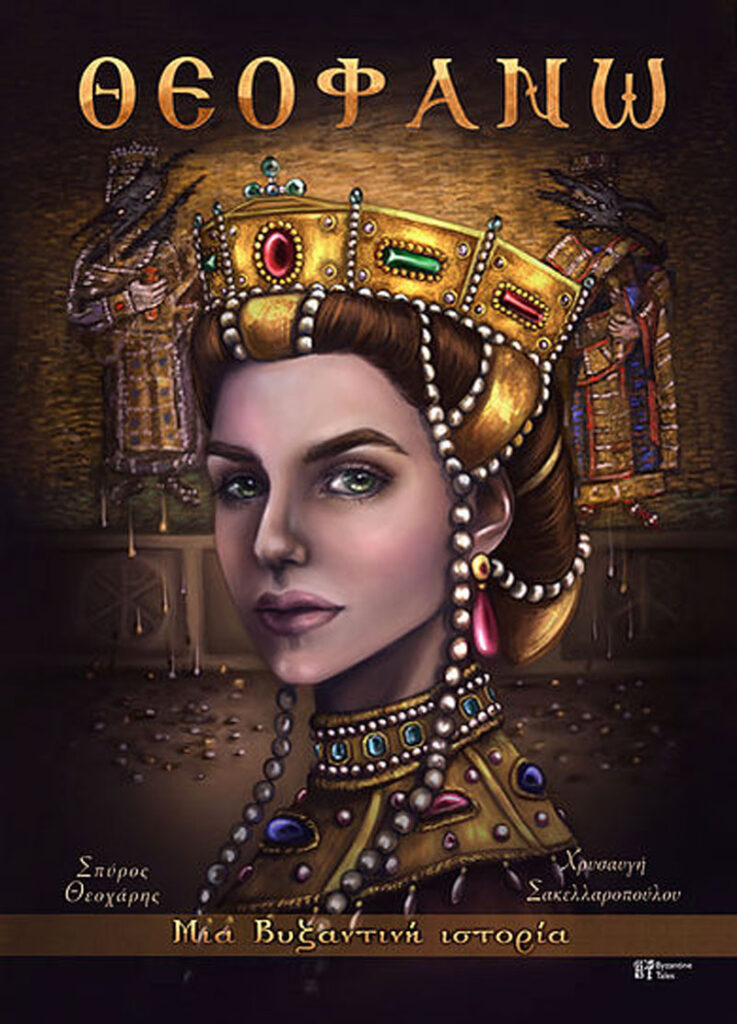
Cover of Theophano, Byzantine Tales.
The remaining Byzantine lands were conquered by the Ottoman Turks in the mid-fifteenth century when Mistra and Trebizond fell in 1460. These Islamic conquests finished an empire that had set a standard for culture, beauty, art, architecture, and education that had inspired both the West and the East.
The term ‘Byzantine,’ which many modern historians use instead of ‘Roman,’ was coined after the empire’s fall in 1453 in order to distinguish the classical Roman Empire from its medieval Greek-speaking continuation.
Among the Byzantine Empire’s paramount contributions to civilization were the preservation and transmission of classical Greek and Roman knowledge, as well as the codification of Roman law.
The Byzantines preserved and copied classical manuscripts. They are thus regarded as transmitters of classical knowledge, contributors to modern European civilization, and precursors of both Renaissance and Orthodox Christian culture.
Their compilation of laws, jurisprudence, and legal commentary served not only as the basis of Byzantine law but also had a profound influence on Europe’s legal development. It is considered the foundation of modern civil law systems and has impacted legal thought worldwide.
Yet, this glorious empire is largely forgotten or neglected by many Europeans.
This is why a publishing house in Greece, the Byzantine Tales, was created in 2009 with the mission of reminding the West about its Greek Byzantine roots. They regularly publish illustrated books and graphic novels that focus on stories from Greek and Roman history. “Our vision is to bring to life the history of the quite unknown medieval Roman East,” their website states.
The publishers are a couple who work as a team. Spyros Theocharis conducts research by looking into academic bibliography and primary sources regarding each historical era. Chrysa Sakel creates the drawings and designs the layout of each page. In some of their publications, they also have other contributors.
The books of Byzantine Tales are published in both paperback and e-book format. They have graphic novels and comic book series, some of which are also translated into English. Interested historical enthusiasts can purchase them at almost any bookstore in Greece or order them online through the publishers’ website. The English versions of the books are also available on Amazon in both paperback and Kindle formats.
The Byzantine Tales publishers have attended many book exhibitions and comic cons in Greece. “Being a small publishing house, that’s the only way to get some people to see what we do. In future, when our portfolio grows, we hope to attend some international exhibitions abroad as well,” Sakel and Theocharis said in an interview with europeanconservative.com:
Byzantine history is taught throughout the Greek educational system. When you learn about Byzantium, it’s hard not to be interested in it because it’s essentially the continuation of the ancient world into the Middle Ages. However, the way it is taught for some kind of reason makes a lot of people find it boring..
Yet, the publications of Byzantine Tales are not boring at all. They are fascinating, thoroughly researched, and based on real-life events. Sakel explained how they conduct research. Inevitably, their research leads to difficult decisions about what events and characters they want to share with their readers:
First, we pick a historical era or an important historical person that would provide an interesting scenario for a graphic novel. Then we conduct research on primary sources and contemporary academic publications to find out what is historically accurate and also to delve into some more specific parts. For instance, what people wore during this time, what the personality of some protagonist would be, or whether there is something truly unique that should be visualized. Apart from that, sometimes we also consult academics who specialize in history or a particular aspect of it (such as architecture, ceremony, or warfare). Of course, since we don’t have definite proof about some aspects of that era, we also use some fictional elements.
The publishing house has released five issues in the series of Emperor Basil Basileus. They noted that,
Basil Basileus focuses mainly on the earlier years of Emperor Basil the Second. There are two reasons behind this. First, most people actually know only about his exploits later in his life. However, his first years on the throne of Rhômania could easily be compared to a real Game of Thrones. Second, Basil was the son of Theophano, the protagonist of our first-ever graphic novel. If someone compares the art from Ono and Basil Bale, they can understand why it takes us longer to create the latter and also why we actually publish it in issues.
The second book in the Basil Basileus series from Byzantine Tales.
In addition, in the graphic novel Theophano, there are many prominent personalities from Byzantine history: the emperor (and prolific author) Constantine Porphyrogenitus, as well as later emperors such as Nikephoros Phokas and Ioannes Tzimiskes. In the future, the couple plans to tell more stories.
They told europeanconservative.com that the international community should learn about the Byzantine Empire because,
The Byzantine Empire is one of history’s greatest missing chapters for many readers. For over a thousand years, Byzantium stood as the bridge between the ancient and the modern world. Yet in schoolbooks it often gets overshadowed by ancient ‘Rome’ and the ‘Renaissance.’ By reading our books, people can rediscover this forgotten world through stories, art, and characters that bring it vividly to life.
Byzantium lived through crises that feel quite modern. Pandemics, climate shifts, migration, religious tensions, political conflicts, economic collapse, and external threats from superpowers. Yet the empire adapted and endured. Modern readers can see in Byzantium a mirror of our own resilience, diplomacy, and cultural synthesis.
Without Byzantium, the heritage of Greece and Rome would likely not have reached us in the form we know today. Byzantine monks preserved ancient manuscripts, its thinkers influenced the Renaissance, its art, and its and law. Their theology shaped both the Orthodox East and the Latin West. The empire was also Europe’s shield, holding back waves of invasions for centuries, allowing Western Europe to develop.
We believe comics are a unique medium to tell these stories. They let readers see Constantinople, hear the Varangians’ battle cries, and feel the complex dilemmas of emperors and empresses. Through our books, Byzantium becomes a living, breathing world full of drama, tragedy, and triumph.
Uzay Bulut is a Turkey-born journalist formerly based in Ankara. She focuses on Turkey, political Islam, and the history of the Middle East, Europe, and Asia.