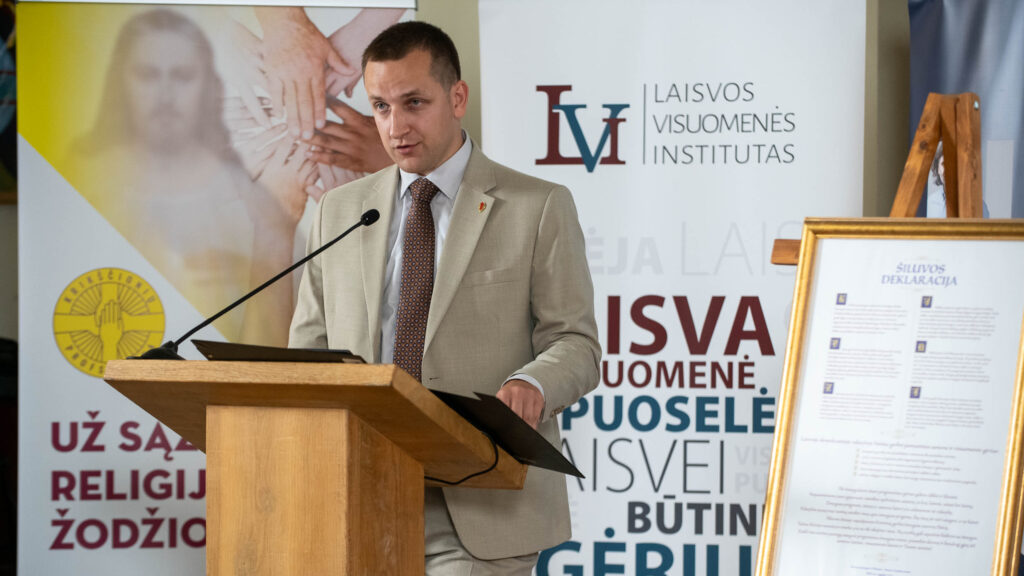
MEP Christine Anderson (AfD/ESN)
Photo: Christian Creutz / European Union 2023 – Source: EP
On May 20th, the World Health Organization’s worldwide assembly of member states finally adopted the so-called “Pandemic Agreement” —or the ‘Pandemic Treaty,’ as it’s more widely known—, the world’s first comprehensive international treaty to harmonize global pandemic response under the central guidance of the WHO. There seems to be a lot of confusion as to what extent member states have surrendered their sovereignty, and what the real purpose is behind the Treaty. Alternative for Germany (AfD) MEP Christine Anderson spoke with europeanconservative.com to shine light on the real nature of the agreement..
Christine Anderson has represented the AfD in the European Parliament since 2019. She rose to international fame during the COVID-19 pandemic for tirelessly advocating against the restrictions on fundamental freedoms globally. The walls of her tiny office in the Parliament are covered with letters and children’s drawings—messages of gratitude from as far as Japan—as well as a giant Canadian flag that was flown in Ottawa during the 2022 truckers’ blockade.
Indeed, the whole text is ambiguous on purpose, but it’s all about power and control at its core. And it’s surprising to see all these supposed democracies in the West approve being stripped of their power. Elected governments, which are the sole executive representatives of the people, voluntarily give up their governing powers and invest them in an unelected and unaccountable body. When you really think about it, why would they do that?
Well, I think the answer is very simple, and they found that out during the Covid pandemic. The EU Parliament’s COVID-19 special committee was named ‘Lessons Learned,’ but they were not trying to figure out where we went wrong, what restrictions we imposed that were not right, etc. No, what they were trying to figure out was “Where did we fail to get the people to just do what they were told?”
They were stunned that there was so much opposition, so the objective was to fix that. Because our governments would have loved to impose a lot more severe restrictions on us, but they couldn’t due to the public backlash. As elected officials, they would have been up for re-election at some point, so they simply had to refrain from imposing stricter measures or risk being replaced. So what they figured out is that if they give these powers to the WHO, then elected representatives can wash their hands and say “We would not have done that to you, it’s the WHO!” So, in essence, the Pandemic Treaty is all about providing governments with plausible deniability.
Yes, it will transfer certain powers in case there is a pandemic. Which is convenient, because the WHO is the one body that has the competence to declare a pandemic, and they even changed the criteria during COVID-19, so now they can declare it whenever they want. As soon as they do, the International Health Regulations and now this Treaty will take effect, meaning that the WHO now sets out what restrictions are going to be imposed and the ratifying governments are bound by that. They can impose curfews, lockdowns, mask mandates, or vaccine mandates. They can also censor social media, deciding what is ‘fake news’ or ‘disinformation,’ and have it banned. And the governments, I must stress, have voluntarily empowered the WHO to do so by approving these agreements.
Well, it’s a very small step from encouraging something to mandating it; the text is intentionally designed to be a stepping stone. They have figured that if they say right away that they want to mandate things, it might not get approved, but if they only “suggest” or “encourage” something, then they can open the door for eventual mandates. They just need to declare an “exceptionally” severe crisis, and suggestions become the norm overnight.
And this is the strategy for many other aspects of this agreement, and even beyond. Look at the ‘digital euro,’ the EU’s digital currency project, that’s coming in October. They say it’s “voluntary,” as you can choose between cash and digital money. But how long do you think that’s going to last? How long until they start banning cash? How long until they start tying all social benefits or government subsidies to the digital euro only? They’ve already started to ban cash by lowering the payment ceilings year by year. The next step is to roll out the digital currency, and then give it two or three years, and they will find reasons to take away cash altogether. It’s the same story with the Pandemic Treaty.
Don’t forget that it’s much easier to change or amend treaties than to get them approved in the first place. That article will likely be gone in a few years, or as soon as the next ‘pandemic’ is declared. All member states will have ratified it by then, and they will hardly go against the mainstream majority and make a fuss about changing ‘technical details’ for the ‘common good.’ It’s a slippery slope; it always starts with a tiny step that seems inconsequential at the time, but adds up over time. If it was inconsequential, as they want us to believe, the WHO would not have pushed so hard for all countries to accept it.
I told you they would not back down. That was their plan all along, to grant governing powers to the WHO, a body that is not elected by, and therefore not accountable to, anyone. There is no democratic process there, the point is to exclude the people from the decisions. Of course, the super-rich of the world, like Bill Gates, can buy their way into the WHO, and then they can determine whether you’d have to take an mRNA shot, put on a mask, stay at home, lose your job, and so on. Like I said, they will not back down. So if they have to go one step back, even, they will do that, but they will not stop until they succeed in their ‘mission.’
Absolutely. At the very least, the WHO is not interested in public health. It’s just a lobby organization for Big Pharma. The WHO is about as interested in public health as the arms industry is in world peace; so not at all. In principle, there is nothing wrong with having an institution for gathering information and maybe advising governments worldwide, but the way they are going about doing it now is to exert power over the member states. And they have to do that because that’s the only way of ensuring that Big Pharma will continue to make billions and billions in profit.
Power. They are really scared at this point, because they see their power slipping away from them. If you look at the election results in the various countries, right-wing parties are on the rise. They are losing control over the narrative, they’re losing control over the elections. They’re losing control, simple as that. So they will do whatever it takes to protect and preserve whatever they have left. That’s also why they are pushing all these new mechanisms to censor “hate speech” and “disinformation” on social media, because cracking down on dissenting voices is crucial to them.
If you want to implant a narrative, you need to make sure that there is no one to call that out. Every dissenting voice has the power to be the one that breaks their cycle of lies and exposes reality to the public, kind of like the little boy who shouted “The emperor is naked!” That’s why they need censorship, because every dissenting voice contributes to more people seeing the actual truth. And that is the hallmark of totalitarianism, by the way, which we slip more into every day.