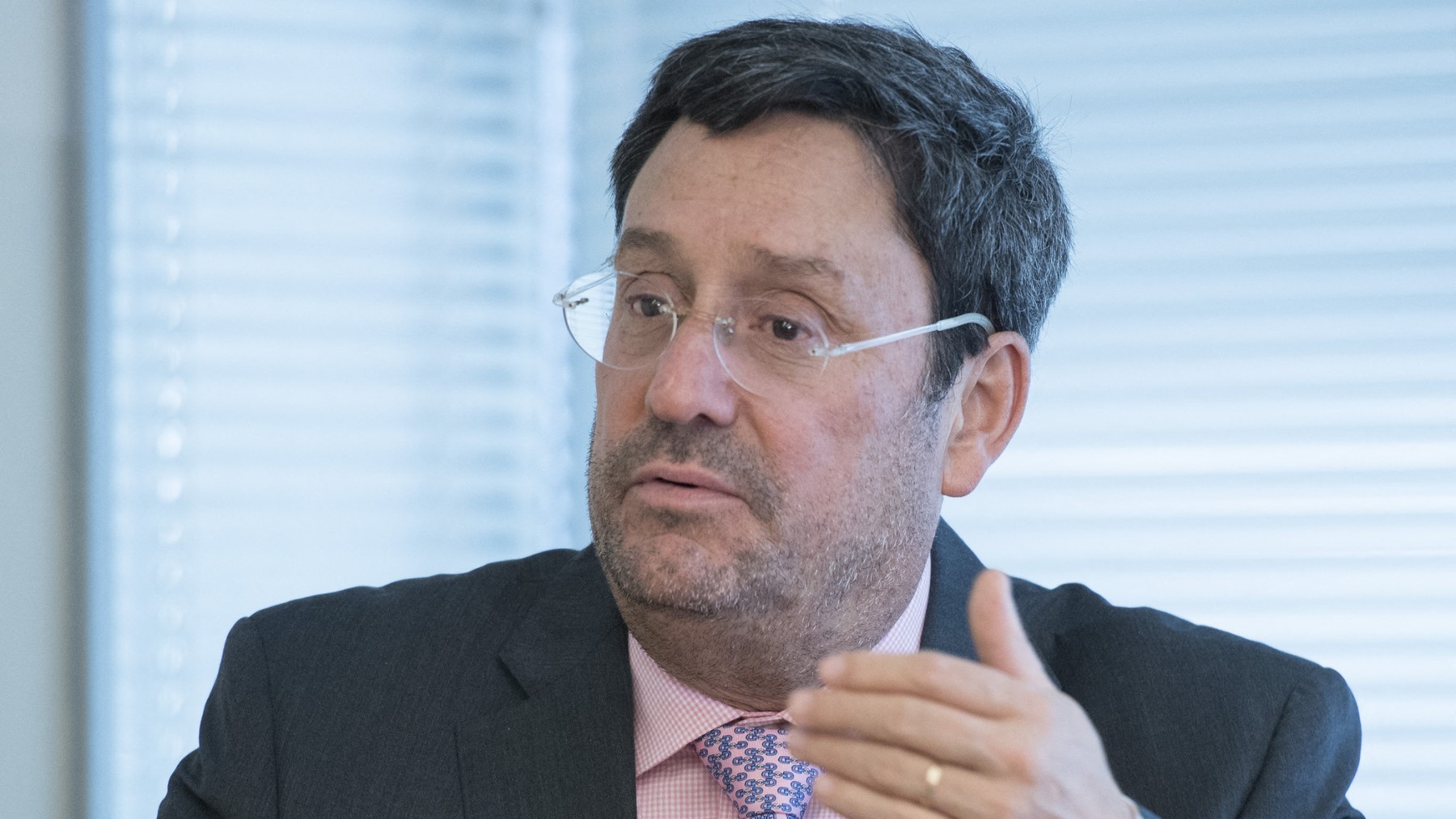
Colombian Ambassador to the U.S. Francisco Santos Calderón at a handover ceremony at the Colombian Embassy in Washington, D.C., on October 10, 2018.
Jim Watson / AFP
Francisco Santos Calderón was vice president of Colombia between 2002 and 2010, and served as Colombia’s ambassador to the United States from 2018 to 2020. As a journalist and activist fighting against organized crime, he stood out for his commitment to the defense of human rights, as well as for fighting against kidnappings and corruption. He himself was a victim of kidnapping by both the Medellín cartel and the FARC (Revolutionary Armed Forces of Colombia) guerrillas. He directed the non-governmental organization Fundación País Libre and led national marches against kidnappings and for peace.
Undoubtedly, one person bears political responsibility for the murder of Miguel Uribe: President Gustavo Petro. Petro constantly singled him out on social networks, stigmatized him and incited against those who followed his line. The absolute responsibility falls on him. And I believe that Miguel’s death is only the first; I fear that more will come. Today we are reliving the past, the nineties. When I was working at the newspaper El Tiempo, there was the assassination attempt against Luis Carlos Galán. Afterwards, two other presidential candidates were assassinated. At that time I was kidnapped together with Miguel’s mother … and they killed her. Those were elections marked by violence and the influence of the mafia. Now we are seeing a similar scenario. We know who s the perpetrators of Miguel’s murder were, but we still don’t know who gave the order. One of those involved was killed in Venezuela, and I believe that those who were behind the assassination are there, including the Venezuelan dictatorship of Nicolás Maduro, as well as drug trafficking networks. I hope that someday justice will be able to connect all these threads and condemn all those responsible.
There is a very important underlying issue: drug trafficking is going to play a much bigger role in these elections than at any other time in history. We don’t know which side the current president is on. And I fear that more deaths will come. In addition, the narcos and the current government are going to invest huge sums of money to buy millions of votes. We will have elections where the government acts as a mafia entity, willing to use all the power of the State to win and prevent transparent elections. The competition is no longer with arguments or debate, but with money.
Yes. Benedetti said it unabashedly: “What are they going to say when we get seven million votes in the consultation?” That is not popularity, it is state money, vote buying and mobilized mafias. The mafia will play a central role in this consultation: drug traffickers, FARC and ELN dissidents. They did it in 2022 and will repeat it in 2026.
Many of them should put aside their ego. We need a patriotic front to save Colombia with only one candidate. That is what we all hope for. The electoral panorama after Uribe’s death is very difficult: there is a lot of concern and a general feeling of insecurity. The new candidate will be Miguel Uribe Senior, who now has to live with the tragedy of having lost his son and, too, after his wife, Diana Turbay, murdered in 1991. What worries me most is that we may not even make it to the elections. I see it very likely that Petro wants to stay in power, and that in the end there will be no elections.
The case of former President Álvaro Uribe is evidence of how justice can operate disguised as legality, but with a clear political function. What we have experienced has not been a judicial process, but a political persecution. This case highlights the urgent need for a profound reform of the Colombian judicial system. It is clear that President Petro has allies in the judicial apparatus, such as Judge Heredia and former prosecutor Montealegre, who have had a direct influence in the case against Uribe. In any other place in the world, Uribe would have been acquitted from the beginning, but in Colombia he has been subjected to a systematic smear campaign. The truth is that we are facing a deeply corrupt network, a real mafia, entrenched in power, with such figures as Armando Benedetti. These people, who clearly should be facing justice, are still at large. On the other hand, those who did not commit any crime were convicted. Therefore, I am pleased that the High Court, despite the avalanche of arbitrary and prevaricating decisions, has acted in accordance with the law.
Drug trafficking did finance Gustavo Petro’s campaign. What is not understood is why this has not had judicial or political consequences, and what is certain is that the big beneficiaries of Petro’s government are the drug traffickers. Already in 2013, President Santos stopped Plan Colombia and, as a result, we went from having 40 thousand hectares of illicit crops to more than 200 thousand. He dismantled the entire anti-narcotics strategy. Now, with Petro in power, the figures continue to increase: coca hectares went from 200,000 in 2022 to 270,000 today. Production also grew: from approximately 1,600 metric tons to more than 2,600. In addition, drug traffickers now have much greater territorial control.
Petro has taken criminals out of prison and brought them to public events–as happened in Medellin, when he ordered the release of drug kingpins–and has proposed a bill that outrageously favors drug traffickers. That document, although not yet approved by Congress, included worrying amnesties and alternative sentences of no more than eight years in prison for criminal leaders. There could be no greater proof of collusion. The narcos’ best ally in Colombia today is Gustavo Petro.
Drug traffickers have realized that politics allows them to expand their business and their economic horizons. We can distinguish different levels of criminal influence: there are narco-states like Venezuela; countries that are almost narco-states, like Mexico; and countries that are in the crosshairs, like Colombia and Ecuador. Then there are those that fly under the radar, but where drug trafficking has great influence, such as Honduras under the Zelaya government. The case of Venezuela is the most striking. Behind this dictatorship there are actors such as Cuba, China, Russia, Iran, the São Paulo Forum, the FARC, the ELN and Hezbollah; all of them are part of the transnational criminal network.
How can it be won? I believe that, in the first instance, as President Donald Trump is doing: the war against drug trafficking is a war. Secondly, by using technology, especially in terms of production and transportation. Today drones and other technologies that we have seen in the war in Ukraine show that it is possible to strike very hard blows to the criminal structures that produce, transform and transport. Mechanisms must be designed in that sense. The banks also need to be clearer about these resources. Let’s not fool ourselves: much of the money stays in the developed world, in Europe and the United States. Third, Europe must assume its responsibility: there, coca is growing at an alarming rate and consumption has reached historic levels, comparable to the 1980s in the United States. Now, what Trump is doing in Venezuela I believe is an important first step in dismantling them. It is a brutal change in the fight against drug trafficking that starts with Venezuela. The United States is going to start doing several things: the first is to take away the visas of all the criminals, their families and friends. They have understood that this is a national security problem for the United States. We all hope it will end with the fall of the Venezuelan narco-dictatorship.
I was kidnapped by Pablo Escobar and later I had to leave the country because of death threats from the FARC (Revolutionary Armed Forces of Colombia). Kidnappings are increasing precisely because President Petro has dismantled an important part of the human, police and military infrastructure. He is handing much more power to criminal organizations, and that, inevitably, is reflected in the increase in kidnappings. Yes, of course there is a risk of returning to tragic levels like those we experienced in the 1990s, if the current government’s course continues. There are already areas of the country completely controlled by drug trafficking, something we had managed to eradicate by 2010.
Dictators and dictatorships, with the support of foreign powers, especially Russia, a country expert in disinformation, use social networks and artificial intelligence to create narratives, destroy opponents and achieve their political goals. Russia, China and Iran work to have an area of influence against what the West represents and they have set their eyes on Latin America.We are in a new cold war. They support Nicaragua and Venezuela and generate political pressure that must be unmasked and confronted. In Colombia, in the last elections, tens of billions of pesos were used in the first round to damage a candidate, Fico Gutierrez, so that he would not go to the second round. Then, in the second round, another similar amount was used to discredit Gustavo Petro’s rival. These resources came from abroad, especially from Russia.
Russia, China and Iran are part of an authoritarian bloc with a growing strategic presence in Latin America. Russia seeks to destabilize democracies in the region through disinformation campaigns, intensive use of social networks, covert financing of criminal organizations and ideological dissemination through media such as RT (Russia Today). For their part, Iran and Hezbollah have penetrated deep into the continent. Hezbollah is involved in illicit economies such as illegal mining and drug trafficking, establishing transnational operation networks. Iran has also transferred military technology to Venezuela, including drones, some of which have ended up in the hands of guerrilla groups in Colombia. A drone factory has even been installed in Venezuelan territory, providing the regime with capabilities similar to those used by the Houthis in the Gulf of Oman. It is feared that this technology could be used in operations against offshore energy infrastructures, such as Guyana’s offshore oil fields.
Yes, it is possible to do honest journalism, but for that it is essential to know who you are following and where you are looking for information. Unfortunately, many big media have taken a very clear position regarding their ideological line. I have been a journalist all my life and, for years, I had The New York Times and CNN as references of rigor and credibility. Today I notice that they have changed course; they are no longer what they were. They have adopted decisions that reflect an ideological agenda and their coverage responds to the interests of a left-wing ‘woke’ elite. This type of journalism, which used to be a symbol of quality, has been largely lost. That is why today it is necessary to look elsewhere. So yes, honest journalism does exist, but it is becoming increasingly scarce.
I have not, but activism is still part of my life. The fight against preventing Colombia from becoming a narco-dictatorship is part of my raison d’être. In that sense, I will participate, but as an activist, helping to avoid disastrous scenarios for democracy, for my future, for my family’s future and for the future of the country.