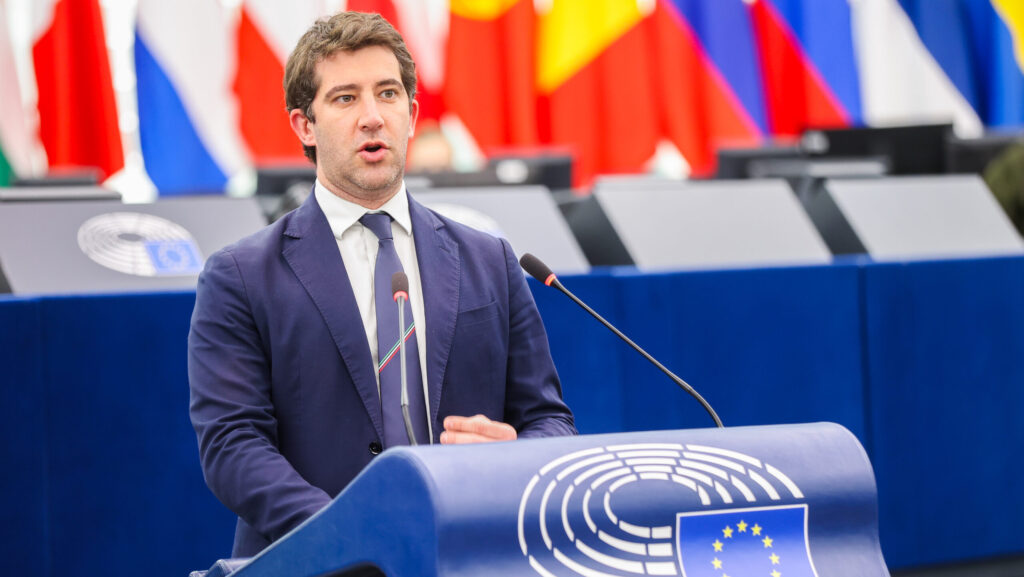
Spanish politician and leader of the VOX party, Santiago Abascal.
Photograph courtesy of VOX.
Santiago Abascal, a member of the Spanish Congress of Deputies since 2019, has been the leader of the conservative VOX party since 2014. He has long been an outspoken defender of national sovereignty and Spain’s right to protect its own borders. Since 2024, he has been president of the sovereigntist European political party, Patriots.eu. Sergio Velasco, a frequent contributor to this publication, recently spoke to Abascal about Spain’s Socialist prime minister, Pedro Sánchez; the role of Fundación Disenso, VOX’s think-tank, in Spain and across Latin America; the persecution of sovereigntist leaders across Europe; and the challenge of unifying the Right across Europe.
Pedro Sánchez will do everything in his power to hold out until 2027. And if he had the possibility of finding some ‘legal’ loophole to annul the elections, he would do it. I have always said that the worst of Pedro Sánchez is yet to come—and, unfortunately, it always comes true. His competitive advantage is that he has no scruples. He only cares about staying in power and covering up his family’s scandals.
You know that we do not give too much credibility to polls, but the situation of the party and the project, which is the only important thing, is very good.
VOX has a national project, solid and coherent, which is based on immutable principles. That is why, despite the attempts of so many, they cannot destroy us. We have suffered brutal attacks from the media of the single party that make up the PP [Partido Popular, “People’s Party”] and PSOE [Partido Socialista Obrero Español, “Spanish Socialist Workers’ Party”]. They have tried everything, and they will not stop trying. But let them lose all hope. We are not going to take a single step backwards.
We have always shown a willingness to reach an understanding. We have come to govern together
in regions of Spain, which is a demonstration that we can reach agreements and, depending on the strength that the Spaniards have given us, defend our ideas without blackmailing—and, of course, always without putting our principles at risk, because we only have one strategy, which is the strategy of conviction. This explains why we are the only party in the political history of Spain that has left governments—left power—because we were not willing to be accomplices or to collaborate in the distribution of illegal immigration in Spain. I insist, we have a national project and we owe ourselves to it.
Let’s take it one step at a time. Our aspiration—and I have reiterated this on several occasions—is to work towards a large group that will displace and represent a real alternative to the socialist and popular consensus that impoverishes Europe, pursues the destruction of democratically elected governments (such as the Hungarian one), and seeks to interfere in the elections of member states (as we have seen in Germany and France). In short, a great party that puts an end to the globalist and federalizing drift of the European Union that threatens the very idea of Europe, its nation states, and the founding values of the EU.
That said, what we need now is, first of all, to consolidate and strengthen the Patriots. This is something we are working on and which, I must say, is relatively easy thanks to the different parties that constitute it and their presidents, who are leaders forged in a thousand battles and to whom I am grateful for their generosity and example.
It is not that Vice President J.D. Vance is right, which he is, it is that his magnificent speech in Munich reflects the denunciation that we patriotic, conservative, and sovereigntist parties have made.
The greatest danger facing Europe comes from within our borders, not from outside. More and more often we see rulers taking decisions contrary to the interests of their own people—even those who elected them—at times going so far as to insult them. In Germany, the outgoing parliament—I emphasize outgoing—has passed three constitutional reforms contrary to the will expressed by Germans at the ballot box. The policies of climate fanaticism promoted by the socialist and popular consensus have produced catastrophes such as that of Paiporta, in Valencia, where more than 200 Spaniards died. We have just witnessed a blackout throughout our national territory.
Unfortunately, this is becoming a constant in Europe. I have no doubt that they are going to try to do the same with VOX, and that they are looking for ways to do it.
It is further proof that we are facing the end of a cycle. These are signs that a regime is dying and that is using all the levers of power to postpone the inevitable: the arrival of new leaders who are willing to really defend the interests of their nations against the impositions of supranational bodies.
We prefer the term Ibero-America or Iberosphere, which better reflects the set of values that it comprises, which we share, as well as the historical ties that bind Spain to that region of the world and which revolve around Hispanidad and, therefore, the West.
The Iberosphere is recovering its freedom thanks to the drive and leadership of heads of state such as Javier Milei in Argentina, Santiago Peña in Paraguay, Daniel Noboa in Ecuador, and many others. These are governments that we must support, because the criminal organizations of the São Paulo Forum and the Puebla Group will not cease in their efforts to cause instability.
It is also important to take into account the arrival of the Trump administration, which is taking significant steps against murderous and corrupt regimes—such as that of Venezuelan president and usurper Nicolás Maduro, who also serves as head of the Cártel de los Soles [a criminal organization involved in drug-smuggling and other illegal activities, and formed by Venezuelan government officials and the armed forces].
We find ourselves at a time when we have to choose between two poles: the Atlantic or the Chinese. Unlike many leaders, we are clear: we believe in and work for the strengthening of the free world—and of the Atlantic link. And the Disenso Foundation is wholly dedicated to this task.
There is only one Javier Milei; he is unique and cannot be replicated. What he is doing and achieving will be recorded in all the history books. To begin with, he has given hope back to Argentina. He has made his nation an international model and has shown that there is a possible alternative not just to Kirchnerism and its policies of misery, but also to the lukewarm centrists.
In Spain and in other nations, the same thing has also happened: political parties present themselves to the public as an alternative to the status quo—but then, in the end, all they do is execute the same old socialist policies, though perhaps with less intensity.
This interview appears in the Summer 2025 issue of The European Conservative, Number 35:84-86. It has been corrected to note that Santiago Abascal is president of the European political party Patriots.eu, not the president of Patriots for Europe political grouping in the EP, whose president is Jordan Bardella.