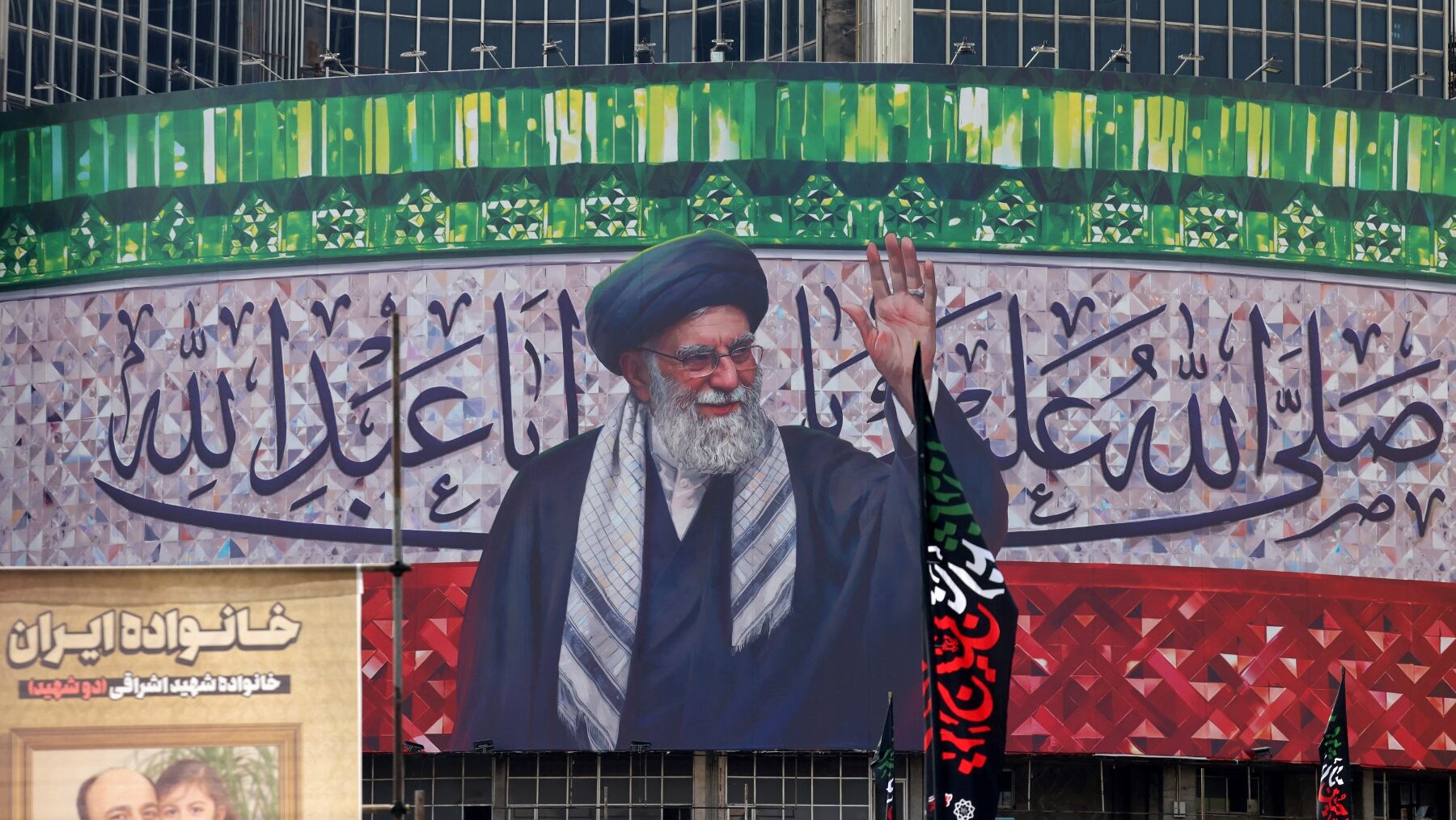
A billboard depicting Iran’s Supreme Leader Ayatollah Ali Khamenei is displayed in the centre of Tehran’s Valiasr Square on July 13, 2025.
ATTA KENARE / AFP
Javier Gil Guerrero holds a Ph.D. in history from the University of Navarra and is currently a researcher at the Institute for Culture and Society at the University of Navarra. Specializing in U.S. foreign policy in the Middle East and the contemporary history of Iran, he is the author of The Carter Administration and the Fall of Iran’s Pahlavi Dynasty and La sombra del Ayatolá. Una historia de la República Islámica de Irán (The Shadow of the Ayatollah. A History of the Islamic Republic of Iran).
It is an authoritarian regime, there is no doubt about that, but in some respects it is unspeakable. We have a parliament and a president elected directly by the people, a supreme leader, the Guardian Council, the Assembly of Experts … a series of institutions that act as checks and balances within the state apparatus, but the people can only choose from a very limited menu of candidates allowed by the regime. These are not free elections, and the real opposition cannot run in them.
At the heart of the system is the supreme leader, a position held for life, of which there have been two: Khomeini, until his death in 1989, and Khamenei, since then. And it is the supreme leader who tips the balance one way or the other, supports one faction or another, allows more electoral freedom or restricts it. What is striking about this system is that debates and clashes between factions within the regime take place in the media, something unthinkable in China, for example. This creates a confusing picture of where power really lies, but the key is the supreme leader, who decides what can and cannot be done at any given moment.
When a president is elected, he is sometimes called ‘open-minded,’ ‘reformist,’ ‘moderate,’ or ‘pragmatic.’ In the last 30 years, there have been three: Khatami, Rouhani, although he was not entirely so, and Pezeshkian. In the end, it is a story of impotence because people place their hopes in them to expand the framework of freedoms, soften the repressive apparatus of the state, and move closer to the United States and the West, which are then not fulfilled. However, these are reformists under the tutelage of the regime and should not be confused with the real opposition. They are not out to destroy the Islamic Republic, but to make it more efficient in the long term.
Iran is a bit like Russia in that it is trying to create an empire beyond its economic means. They project a very strong image to the outside world, but then the economy and the system itself are not prepared for the global role they aspire to. Iran has tried to project a hegemony beyond its means because it is a system plagued by corruption, economic mismanagement, and leaks on all sides: power cuts, droughts, lack of competitiveness, spiraling inflation, etc. It is true that many economic problems have been exacerbated by Trump’s policy of maximum pressure, but this policy is not the root cause of these problems, and Iran has never again experienced the economic growth it enjoyed during the years of the Shah.
The spark for these protests, except in the case of Masha Amini, is usually economic: power cuts, cuts to diesel subsidies, or inflation. But in the end, the important thing is that these protests do not remain at the economic level, but end up snowballing, taking on political demands and calls for regime change. The people of Iran see no future for themselves or their country, and feel that the Islamic Republic is ideologically and administratively exhausted.
There is a certain economic incompetence, but also a lack of political will. Many sectors have benefited from this clientelist, smuggling-based economy marked by nepotism, and they fear a more liberalized economy. For this reason, interests have been created, such as those of the Revolutionary Guard or religious foundations, which are ultimately toxic to the country’s economy. This has led to the destruction of the private industrial fabric and the growth of a parallel industrial fabric that is essentially parastatal and has no interest in creating a competitive or open economy.
After Masha Amini’s death, the regime, astute as always, realized that the situation could get out of hand and that it would be wise to allow a certain relaxation of social norms. This does not mean the end of the legal apparatus that forces women to wear the veil but rather that, in recent years, it has not been enforced with the severity with which it has been exercised for decades. In other words, it is not due to a change in the authorities’ opinion but simply a measure to curb the frustration and weariness of the population. The entire repressive apparatus and legislation are still in place, but to prevent an escalation of protests, the morality police are not being as rigorous or vehement as before. Of course, all that may change as soon as the regime regains control of the situation.
What must be understood is that one of the reasons for the regime’s longevity is that they have managed the timing very well and [play] foreign and domestic policy like an accordion. When they deem it convenient, they allow more freedoms and open up to the outside world and, at other times, they do exactly the opposite.
In general, the Western Left has a natural sympathy for the Islamic Republic because of its anti-globalist, anti-American, anti-Zionist, anti-capitalist, and anti-liberal rhetoric. All this rhetoric and propaganda is loaded with imagery that is essentially very left-wing. The contradiction regarding the situation of women, homosexuals, and minorities remains within Iran, and, for the sake of the greater good, the Left chooses to ignore it.
The Islamic Republic of Iran is, at heart, a rational actor; they are not fanatics willing to martyr themselves. All this rhetoric that frightens the West so much, about a country willing to sacrifice itself and unleash an apocalypse if attacked, is nothing more than a strategy. The reality is that when Iran has been attacked, nothing like that has happened. Think of when Reagan launched Operation Praying Mantis and sank part of the Iranian fleet, when Trump ordered the elimination of Soleimani, or when the United States and Israel attacked Iranian nuclear facilities. In all those moments, Iran did not behave like the Islamic State and embrace martyrdom. The Islamic Republic has shown that if, in order to survive, they find themselves between a rock and a hard place and have to negotiate with ‘the Great Satan,’ they are willing to do so. During the war with Iraq, they bought many weapons from Israel and also secretly from the United States. At that time, there was no problem in making deals with the enemies of Allah.
The mistake in these negotiations, according to the information that is coming out, is that they seem to be focusing on the nuclear program. My fear is that Iran, in order to survive, will offer significant concessions, but after the U.S. and Israeli bombings, that program is badly damaged. What they do not seem willing to give up is the ballistic missile program and support for proxy militias in Iraq, Lebanon, and Yemen, which are the points of interest to Israel. If Trump is only concerned about the nuclear program, he will repeat Obama’s mistake, who also ignored ballistic missiles and military adventurism.
These are two different societies, cultures, and ideologies, so a similar outcome is not possible. I believe that the Islamic Republic is at its weakest and most vulnerable since Saddam Hussein’s invasion in September 1980. It is the most delicate moment in its 47-year history, and they are aware of this. They are very afraid of a U.S. operation that seeks to destabilize the state apparatus and that this, combined with the protests, will cause the regime to collapse. The question is, is there anyone who can fill the power vacuum once the Islamic Republic implodes? It is true that the figure of the crown prince, Reza [Pahlavi] Shah, has legitimacy because he is his father’s son and because his father’s legacy has been greatly revalued in Iran in recent years, and people look back nostalgically on the 1960s and 1970s. He is a figure who stands above politics and could play the role of arbiter in a transition. The problem is that he has been outside Iran for 47 years and does not have the infrastructure or organization within the country to take over the government.
Regarding the possibility of a scenario like Libya or Syria, I believe that the Islamic Republic is playing with the idea of “either us or chaos.” However, I find it difficult to see that scenario happening because Iran, unlike Iraq, Yemen, or Syria, is a state that has remained more or less within its current borders for centuries, and the historical tradition of Iranian identity and government goes back 2,500 years. It is true that there is a threat from ethnic and linguistic minorities on the periphery of Iran, and that at a time of institutional collapse they may attempt to claim independence or autonomy, but it is a much more cohesive society than other countries in the Middle East.