Ignas Kriaučiūnas
© Courtesy of the Ateitis Foundation
Across Western Europe, Catholic youth movements have largely accommodated themselves to the secular mainstream by softening their identity, retreating from the public square and watching their membership age and shrink. Ateitis, Lithuania’s oldest Catholic youth association, has taken the opposite path.
Founded in 1910 and shaped by decades of underground resistance during Soviet occupation, Ateitis operates on five founding principles: Catholicism, nationality, family, intellectual excellence, and public engagement. In Europe’s current cultural environment, those principles are a direct rebuttal to the ideological pressures bearing down on European society, namely that of relativism, rootless globalism, radical individualism, cultural mediocrity, and the steady effort to push faith entirely out of public life.
Ateitis is also the only organisation in the Baltic States and Eastern Europe to hold full membership in FIMCAP, the International Federation of Catholic Parish Youth Movements, placing it in a network that spans Western Europe from Germany and Italy to Belgium and Switzerland. Yet it is arguably doing more to hold the line on religious identity than most of its Western counterparts.
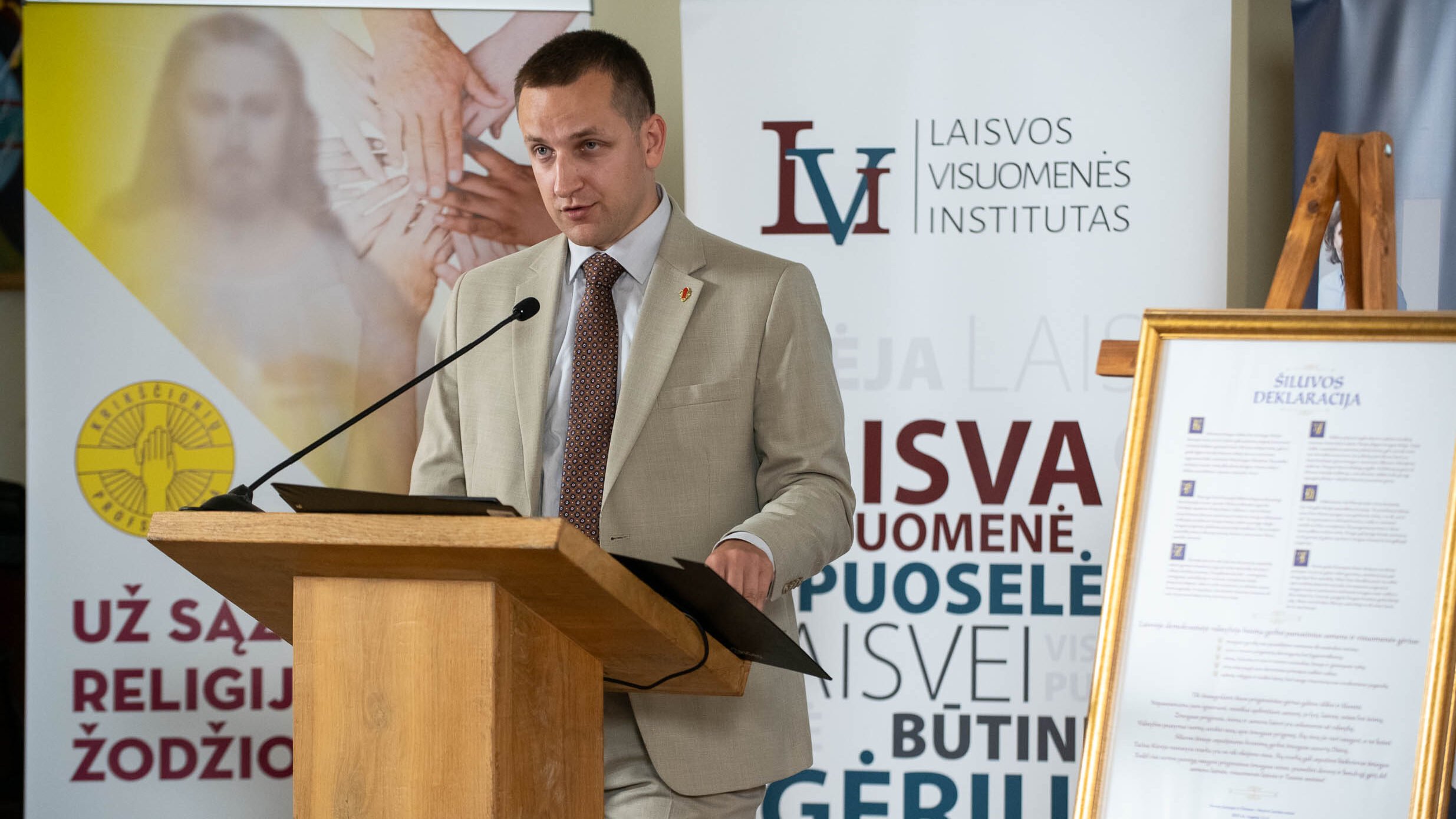
Ignas Kriaučiūnas, the organisation’s general secretary, is a graduate in biotechnology and philosophy from Vilnius University. He currently holds the rank of lieutenant in the Lithuanian Armed Forces Reserve. europeanconservative.com spoke with him about formation, patriotism, family, and what the rest of Europe might learn from a movement that refused to disappear from public life as it continues to advocate for traditional values in the face of progressive pressure.
Hope, for me, begins with faith. No matter how dark things become, Christ is risen and that fact changes everything. Salvation remains within reach of every person and that is not a sentiment but a foundation.
Beyond that, I look to my family. My newborn daughter, more than anything else, has sharpened my sense of why any of this matters. The demographic crisis, particularly acute here in Lithuania, weighs on me more than any other issue we face. What is the point of debating the economy, innovation, or defence, if there are simply no people left to benefit from it? My family is my answer to that question. It is a daily confirmation, to myself and to those around me, that I chose life rather than extinction.
There is a famous phrase often attributed to Jordan Peterson—”clean your room before you criticise the world.” I have my own version of it: have your own children before you start worrying about the demographic crisis.
Lastly, even if the current civilization is crumbling, I see that there are embers in it that could later ignite a new fire. Christian families, their circles, and organized groups like Ateitis, which practice different ways of life that may one day be useful to civilization. An example would be the monasteries during the collapse of the Roman Empire, thanks to which the legacy of civilization was preserved and later restored in Christian Europe.
I must admit that I often doubt Europe’s ability to survive. At least on the outside, everything seems irretrievably broken. Once upon a time, there were active Catholic Action organizations throughout Europe involving students, schools, workers, and Christian Democratic parties.
We Lithuanians were one of the last to gather our own, and it was quickly suppressed by the Soviet occupation. After regaining our independence, we restored ties with Catholic Action organizations in other countries. And what we found was emptiness. Some of them are numerous in members, most are rich and yet they are empty inside. Our representatives often go to joint events as a voice of protest, reminding them that their organizations are Catholic and should act like it.
At international events, it is often among representatives of Central and Eastern Europe and surprisingly among Africans and Asians that one finds the most natural allies. This presents an interesting paradox, at once a challenge and an opportunity. Is it not possible that Europe, which once sent missionaries to the ends of the earth, may yet find itself re-Christianized by the very peoples it once sought to convert?
Keep in mind that the most important principle of our movement is Catholicism. Patriotism, which is love for one’s country, comes later. I live by these principles and yet I believe that global Christianity is more important than its individual regions. After all, when Europe was formed, it was simply Christian. Before the Reformation, the inhabitants of this continent understood themselves as Christians, this was the unifying factor. Later, they more or less coincided—we are both Christians and Europeans. Now—no longer. As I mentioned before, Catholic Lithuanians begin to find more in common with Africans than with their own compatriots or other Europeans.
The answer, quite frankly, is the blood of martyrs. During the Soviet occupation, practising Catholicism openly could mean exile to Siberia or imprisonment. The founder of our organisation, Professor Pranas Dovydaitis, a former prime minister of Lithuania, was arrested in the very first days of the Soviet occupation and taken deep into Russia, where he was shot two years later.
Some argue that Lithuania maintained its religiosity simply because the Soviet occupation ‘conserved’ our society, and that in the political environment of a free Lithuania, de-Christianisation is merely delayed, not avoided.
I reject that theory entirely. What kept us religious was not passive preservation but active resistance against Soviet communism. And personally, I have seen that resistance alive and well in unexpected places. I had known of the Ateitis Federation for years, held its history in high regard, and yet remained deeply sceptical of what it had become, convinced it had been de-Christianised. I joined nonetheless. What I found was an organisation quietly returning to its roots, while those who had steered it toward secularisation gradually moved on.
Our identity is based on the fact that we are Catholic and that all Christians are our brothers and sisters. Even during the interwar period, when Lithuania and Poland were locked in deep rivalry, Lithuanian Christians were among those who at least attempted to build bridges.
The pillar of nationality has, however, undergone significant change over time. A century ago, it carried a different weight, particularly when the urgent task was gathering the Lithuanian nation into a strong national state, distinct from those around it. That principle took on fresh importance again when our organisation’s governing body relocated to North America after the Second World War, as Lithuanians there sought to preserve their identity amid America’s diversity.
Five years ago, I would have said that with Lithuania’s national statehood no longer under threat, this principle had become less urgent, reduced largely to the preservation of national culture. Then the chauvinist propaganda of Russia resumed, once again dividing European nations into the ‘real’ and the ‘fictional,’ and the national question returned with force.
In my view, the principle of nationality holds that every nation deserves its own state and that nation-states remain among the most stable frameworks for organising human society. In Scripture, Christ sends the apostles to make disciples of all nations, not of some formless, nationless mass.
The deeper question is who belongs to a nation. My answer follows a specific Christian interpretation: whoever contributes to the work of that nation’s salvation. We have had an Argentine priest in our ranks for many years who has likely done more for the salvation of the Lithuanian nation than most Lithuanians ever will. I could not regard him as a foreigner.
In theory, reconciling Catholicism, which calls for universality, with nationality, which calls for particularity, is genuinely difficult. But when properly combined, that tension can generate remarkable cultural power.
Our method is to work with youth, beginning from a young age through children’s camps, where we form young people in an authentic Christian culture. An environment where it is normal to be a believer, to want a large family, and to cherish the values of marriage. This is our strength.
The next stage is drawing young adults into social engagement. We admit this does not always succeed. At the end of secondary school or the beginning of university, life intervenes, and some members who grew up in the organisation drift away from active participation and sometimes from our ideas altogether.
We sow, and not every crop ripens at harvest. Our aim is to influence culture, not to chase immediate results. The founders of our organisation were clear on this point: avoid direct political activity, at least while young. Maturity in virtue and ideas must come first. We must live the ideals we profess before we proclaim them publicly. We speak of family values, but first we must embody them. Have your own children before engaging in the demographic crisis.
So far, we have managed to maintain our independence. However, we feel that the window may soon close. We notice an increase in various ideological conditions in project funding competitions.
I must admit that sometimes ,we have to make small reservations or carry out different communication than we would like. And yet, most of our income does not come from state funding sources. We have our own intangible capital fund, and we have developed our own fundraising system.
As the current legal head of the organization, I constantly set a goal to diversify the organization’s income generation so that we may continue our activities. This also contributes to the financial education of the organization’s members. We live not from some obscure foundations or state funds that distribute funds collected from taxpayers, but from the donations collected from our supporters and people of good will.
To answer this question, one must acknowledge that there is such a thing as culture wars or that someone has to seize something. This seems like a Marxist worldview: the constant insistence that someone is at war with someone and that there are irreconcilable animosities, with the implication that one must win and destroy the enemy.
I cannot accept such a Manichean dichotomy. There is no need to win against anyone. There are no irreconcilable enemies or groups of people who need to be destroyed. And ‘leftists’ or ‘progressives’ are people with their own inherent dignity, just misguided or mistaken.
Christian anthropology has a concept of original sin and the fall of man. People make mistakes, sin, do evil without knowing it, or rather, firmly convinced that what they are doing is right. In each period of human history, that sin manifests itself in different forms in social life. In the 19th and 20th centuries, it was communism; now, it is certain ideological movements that detach freedom from moral responsibility. It is no coincidence that these ideologies have an ideological genealogical connection.
Pope John Paul II called it “structures of sin.” In the end, it was not sin that won, but Christ. At some point, even the truly popular leftism will fall, but I have no doubt that new “structures of sin,” new poisonous ideologies, will emerge, and those who consider themselves conservatives will have to remind society again and again of the old truths and protect the very fabric of society.
The most dangerous threat would be the loss of the fighting spirit. Our federation was born under the sign of struggle and in some sense it must remain so. Not only in the struggle against external pressures, but in the internal struggle regarding the constant spiritual battle against our own weaknesses and against that ancient temptation: “I will not serve.”
In the end, organisations live or die not because of funding structures or legal pressures, but because of ideas. Institutions are simply the visible form of invisible convictions. If the living idea is present, the rest will follow: members, resources, resilience. If the idea fades, no amount of institutional support can save it.
Perhaps this is the deepest challenge facing Europe today: not primarily economic or political decline, but the quiet loss of the ideas and the idealism that once gave meaning and direction to its civilization.