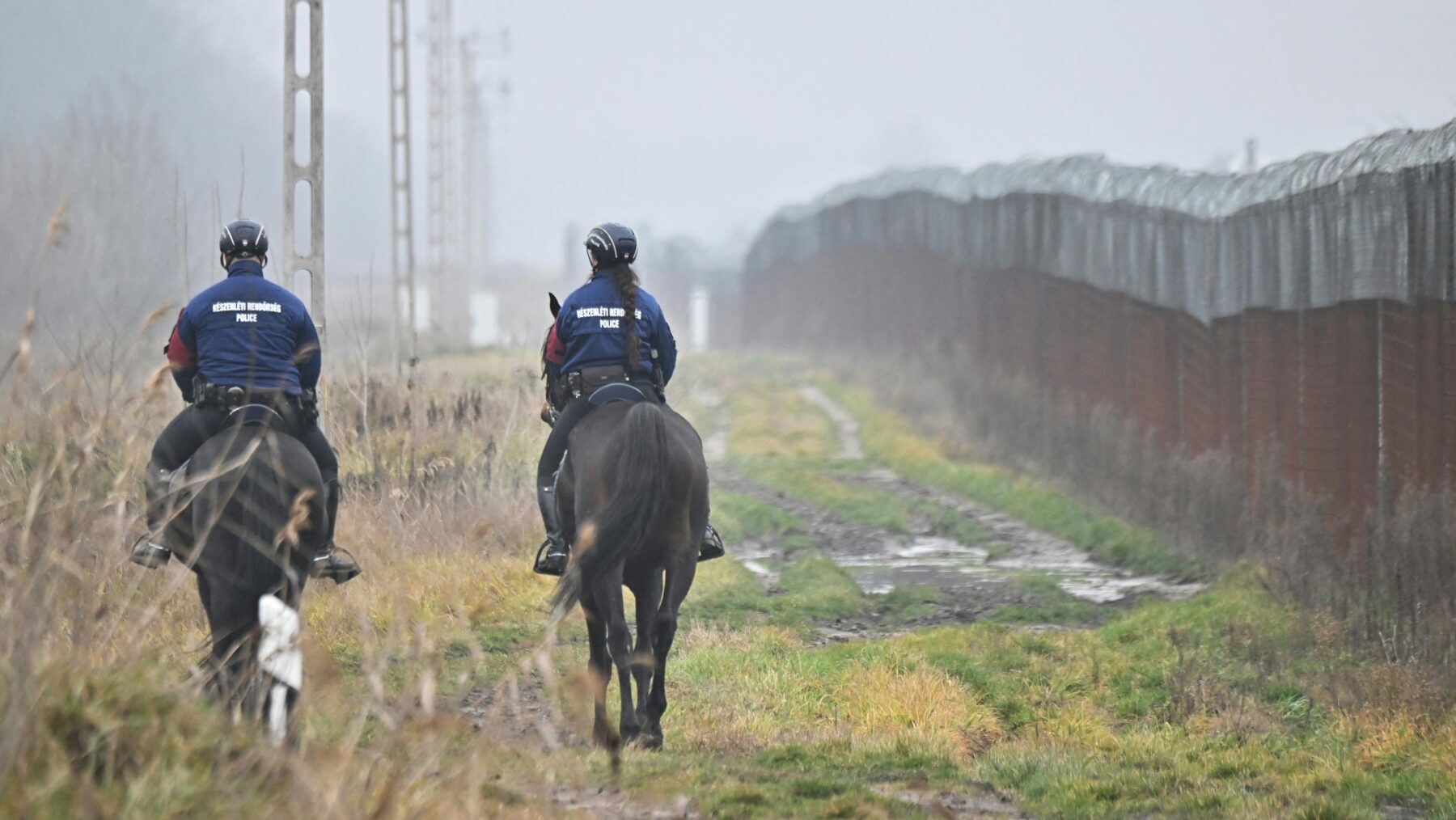
Hungarian border police officers patrol on horses on December 15, 2022 at the Hungarian-Serbian border, close to Kelebia village.
Attila Kisbenedek / AFP
Szabolcs Janik is a Research Fellow at Mathias Corvinus Collegium’s (MCC) School of Social Sciences and History in Budapest, and the former deputy director at the Migration Research Institute (MRI). Despite the fact that ten years have passed since the beginning of the migration crisis, Janik believes Europe remains vulnerable, the risk of new migration waves remains high, and the root problems identified in 2015 have not been solved.
We interviewed him in the Hungarian city of Szeged, on the sidelines of a conference on the 10th Anniversary of the European Migration Crisis organised by the MCC and the MRI.

I think ten years is long enough to take stock and make some reasonably firm assessments. The consequences have been many and varied. Back in 2015, a major Europe-wide debate erupted over how to handle the crisis. Hungary, suddenly finding itself on the front line, took a very different approach from the European mainstream.
From the very start, the Hungarian government decided that this was not simply a humanitarian issue but one of security and sovereignty. It introduced strict measures designed to curb migration. These steps were met with fierce criticism from EU institutions and Western governments, who insisted that the situation was purely a humanitarian crisis.
Ten years on, while there has been some progress, the opposing viewpoints largely remain. I’m more optimistic than some of my colleagues, because the importance of protecting the EU’s external borders is now more openly discussed—even by actors who, in 2015, would have rejected the idea outright. I see that as a genuine achievement, one that would not have happened without the Orbán government’s stance.
Of course, there have been many tangible consequences for Hungary: infringement procedures, fines, and political battles. Most recently, the European Court of Justice ordered Hungary to pay one million euros per day for not complying with a 2020 judgment of the Court (which complained, among other things, about the restriction of access to the international protection procedure). The conflict has not disappeared—it has simply become quieter, overshadowed by the pandemic and then the war in Ukraine.
The root problems identified in 2015 have not been solved. Western European societies are increasingly dissatisfied with the results of large-scale immigration: social tensions, welfare burdens, and issues of integration and public safety. These concerns resurface regularly in domestic politics, even if right-wing parties that campaign on them rarely manage to form stable governments due to the electoral systems and the resulting coalition constraints.
Meanwhile, the demographic and geopolitical pressures have not gone away either. Africa and South Asia are experiencing explosive population growth. Add to this climate-induced migration—Bangladesh is a prime example—and Europe remains vulnerable.
That fewer people have arrived in recent years, compared with 2015–2017, is mostly due to factors outside Europe. There hasn’t been another disaster like the Syrian war and the resulting mass migration from Turkey. Europe simply couldn’t have handled that again. Our continent is still vulnerable. With ongoing tensions and conflicts in Africa, the Middle East, and South Asia, the risk of new migration waves remains high. In short, the issue is far from solved.
Building walls alone is not a solution, but defending external borders is essential if Schengen and sovereignty are to mean anything.
Yes, it’s a fair and relevant question. The EU has its own court, which enforces European law. In this case, the Court judged that Hungary violated EU asylum regulations that are based on the 1951 Geneva Convention.
From Budapest’s perspective, the logic was clear: there was no active armed conflict in neighbouring countries—until the outbreak of the war in Ukraine in 2022, a development the cabinet immediately addressed with legislation—so genuine refugees were not arriving from the immediate region at the time. Hungary therefore limited the asylum process to two transit zones until 2020, then to its embassies abroad. But the Court considered this and other measures a disproportionate restriction, which finally resulted in the mentioned daily fine of one million euros per day.
It’s ridiculous because this legal approach ignores the security dimensions. EU institutions tend to treat the issue as a purely technical matter of law, while in reality it is also about sovereignty and security. And the double standards are striking. Only recently, European Commission President Ursula von der Leyen visited the Polish-Belarusian border with Prime Minister Donald Tusk and praised the fence there—something Hungary has been condemned for.
In many respects, yes. The Polish government erected a fence and suspended the right to submit asylum applications at certain border points; border forces apprehend every migrant, just as Hungary did. Yet instead of criticism, they’re being applauded. It shows how politically driven the EU’s reactions can be. Migration policy is not treated consistently—what is punished in one case is tolerated, even praised, in another.
Returning to the case of Hungary: one can debate what a fair asylum system should look like, or how it aligns with the Geneva Convention, but the reality is that people crossing from Serbia are not fleeing for their lives. Still expecting Hungary to treat this purely as a humanitarian crisis goes against a decade of experience and evidence—something the Polish government has also realised at its own border.
On paper, the EU’s policies and declarations look admirable, but in practice they are often detached from reality—and migration is a clear example of that gap.
The essence of the new Migration Pact is to reform asylum rules across the EU. Some parts are more realistic than the Commission’s earlier proposals, but the core issue remains the same: mandatory solidarity. Member states will be required to choose between three options in emergency situations—taking in relocated asylum seekers, paying financial contributions instead, or providing border management assistance.
The idea of helping through funding or manpower is reasonable, but the inclusion of mandatory relocation keeps the same problematic logic. It risks acting as a magnet, encouraging people to attempt the journey to Europe because they know they will eventually be admitted and distributed among EU states.
The Hungarian government believes the focus should be on protecting the EU’s external borders, not distributing migrants. And the everyday reality in several Western countries—from parallel societies to rising crime rates and heavy reliance on social welfare systems—shows that integration has not been as successful as many hoped.
We are witnessing a slow awakening in parts of Europe, with anti-immigration parties gaining ground as societies recognise the long-term challenges of uncontrolled migration. Whether those parties can eventually enter government remains to be seen, but the result is clear: migration remains Europe’s unresolved question.