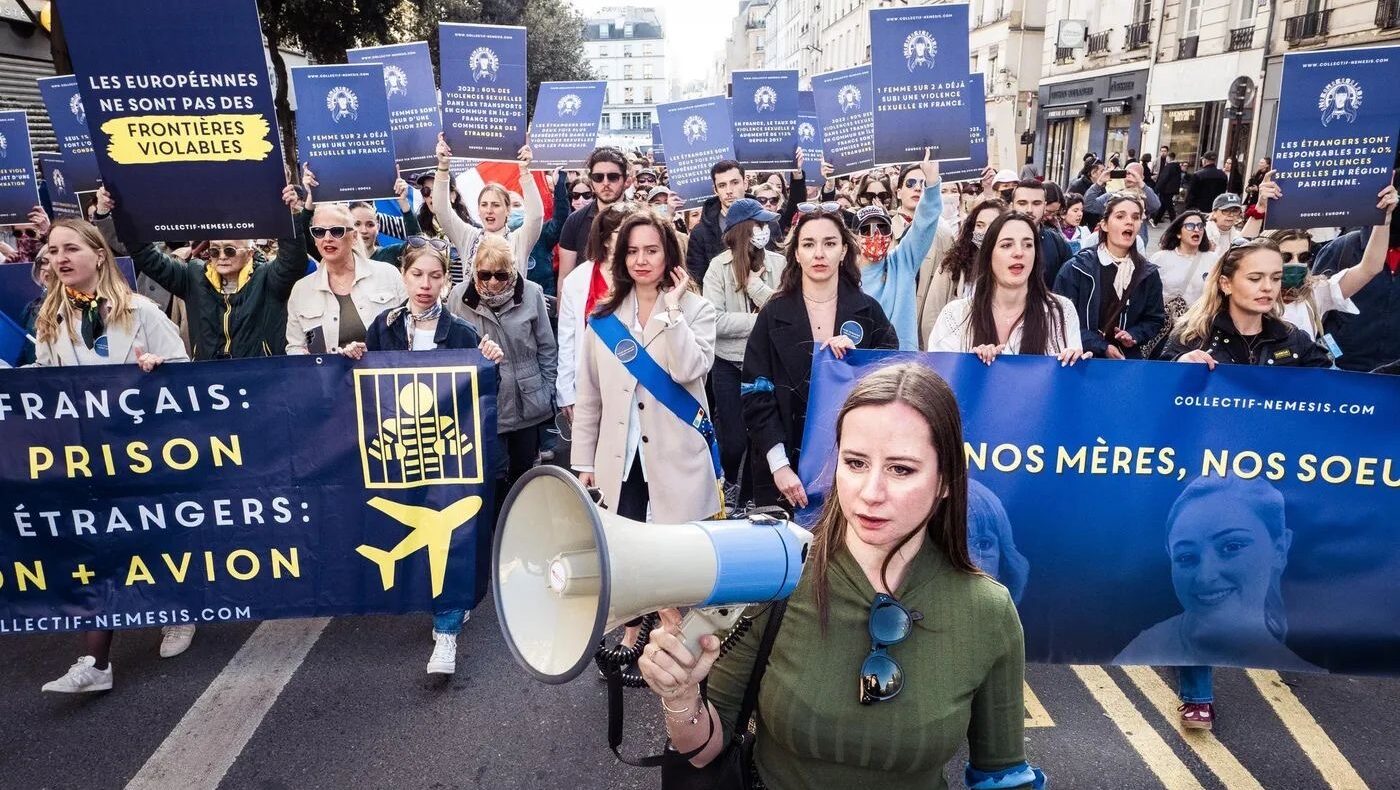
Alice Cordier at the head of a Collectif Némésis demonstration.
Courtesy of Alice Cordier
Alice Cordier is one of the most prominent young voices of the new European counter-feminist movement. As the leader of Collectif Némésis in France, she has become known for denouncing the blindness of mainstream feminism toward the consequences of mass immigration on women’s safety and civil liberties. Her activism confronts both the political establishment and the dominant cultural narratives, placing her at the center of France’s heated debates on identity, security, and women’s rights.
Under her leadership, Collectif Némésis has staged high-impact public actions, often facing hostility from far-left groups and resistance from institutional actors. Cordier and her colleagues argue that the protection of European women cannot be separated from broader questions of borders, national identity, and social cohesion. Their efforts have earned them both enthusiastic support and intense opposition, making Némésis one of the most controversial feminist initiatives in contemporary France.
At MCC Brussels’ ‘Battle for the Soul of Europe’ gathering, where thinkers, politicians, and activists from across the continent met to discuss Europe’s future, Cordier brought a stark message: Europe is undergoing a civilizational shift, and young women must take a leading role in confronting the cultural and security challenges posed by uncontrolled immigration. She spoke with europeanconservative.com‘s Javier Villamor about the situation facing women in France.
For me, in France, everything comes down to the question of immigration. That is my fight. We have a huge problem with Islamic immigration in particular. There are a lot of rapes of women, and many people are victims of knife attacks. Today in France, we have around 120 knife attacks per day. It is terrible.
And I think you can imagine the real number is even higher, because not everyone goes to the police. We also have many rapes. For example, in France, 62% of sexual assaults on public transport in Paris are committed by migrants, and 40% of sexual assaults on public transport in the whole of France are committed by migrants.
Migrants represent only about 8% of the population in France, but they are vastly overrepresented in sexual violence statistics. This is a very serious problem.
At the same time, many feminists refuse to denounce this reality because they belong to left-wing feminism. That is why it is important to create another group of women who understand that we must fight against mass immigration, and especially Islamic immigration, for the sake of our civilization.
For me, it is essential to build a pressure group of women that can influence politics and help change our country.
I am not considered a ‘real’ feminist by other feminists. For them, I am a fake feminist. And because of that, we have a lot of problems.
We face violence from so-called anti-fascists. We face daily harassment and persecution directed at our association. Some of our activists have been victims of violence in the street. Others are under pressure at their universities or at their workplaces simply because they are part of Némésis.
But I think this is similar in many countries: if you are right-wing, it can mean the end of your public and private life. Still, we fight, and we will not stop. We know the risks.
France will have a presidential election in one year, and I think the violence will increase, but we accept that risk because we feel we have no choice.
We take the risk because, today, when we participate in feminist demonstrations, many left-wing men and women want to attack us physically.
If we want to organize any action, like a demonstration, we now need very strong police protection. If you look at our social media—Twitter, Instagram—you can see videos of our demonstrations. Sometimes I feel like I am a prime minister because there are so many police officers around us.
It is very strange. It means we are at war. If I need that level of police protection just to demonstrate, it is because the situation has become a kind of war.
At our last demonstration two weeks ago, Laurent Nuñez, the new Minister of the Interior and former prefect of police in Paris, first told us not to go ahead. He said we would create trouble, that people with knives could come and attack us, and that it would be dangerous.
I answered that the real problem is not us, but those who carry knives—often Antifa militants—who want to attack us. In the end, he decided to protect Némésis. But still, it shows how crazy the situation is.
I am afraid when I see what is happening in the United States. For us, Charlie Kirk was an example, and seeing attempts on his allies or on President Trump is traumatizing. They tried to kill Trump.
Today, I am not only afraid for myself, but also for Jordan Bardella, because all the statistics show he can become the next president. And I think Antifa will want to try to kill him, too.
It is a good question. I think there are two kinds of boomers. Some of them are the ’68 boomers, from May ’68, and they are still revolutionaries in their minds.
For them, it is almost impossible to change their worldview and rediscover the French cause. All their lives they have fought for progressive ideas: ‘living together,’ the end of borders, multiculturalism.
Today, perhaps they see that there are problems with immigration, but they do not want to see it. It is too painful. Accepting reality would mean admitting that the fight of their whole life was a mistake.
So many people of my grandmother’s generation do not want to accept that immigration is a problem. In France, we say “vivre ensemble”—living together—but they cannot admit that this ideal has failed. They fought for that, and they cannot accept that it does not work. That is my interpretation.
I have a clear message for the youth, especially in Eastern Europe: never accept mass immigration.
We made this mistake in France, in Western Europe. Today, it is very difficult to find a solution, because many people who cause problems now have French nationality, but in their minds, they are not French.
It is impossible to “re-migrate” them because, legally, they are French. So do not repeat our mistake. Fight for your civilization, fight for your life, fight for your values. Fight for who you are.
For me, this fight is personal. My little sister was the victim of a sexual assault when she was 12 years old, on a bus in Orléans, the city of Joan of Arc. Nobody moved, nobody helped her.
I fight today because I will never forget that. And I will never forgive it. I cannot accept that someone can attack a little girl like that in France and that nobody reacts.
This event traumatized me—and not only me. Today, many young people in France are traumatized by the effects of immigration. Even everyday sexual harassment in the street is very often committed by migrants or people coming from migrant backgrounds.
So my message is: fight for your little sisters. Fight so they do not have to live what my sister lived. Fight so that your country remains your country.