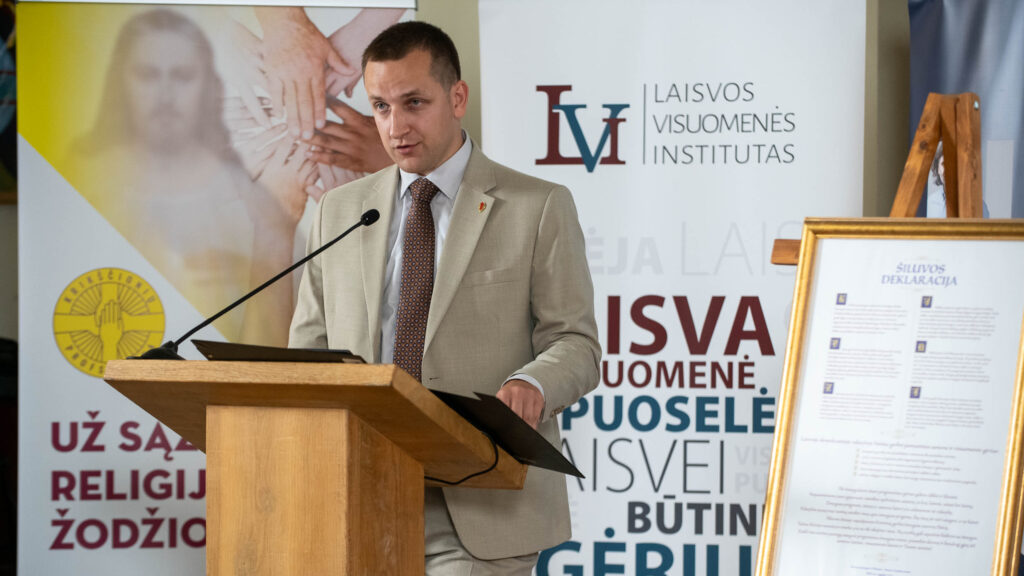
Csaba Dömötör
Image courtesy Csaba Dömötör
Csaba Dömötör is a Hungarian Member of the European Parliament for the right-wing Patriots for Europe (PfE) group. He has been one of the leading voices exposing how the European Commission has funnelled billions in taxpayer money to left-wing NGOs that lobby for its agenda.
On Thursday, November 27th, a six-month inquiry was launched in the European Parliament into whether Brussels used taxpayer money to fund lobbying for its own Green Deal—a deal that has been harshly criticised by European companies, farmers, and member states for creating serious financial and administrative burdens in the name of fighting climate change.
Unsurprisingly, left-wing parties strongly opposed any kind of inquiry, while the centre-right-liberal European People’s Party (EPP) was only willing to support a compromise solution: a working group instead of a fully independent inquiry. With the aid of right-wing groups a so-called ‘Scrutiny Working Group’ was set up within the Parliament’s budgetary control committee. Europeanconservative.com asked Csaba Dömötör about the upcoming investigation.
Our purpose is clear: we seek full transparency regarding the funding of NGOs that, in many cases, prove to be activist groups that play a political role throughout Europe. It is important to highlight that the mandate of this working group is much weaker than what we initially proposed. We pushed for a separate investigating committee with full transparency. The EPP and other left-wing parties, however, wanted a sub-committee of the Budgetary Control Committee, with a much narrower mandate.
It is hard to tell, because I seriously doubt whether the EPP is interested at all in full transparency. In the current working group, we can examine only a tiny number of contracts, and definitely not those that are the most problematic. I even had to sign a statement of confidentiality. So I cannot talk about the content of the contracts publicly, which is nonsense. We are talking about taxpayers’ money.
In our view, we do not even need a special working group to have the right to examine the contracts. According to EU legislation, any EU citizen has the right to do so. In my country, Hungary, all ministries have to disclose the documents to any citizen with a deadline of 14 days. In the meantime, the Commission is reluctant to publish even the list of the beneficiaries.
You’ve already obtained some data. What did the numbers reveal?
After submitting two rounds of data requests, we received the NGO lists some months ago. The numbers are shocking. Between 2019 and 2023, the Commission signed 37 thousand NGO contracts worth €17 billion. We made this public on a special website (ngotransparency.eu). But this is only a list with the sum of the grants, not the contracts themselves.
First, we have to have a clear picture. However, in the scrutiny working group meeting, Commission officials gave various excuses for not disclosing the contracts. They were citing “commercial interests” of the NGOs, which is quite absurd. They also mentioned that most contracts are classified, giving them a legal basis for not disclosing them. This is even more absurd. Why is an NGO contract classified? If there is nothing wrong with them, they should make them public. If there has been any wrongdoing, it should be made public. As with any government or public institution in any member state.
In my intervention, I summarized the main flaws of the current NGO funding system. First of all, in a great number of cases, NGOs act on behalf of and in the interests of the Commission. This has nothing to do with civil society. It is called political lobbying, but without a lobbyist badge.
Furthermore, there are hundreds of NGOs that play a political role in Member States without a mandate from the voters. In Hungary, there are NGOs that sue my country at the Strasbourg Court for our border protection practices. There is an NGO financed by the Commission that writes negative papers on my country, based on which the Commission suspends billions of EU funds. In other cases, leaders of NGOs become candidates of political parties, right after being promoted for months by media outlets that are also financed by the Commission.
What we have here is a vast political machinery that is quite the opposite of the definition of civil society. It does not represent certain groups of society, but a closed institutional elite in Brussels, definitely on the left and liberal part of the political spectrum.
I hardly think so. When it comes to relevant legislative dossiers, the EPP only voted with real right-wing parties twice in this parliamentary term. This is not a new rule, but a rare exception. As far as the scrutiny working group is concerned, it is obvious that they want to focus on only a small number of contracts and not even the most important ones. When I signaled that we propose a wider scope for the monitoring work, they denied this possibility.
I would not be surprised if, after all this, many, many weeks pass until the next meeting takes place. They even announced that there won’t be any further meetings this year.
However, in fact, nobody needs a working group to have the right to examine the contracts. It is enshrined in the treaties. Not only for MEPs, but for all citizens. So, we will fight for full transparency. By all means. In meetings in the European Parliament, and beyond.