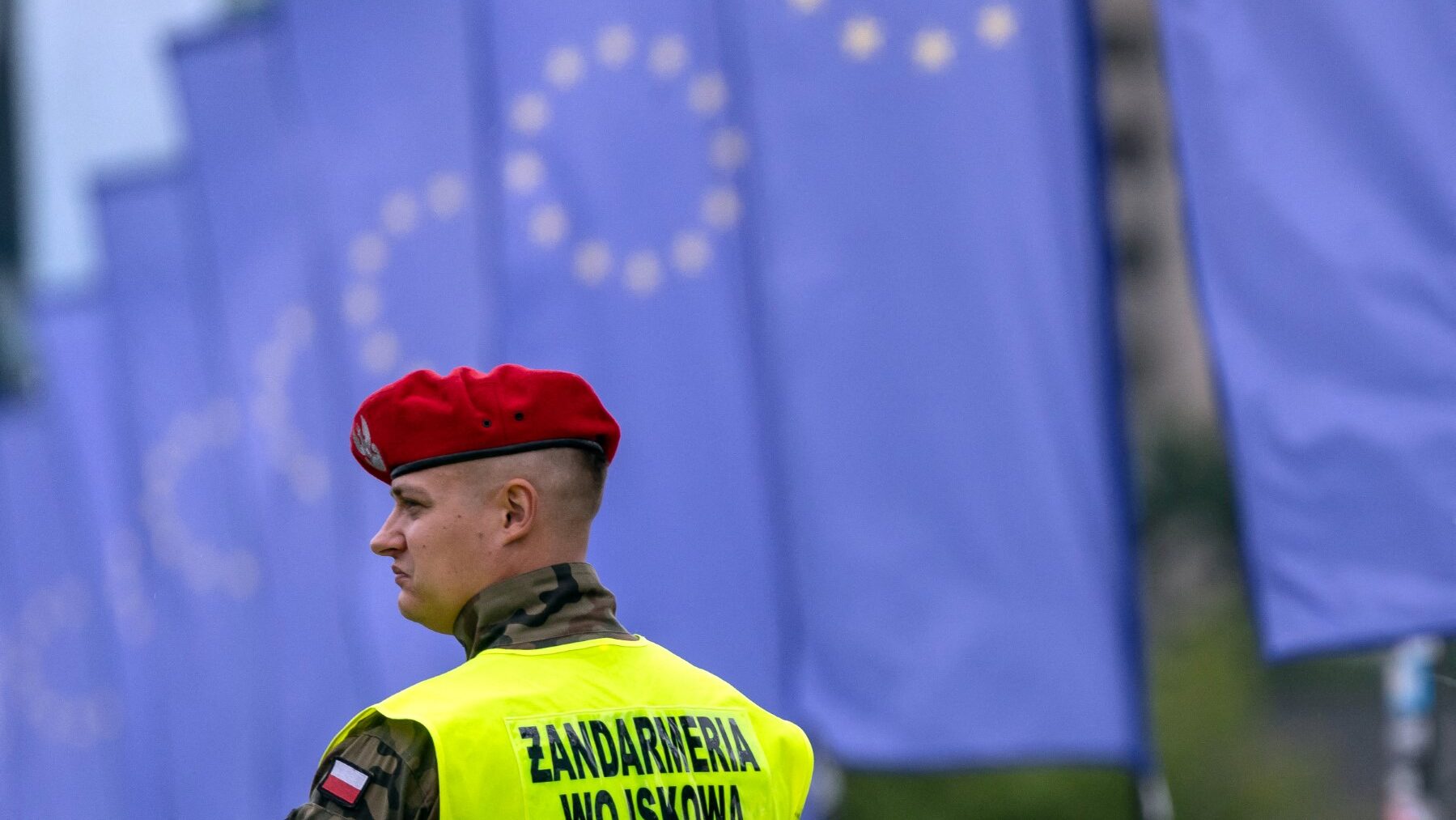
Polish military police officer at the Polish-German border
Wojtek Radwanski / AFP

Jerzy Kwaśniewski is a Polish lawyer and public figure, best known as the co-founder and president of the Ordo Iuris Institute for Legal Culture, a conservative legal think tank based in Warsaw. No political community has ever thrived when detached from national and cultural identity, Kwaśniewski told europeanconservative.com in a recent interview. Attempts to erase these foundations, he said, lead only to centralisation, coercion, and ultimately, revolt.
The German authorities officially invoke the principle of returning migrants to the first EU member state through which they entered the European Union—namely, Poland—if those migrants subsequently made their way to Germany and submitted applications for international protection or residence there. According to an EU regulation commonly known as Dublin III, the responsibility for examining such an application lies with the member state where the migrant first set foot. That would be Poland.
The difficulty arises, however, when one examines the procedural obligations set out by that very regulation. The Dublin framework stipulates a formal readmission process, even under its expedited operational variant. This process mandates that the German side notify the Polish authorities of its intention to return the individuals in question. It further requires an affirmative response from the Polish authorities, after which the actual physical transfer must be carried out in a coordinated manner. Should the Polish side refuse at any stage, the transfer cannot proceed.
If, in defiance of this, German officers simply transport migrants across the border and release them on Polish soil, then we are no longer speaking of any Dublin-related procedure. We are, rather, facing a serious international incident. German authorities have, at one point, acknowledged that their officers were acting in violation of legal norms—most recently in connection with an incident on June 14th of this year.
From the standpoint of international law, these actions amount to internationally wrongful acts. The German state—through the actions of its officers—is violating the territorial sovereignty and legal jurisdiction of the Republic of Poland by crossing the border and forcibly introducing unwanted, illegal migrants onto its territory. The Polish authorities are thus fully entitled—under both domestic and international law —to initiate the appropriate criminal procedures, including detention and the filing of formal charges. This is no minor infraction. It is a grave breach and must be met with immediate intergovernmental, diplomatic, and operational countermeasures on the part of the Polish state.
Because the current Polish government tacitly accepts these actions. One may reasonably assume that an understanding has been reached between Warsaw and Berlin—one in which the Polish side has effectively pledged not to object, nor to invoke its instruments for safeguarding national sovereignty and jurisdiction. Emboldened by this political indulgence, German authorities have proceeded to carry out factual operations—operations that amount, in no uncertain terms, to human smuggling, with German officers now acting as the couriers of illegal migration into Poland.
Last year, German officials admitted to having more than 30,000 potential cases for readmission to Poland. That the Polish government fails to respond amounts to tacit consent—a complacency which the German side is only too eager to exploit.
Precisely. Political will, coupled with the strict enforcement of our rights and the German side’s obligations. In essence, what is at stake here is not only our border security, but the very principle of the rule of law within the European Union.
The entire machinery of mass migration exploits a natural human instinct: the desire to find a better life for oneself and one’s family. If Europe is presented as a promised land—where generous welfare awaits, where one need not work, where laws are lenient or not enforced, and where a general sense of impunity reigns—then it is only logical that people will be drawn to that image.
But that is only the beginning. For the operation to scale, permanent channels and logistical systems for smuggling must be established. These require an initial investment—financial, political, and institutional. Typically, such an investment comes from an interested party: an NGO, a foreign government, or some other actor intent on provoking migratory flows for strategic purposes. This is not theory. It has been methodically analysed by scholars such as Professor Kelly Greenhill, who termed the phenomenon ”weapon of mass migration’.
One illustrative example would be the Russian aerial bombardments of Aleppo—explicitly designed to displace large populations and flood Europe with refugees. That was over a decade ago. Another example is more recent: the financing of flights from the Middle East to Minsk or Moscow, from where state services of our eastern neighbours—Belarus and Russia—escort migrants to the Polish border to create yet another pressure point. Once that initial phase is complete, organised crime assumes control. That is, in fact, the very design of this weapon: a self-sustaining, self-replicating system intended to destabilise the target state.
The moment the first migrants cross the border and successfully post selfies from Warsaw, Berlin, or Paris, the message is received loud and clear back home: the route is open. Initially, these migrants rely on NGOs or states sponsoring the route. But almost immediately, intermediaries emerge—traffickers, smugglers—who profit from the now-proven success of the journey. Demand rises, and soon the entire mechanism is operating autonomously. Meanwhile, the second key to the weapon’s effectiveness is the compliance—or at least acquiescence—of the receiving country. To ensure that, resources are invested in NGOs operating domestically, shaping policy, lobbying governments, and establishing infrastructure for internal migrant movement.
Here we had a government deliberately inflicting an internal shock upon its own nation via mass migration. The only proper analytical question to ask is: cui bono? Who benefits? What possible political advantage is being sought? Part of the answer lies in democratic instinct—the widespread, sentimental desire to help the persecuted. Merkel likely sought to transform Germany into a “humanitarian superpower” and, in so doing, finally shed the historical guilt associated with the Second World War.
But beyond that, we observe the ideological influence of global “philanthropists” such as George Soros, who have championed the doctrine of diversity as virtue. According to this belief, migration is not only a moral good—it is economically and socially beneficial to the host nation.
That idea has been institutionalised. If one reads EU documents on migration, normative acts and strategy papers, the underlying assumption is always the same: greater diversity and reduced ethnic-cultural cohesion lead to increased creativity, productivity, and prosperity.
There is no empirical basis for these claims, and yet they are advanced as the cornerstone of EU migration policy. Even in documents ostensibly aimed at reducing migration—like the Migration Pact—one finds, at the very outset, these same assumptions reiterated. In truth, such texts are not about limiting migration. They are about legalising it, managing its flow, and imposing quotas on all member states to distribute the burden evenly. Nowhere do we find serious provisions for actually reducing the number of arrivals.
That is an ideological axiom, not an economic fact—and it has proven catastrophic for European societies. There is no evidence that the kind of migration we are currently experiencing contributes meaningfully to economic growth. We are not dealing with a flow of skilled, productive labourers. We are dealing with large, unqualified populations whose principal motivation is access to welfare.
This kind of migration does not meet labour shortages—it creates new burdens. And those burdens are not abstract. They include a documented rise in crime, a pervasive sense of insecurity, and a breakdown in the social contract—the basic expectation that the state will provide peace and order. These are precisely the things that define the legitimacy of a functioning government.
The economic cost is equally measurable. Beyond direct welfare transfers, one must factor in healthcare, education, public safety, and the increasing fragmentation of civil life. In some Polish schools today, a significant proportion of students no longer speak Polish. That is a clear sign of social disintegration. With that disintegration comes a collapse of trust—both interpersonal and institutional—and that, too, is a threat to the economy.
Any form of migration—particularly into ethnically and culturally cohesive nation-states—produces instability, erodes security, and contributes to criminality. Now, there is a longstanding model for controlled migration: the selective admission of qualified workers for limited durations, with strict enforcement of departure once the term expires. That is a defensible policy. But in Europe, so-called “legal” migration too often means little more than legal entry.
What follows is illegal residency, shielded from consequence, immune to deportation. Asylum, in turn—once a sacred legal right for the persecuted—has been hijacked and repurposed into a general legalisation mechanism for economic migrants. The term “legal migration” should imply that the state retains control—that it tailors immigration to its own needs and capacities. That, alas, is not what we are witnessing.
This is a profoundly troubling model—one that shifts the costs of employment from the firm to society. Responsible Polish entrepreneurs have long warned of this: that mass migrant labour and the ease of obtaining work permits artificially lower the costs of production. But the savings are illusory. While the company may enjoy reduced overhead, society pays the difference—in social services, healthcare, education, policing, and security risks. And they distort the labour market. Migrant labour suppresses wages, weakens bargaining power, and ultimately diminishes the quality of life for native workers.
We are faced with two alternatives. The first lies in the realm of wishful thinking: radical demographic change. However, this is a long-term strategy—one that Poland is not currently pursuing. Several European countries have attempted such pro-family policies, but the clash with mass culture has meant that even significant public spending—as seen in Hungary, for example—yields limited effects.
The second option is automation. It’s possible that within 5–10 years, the driving force behind [labour] migration—demand for manual labor—will disappear. Already, we’re witnessing a rising degree of production—“cobotization”—whereby entire groups of manual workers are being replaced by a single, more highly skilled technician supervising automated systems. At the next stage, with robotics combined with advanced artificial intelligence and machine learning, production will become even more detached from human physical labor.
At that point, we may find ourselves with our migrant workforce no longer in demand, yet still present, with the costs of their accommodation continuing. If we care about ensuring employment opportunities for our own citizens, we must start seriously considering a significant reduction in migration.
There has never yet been a successful internationalist experiment—one that attempts to abstract a political, legal, and constitutional community from national and cultural identity. Such undertakings invariably lead to atomisation, the expansion of state power, and the collapse of organic, natural intermediary structures of community. Governance in such conditions ultimately becomes reliant on force, for without it, security cannot be maintained.
We’ve seen these experiments before. We know all too well how tragic their consequences were, particularly within the Soviet Union. Any attempts today to revive the doctrine of internationalism—to erase national and cultural distinctions as we see, for example, in certain documents of the European Commission and Parliament that explicitly reference the Trotskyist “Manifesto of Ventotene” as an inspiration, are a direct forecast of repeating that same tragedy. This is simply not viable.
The only truly effective model for administering European states is one rooted in national, constitutional, and cultural identity. The founding architects of the European Communities understood this well, and we see this principle clearly expressed in the EU treaties—namely, the requirement to respect national and constitutional identities, a clause which today is often forgotten.
What would real respect for constitutional identity entail? For instance, refraining from launching proceedings for violating the rule of law against countries undertaking internal constitutional reforms.
Unfortunately, we are witnessing a powerful centralising current within the EU, which instrumentalises migration as a means of social engineering—a mechanism for political takeover in Europe. Citizens are rightly resisting this. We can observe it plainly on the Polish-German border, where—faced with the state’s abdication of responsibility—ordinary people don reflective vests and form citizen patrols to defend themselves against migrants.