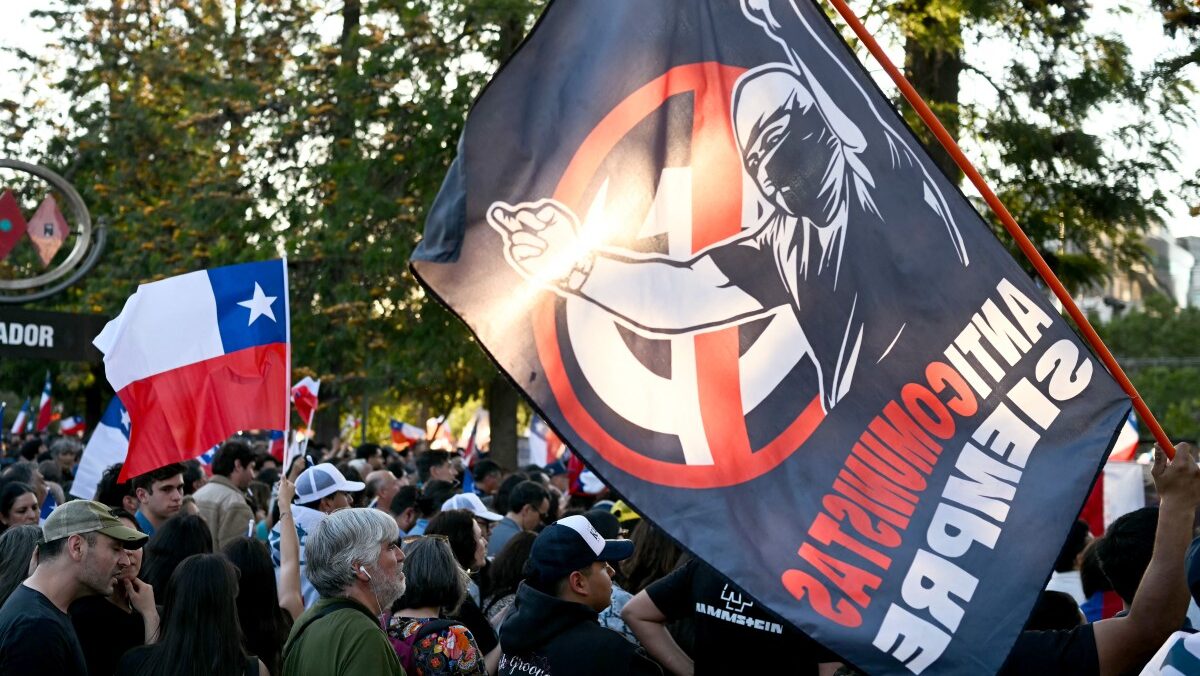
Supporters of Chile’s presidential candidate Johannes Kaiser of the Libertarian National Party attend his closing campaign rally in Santiago on November 12, 2025.
Marvin RECINOS / AFP
“If the European Union starts to consider democratically elected governments illegitimate simply because they do not share the dominant political line in Brussels, then the problem is no longer Viktor Orbán.”
Juan Lehuedé Donoso is a Chilean political analyst and commercial engineer. A professor of finance and business policy, he has extensive experience as a manager and managing partner in various construction companies. He spoke with europeanconservative.com about the upcoming Chilean elections on Sunday, the challenges facing the country, and the top candidates vying for the presidency.
Jeannette Jara embodies pure, hardline Marxism-Leninism. In my opinion, candidate Jara is a wolf in sheep’s clothing, hiding her true totalitarian intentions, which have not changed within the Chilean Communist Party since the 1950s. On the other hand, Evelyn Matthei symbolizes the social democracy of “Piñerismo,” a movement associated with former President Sebastián Piñera. This social democracy responds to the interests of the hegemonic economic groups in Chile and is clearly infected by progressivism and globalism. The Chile Vamos coalition, which supports Matthei, has collaborated with left-wing governments and also with Gabriel Boric’s Marxist government. Matthei’s team is essentially the same one that governed alongside Sebastián Piñera in his two previous administrations (2010–2014 and 2018–2022).
José Antonio Kast embodies the ‘new conservative right’ and presents himself as a free-market option, in contrast to progressive ideas. He has never been in government, although this is the third time he has run for office, after being defeated by Gabriel Boric in 2021. Finally, Johannes Kaiser, the fourth candidate, represents economic libertarianism and conservative nationalism in terms of values. He advocates for the least possible state intervention in all areas. I believe that Kaiser could obtain more votes than Matthei in the first round and even surpass Kast and move on to the second round, although this is not very likely.
I believe that the communist candidate will be defeated in the second round by any of the other candidates, whether it be Kast, Matthei, or Kaiser. The result of the second round should not exceed 35% support for Jara. The fact that there is a communist candidate running for president is certainly an anomaly on the international stage. Her emergence is due, in part, to the Gramscian Marxist indoctrination that has existed in Chile in schools, universities, and the media, mainly since the fall of the Berlin Wall. Chilean elites have never noticed the advance of cultural Marxism and have never resisted or rejected this indoctrination with ideas from the right. Nor have they invested money in financing think tanks or media outlets. As a result, the Chilean left, despite its resounding failure under Allende’s government and the repeated failures and misery caused by communism around the world during the 20th and 21st centuries, still enjoys the support of around 30 to 35% of the population today. Chileans should learn the lesson of what it means to neglect and fail to finance the culture war.
The government of Gabriel Boric, supported by the coalition of the Frente Amplio and the Communist Party, has been a real catastrophe for Chile. Boric’s ‘legacy’ is one of destabilization, infiltration, dismantling, and corruption of state and municipal institutions. Chile currently has a total fiscal debt of close to 60% of GDP, and the country is on the verge of default. The economy is stagnant, while housing and public services are collapsing as a result of uncontrolled immigration caused by the open borders policy. In the area of health, there are more than three million people on waiting lists, 45,000 patients awaiting urgent surgery, and between 35,000 and 40,000 people die each year due to lack of medical care. This is an unprecedented situation in Chile’s history. In Chile today, there is a stock of 175,000 homes that are finished and ready for delivery, but they cannot be purchased due to the extreme cost of mortgage loans, which makes them inaccessible to most Chileans. At the same time, the country faces a deficit of 850,000 homes. Construction has practically come to a standstill due to capital flight, with funds being invested in other countries.
The security crisis is equally critical: the Carabineros police force is severely weakened in terms of both numbers and equipment, and lacks the political backing to act. Chile has never experienced such levels of violence and insecurity as it does today, and organized crime and drug trafficking have grown stronger in many parts of the country. The Carabineros are completely overwhelmed by the situation, and Boric’s government has demonstrated a pro-crime stance, both in its legislative actions and in its weak policing. Likewise, there has never been so much corruption and theft within the state, and institutions have been unable to stop this situation. In my opinion, Boric’s government is a government of incompetents, thieves, and irresponsible individuals. All of its actions have been detrimental to the interests of Chileans and the common good. In that sense, Boric has fulfilled his promise to end the “neoliberal model.” If the institutions function under the new government, Boric and several of his collaborators should be investigated, prosecuted, and sentenced to prison.
The ‘new constitution’ that was put to a referendum on September 4, 2022, and was overwhelmingly rejected, proposed completely changing the entire Chilean institutional framework and transforming the country into a Castro-Chávez model of 21st-century socialism, with a strong indigenous component and all powers handed over to the state. They attempted to transform Chile into a mixture of Cuba, Venezuela, and Bolivia, without any consideration for its constitutional history since 1833, disregarding our tradition and our way of life. For these reasons, the Chilean people dubbed this proposal ‘El Mamarracho’ [the monstrosity],a very derogatory adjective in Chile.
The current state of the rule of law can be defined as solid in terms of its structure but very fragile in practice, given the irresponsibility and weakness shown by the executive, legislative, and judicial branches over the last few decades. Formally speaking, the Constitution and laws are in good shape, but the actions of the authorities are clearly deficient. We hope that this situation will change with the future government, starting in March 2026.
There are some similarities between the principles and programs of Johannes Kaiser’s National Libertarian Party and Javier Milei’s La Libertad Avanza party. I believe that La Libertad Avanza’s economic approach is closer to Rothbard-style anarcho-capitalism, while the National Libertarian Party is closer to the positions of Hayek and Mises, who advocate for a small state and the strengthening of the business sector, especially entrepreneurship. In terms of social and geopolitical policies, I do not see any significant differences worth highlighting.
The misnamed social uprising of October 2019 was neither spontaneous nor caused by social discontent, as the Left has claimed. What happened in October 2019 was a failed coup attempt, planned, financed, and executed by the Chilean far left (PC and Frente Amplio) and supported by the Sao Paulo Forum and the tyrannies of Cuba and Venezuela. This coup attempt froze the economy and investments, caused incalculable losses in state and private infrastructure, serious damage to the police forces (5,000 police officers injured), and widespread demoralization of citizens and productive forces. In addition, the damage to institutions has been enormous. Until the perpetrators are investigated and punished, Chile will not be able to move forward and return to progress. There was tremendous cowardice on the part of President Piñera, his team, and his coalition, which led to two constitutional processes that sowed uncertainty and brought progress to a standstill. The country has deteriorated in every way since October 2019.
There is no ‘Mapuche conflict’ in the Araucanía and neighboring communities due to alleged ‘historical grievances’ among the Mapuche people. In my opinion, this narrative is completely false. What we have here is terrorism supported by foreign governments (Cuba, Colombia, and Venezuela) and guerrilla groups such as the FARC, the ELN, and Hezbollah, which seek to capture territories to carry out drug trafficking and organized crime, as well as to enrich themselves through the mineral resources present in the area. These are relatively small paramilitary groups, but they are well-organized and well-equipped. The problem persists because these groups have not been confronted in the last 25 years. We hope that the next government will take action and confront these paramilitary forces militarily, neutralize them, prosecute them, and convict them. Those who do not surrender or turn themselves in to the authorities should be treated as internal enemies and, consequently, eliminated. It is a very complex problem, but it has a simple solution: an attack with the full force of the state.
It is very true that Chile, along with Mexico and Argentina, are the most ‘progressive’ countries in Latin America. This political and social movement promotes the third way in politics: extreme feminism, gender ideology, comprehensive sex education, the idea of accepting ‘diversity by law,’ equality, and the narrative of struggle between perpetrators and victims, the intersectionality of victimhood, as well as the thesis of ‘climate change’ and environmental damage caused by humans, in addition to the new doctrine of ‘new human rights,’ has caused Chile a great deal of damage in all areas.
The Left and the Piñeraist Chile Vamos joined the UN’s disastrous 2030 Agenda almost twenty years ago, implementing a series of laws and public policies that have damaged both the economy and the psyche and common sense of Chileans, who have become increasingly manipulable in the face of these ideas, which I consider to be ideological garbage and products of clear totalitarian interests and domination driven by the great powers and corporations. These policies seek to weaken our nation-state, imposing regulations, obligations, and prohibitions that leave us easy prey to their desire for domination. We need the next government to put an end to all agreements with the UN and all of its associated aberrant institutions in order to fully recover our sovereignty.