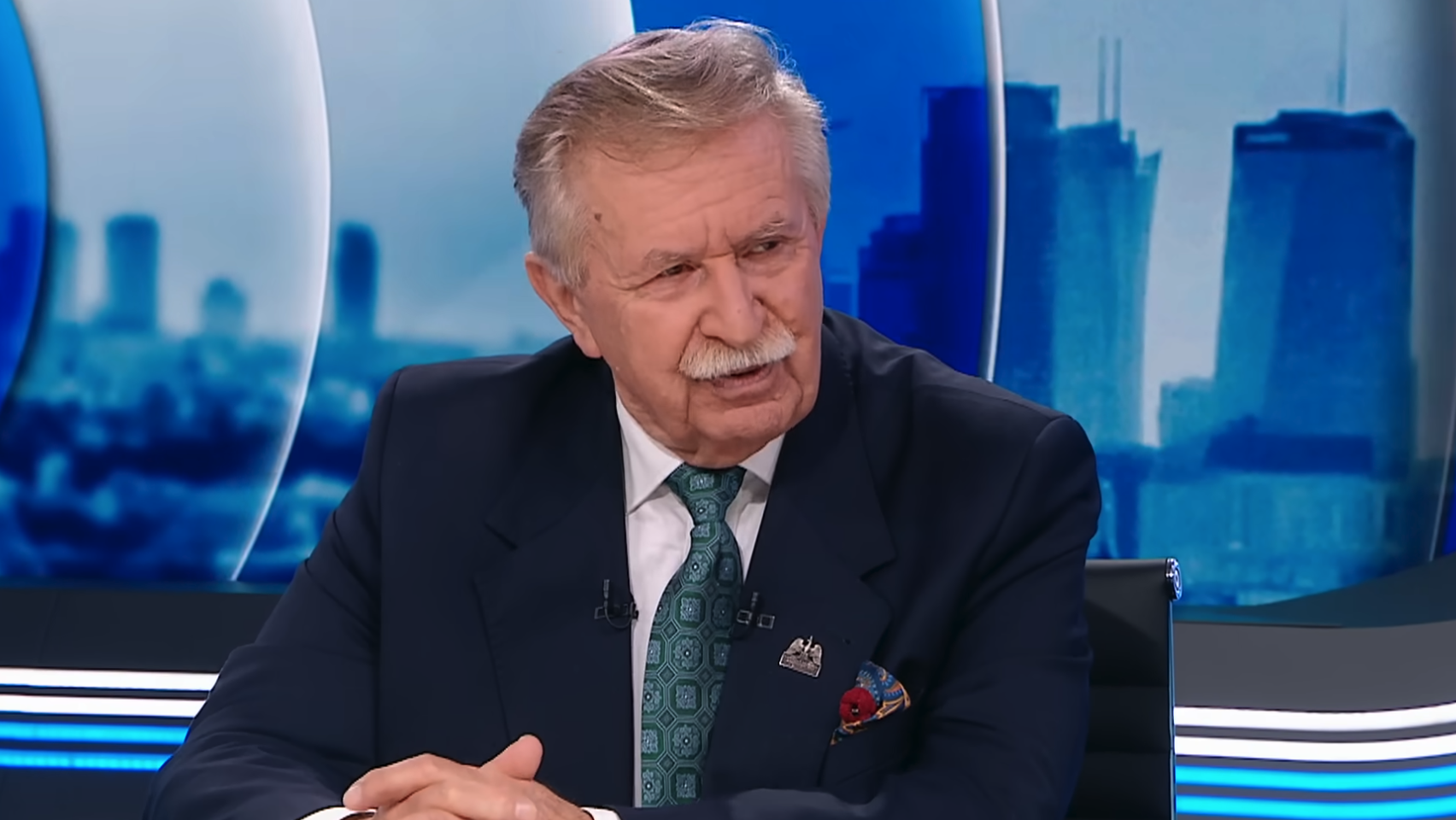
General Leon Komornicki
Screenshot, YouTube, polsatnews.pl
“If the European Union starts to consider democratically elected governments illegitimate simply because they do not share the dominant political line in Brussels, then the problem is no longer Viktor Orbán.”
Last week, during a Russian attack on Ukraine, many drones violated Polish airspace. At least three were shot down after Polish and allied aircraft scrambled in response to the threat. It was the most serious incident between Moscow and the North Atlantic Alliance since the start of the war. “This incident exposed our weaknesses,” General Leon Komornicki, one of Poland’s most highly qualified military commanders and a former deputy chief of the General Staff of the Polish Armed Forces, tells europeanconservative.com.
I am afraid not; quite the opposite. This incident exposed our weaknesses. It revealed the gap between the propaganda peddled by European politicians and military leaders and reality. It laid bare the lies we are fed. This case shows that we have a total collapse in terms of air defence in Poland. Meanwhile, the military command and politicians are having a picnic, celebrating and proclaiming themselves heroes. I congratulate them on their sense of humour.
For almost four years, there has been a war in Ukraine, including heavy use of drones. We are a frontline state. I would like to hope that our commanders and politicians noticed that, drew conclusions, and secured our country against such incidents. Instead, drones fly in, stroll through our airspace and land somewhere in fields in central Poland. I repeat: we had nearly four years to analyse the Ukrainian experience and build a safety buffer on the border through which no drone could fly so they could not threaten Polish citizens. Instead, there is chaos—planes are being sent after drones, and strategic-level commanders give orders to single pilots. What will happen if thousands of drones enter our airspace?
Anti-drone defence is simply general air defence. That means every soldier should be capable of shooting down such an object using personal weapons if he spots it. Additionally, with the equipment we have—even older, post-Soviet systems—we should build a buffer zone, rather than constantly announcing purchases of new kit that we do not know how to operate or coordinate. It also matters that we gave a lot of equipment we knew how to use to Ukraine, thereby weakening our own capabilities.
I will ask you a different question: why has Russia not destroyed the supply routes for Western equipment and weapons to Ukraine? After all, it has the ability to do so. The answer: it suits Russia that the USA and Europe, including Poland, send their weapons en masse to the Donbas, where they will be ground down. Russia is deliberately conducting the war in Ukraine as positional warfare. This is not due to its weakness but to its strength. The Russians’ aim is to physically neutralise the enemy’s living force, to induce as much emigration as possible and to exhaust the potential of Ukraine’s allies. Neither the U.S. nor—even less—Europe has an adequate defence industry capable of rebuilding that potential. Production would need to be increased threefold, and that is simply impossible. If Europe woke up now, it would need ten years to achieve it. This is part of the bigger picture, the crisis Europe faces politically, socially and militarily.
European NATO members don’t really have armies, with the exception of Turkey and, to a degree, Finland and Sweden. We—Poland—also lack capabilities, infrastructure and an industry comparable in potential to Russia’s. Europe disarmed because it believed in the “end of history.” I remember well, because I was still in active service, how in the 1990s strategies were developed that treated the army as essentially unnecessary. And the defence industry even more so; it was deemed a waste of money. The army? At most professional and export-oriented, serving as a showcase. Today we reap the fruits of that thinking. A ragbag of former policemen and non-commissioned officers from the Wagner Group drove the French out of Africa.
One of the most catastrophic mistakes a military person can make is underestimating the enemy. If I were the Russians, I would reward all those useful idiots who spread disinformation about Russia’s weakness. The cornerstone of Russia’s war machine is Russian society. That is Russia’s greatest strength—not the army. Society has been shaped over centuries to perform a servile role toward authority: to give everything so Russia is strong and the army wins. Russia or death. Therefore, counting on social unrest because someone’s standard of living worsens is naïve. That is to apply a Western European measure to a different mentality and different realities. If anyone hopes Russia will collapse because of sanctions, they are mistaken.
First of all, to recognise the geopolitical realities. We currently have a global balance of 2+2: two superpowers vying for primacy, the USA and China, and two major powers, India and Russia. Superpowers need at least neutrality from other major states to think about victory, so they court their favour. If we understand that, we can see how logical and consistent President Donald Trump’s actions are. Poland will never be a great power, but we can be a moderator, like Turkey, Israel, South Korea, or Hungary. These smaller states influence great powers so that their national interests are taken into account. How to do that? First, do not humiliate or abase ourselves or act as a senseless vassal who would give away the last shirt or commit national suicide for an uncritical ally. Second, read a much underrated text, the Washington Treaty. Article 3 says every NATO member will “maintain and develop its individual and collective capacity to resist armed attack”—in short, build strength. Be strong enough that no one finds it worth going to war with us.
The countries I mentioned have done exactly that. Their political leadership concluded that their task is not to be liked by allies but to defend the state’s and nation’s raison d’état. They secured technology transfers and built a domestic defence industry. Any power would think ten times before attacking such states because the losses would be enormous. We are not at that stage. It is worth stopping the posturing because we do not have the muscles. We must build our strength without brandishing sabres. Stop talking about shooting down missiles in Ukraine or sending troops there. It is not heroic to go and die. A military must not be a one-use force. The art is to ensure peace, peaceful development, and the survival of the Polish nation. Our aim is to be ready for war so that war does not happen.
The Americans will help us if we are strong and if they see we are prepared to defend ourselves. They will see that supporting us is not throwing money and equipment into the void. As for our Western European allies, their decline is so great that I would not count on them.
I said earlier the foundation of Russia’s strength is its society; that is a truism because society is the basis of any state’s strength or weakness. In Europe, the processes of societal destruction and demoralisation are advanced. They are embodied in polarisation, the lack of national cohesion, ideologies of so-called diversity, and the undermining of natural law. Europe is becoming the world’s rubbish dump. Russia does not allow that at home. Donald Trump is trying to reverse it and rebuild a society based on values. He understands that a society in which values mean nothing is a society doomed to slavery.
In my view, Ukraine is losing and will lose this war. Promoting the narrative that Zelensky and his circle might succeed is an illusion, a myth. The worst thing is to fall victim to such a myth, because then one neglects one’s own defence and repeats the nonsense that Ukraine is fighting for us.
The longer this war lasts, the greater the risk it poses to the countries on NATO’s eastern flank. There is a danger of incidents that may escalate. Ukraine will also try to draw us into the war through various operational configurations; that can never be ruled out. The continuation of this war also creates conditions for Russia to steadily erode our potential. Therefore, it is necessary to sit down at the table and end this war.