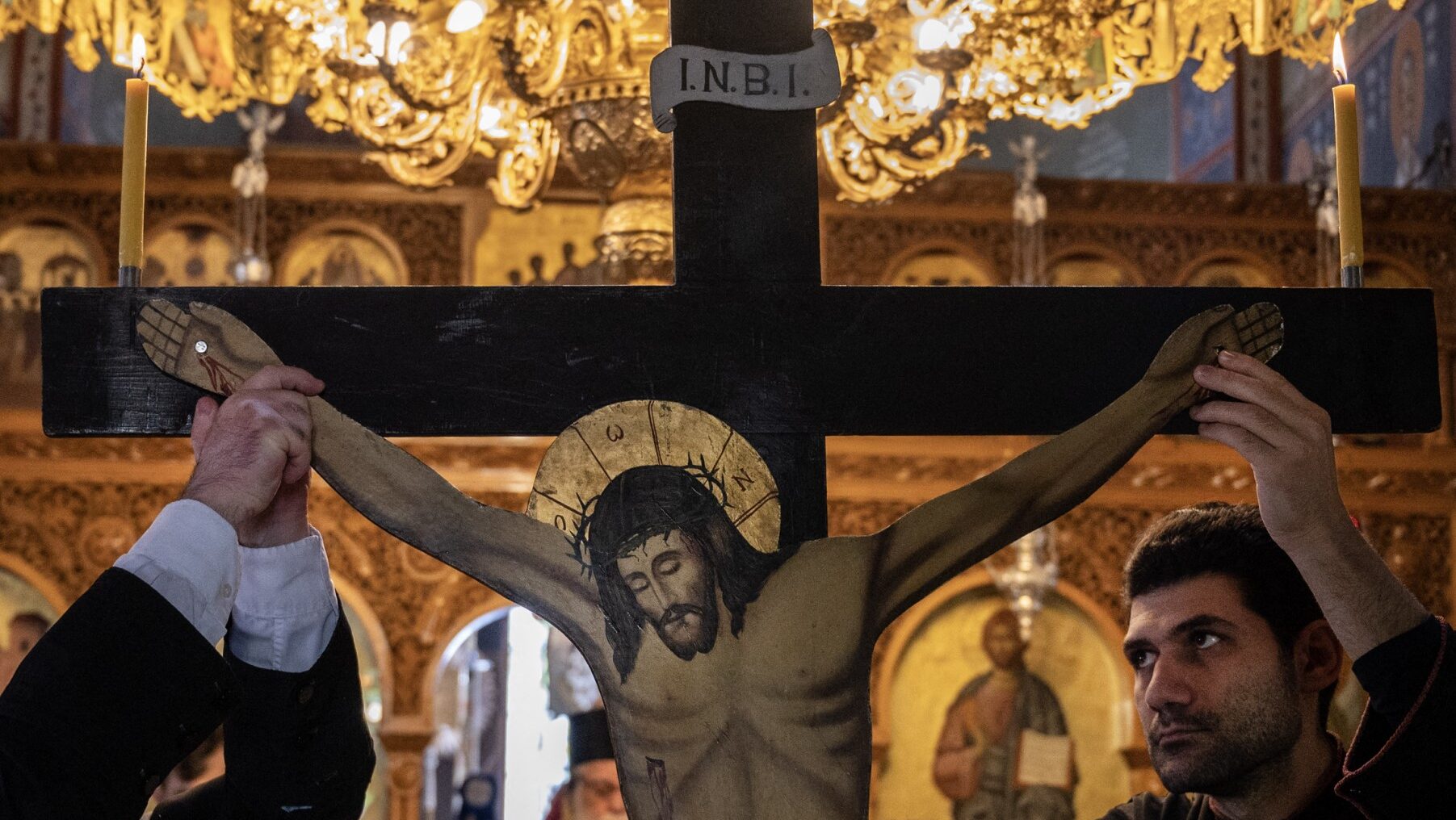
Greek Orthodox priests carry out the Apokathelosis, the removal of Christ’s dead body from the Cross, which forms a key part of Orthodox Easter, in a ceremony at the Church of the Dormition of the Virgin in Penteli, northern Athens, on April 14, 2023.
ANGELOS TZORTZINIS / AFP
Christodoulos Molyvas is the head of the development and investment policy department of the Democratic Patriotic Popular Movement NIKI, often shortened to NIKI (“Victory”), a Greek conservative political party. It was founded by educator and writer Dimitris Natsios in 2019. In the parliamentary elections of June 2023, ten deputies from the party were elected to the Hellenic parliament in which it currently forms the 7th Parliamentary Group. The party has one member of the European Parliament, Nikolaos Anadiotis, who is not affiliated with any EU party group.
Its main programmatic positions are defined as “Faith, Fatherland, Family,” and some of the party’s policy ideas include the restructuring of education in Greek schools, supporting the Greek Orthodox Church, and the adoption of measures to solve Greece’s demographic problem.
“In the halls of Strasbourg, where Europe presents itself as the guardian of human rights,” Molyvas writes, “a quiet but systemic deviation recently took place.”
With Resolution 2643 (2026) [“For a ban on conversion practices”], the Parliamentary Assembly of the Council of Europe (PACE) [a human rights body separate from the EU, representing voters from 46 countries] did not merely attempt to regulate the social behaviors of Europeans, but to invade the most sacred and private space of the human being: religious conscience and free spiritual communication.
In paragraph 9.1.1, it stipulates that member states must ban these practices in “every setting… including religious and private ones.” The state now claims the right to place a thought-policeman inside the confessional.
A combined reading of the official texts (Doc. 16315) reveals a grim reality … Even if an adult believer voluntarily seeks the advice of their spiritual father, the resolution stipulates that the prohibition applies regardless of whether the individual has consented. This is the absolute devaluation of human freedom…
For NIKI, religious freedom is not a bureaucratic footnote, but the foundation of democracy. … How are human rights protected when free spiritual communication between a believer and a spiritual advisor is prohibited?
Molyvas talked to europeanconservative.com about the party’s platform, the importance of the Orthodox faith for Greece, and the demographic challenges facing Greece and, indeed, Europe.
NIKI is not a typical political party. It is a movement that seeks to restore the Romeosyne ethos—the traditional identity of the Greek people that balances personal freedom with community solidarity. We believe that Greece’s current challenges are not merely economic but deeply spiritual. Our vision is a model where the economy serves the human person and the sanctity of the family, rather than the other way around. We aim for a national rebirth that draws wisdom from our Orthodox heritage and the teachings of the Church Fathers to address modern global crises.
There is a growing tendency in European institutions to perceive tradition and faith not as foundations of culture, but as obstacles to a new, homogenized societal model. The targeting of Christian liberty stems from a desire to erase distinct identities. When the state attempts to police silent thoughts or peaceful prayer, it crosses a dangerous line from secularism into authoritarianism. They fear faith because it offers an authority higher than the state, and it fosters a sense of belonging that cannot be manipulated by political agendas.
An economy that forces young people to choose between their livelihood and their family is a failed economy. We believe that the market should serve the family, not the other way around. To restore financial confidence, we need a radical shift: tax relief must be directly linked to the number of children, and housing must be accessible, not a speculative commodity. The state must treat parenthood not as a ‘lifestyle choice’ but rather as a vital contribution to the nation’s future, rewarding it with tangible economic support.
Beyond economics, there is profound spiritual and cultural fatigue. We have shifted from a community-centric way of life to hyper-individualism. Modern culture promotes the ‘self’ over the ‘we’ and career success over the joy of raising a successor. There is a loss of hope and a devaluation of the sacred role of the mother. When a society stops believing in its own continuity and values comfort over legacy, demographic collapse is inevitable.
Replacing a population is not a solution. It is the admission of a nation’s defeat. A society is not just a collection of economic units that can be swapped; it is a continuity of history, language, and ethos. NIKI’s plan for a demographic renaissance is holistic. It involves aggressive financial support for the unborn child and large families, but it also looks outward. NIKI has established a dedicated department for Greeks abroad, aiming to reconnect with the millions of Greeks in the diaspora. We believe that strengthening the bonds with Hellenism worldwide is a crucial part of revitalizing our homeland, rather than relying on illegal migration to fill gaps in the labor market.
Education (Paideia) is not merely the accumulation of skills. It is the formation of character. Integrating Christian teachings fosters virtues like solidarity, sacrifice, and critical thinking, which are the antidotes to today’s confusion. Language and identity are inseparable from our faith and history. This is a priority for us; in fact, members of our party recently participated in a conference in Italy specifically focused on the Greek language. For parents dissatisfied with the current system, I suggest taking ownership of their children’s upbringing: create ‘schools’ within the home where the Greek language, history, and Orthodox ethics are taught by the family, ensuring our roots remain alive regardless of the formal curriculum.