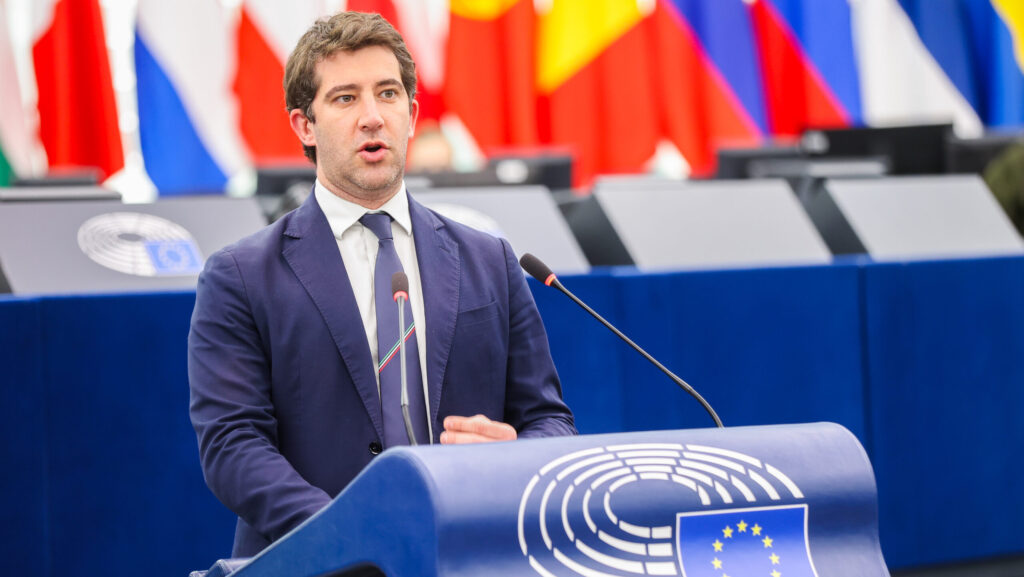
A person holds a Mexican flag outside the United States Citizenship and Immigration Services (USCIS) Santa Ana Field Office to protest Immigration and Customs Enforcement (ICE) raids finding illegal immigrants slated for deportation in Santa Ana, California, on June 9, 2025.
Patrick T. Fallon / AFP
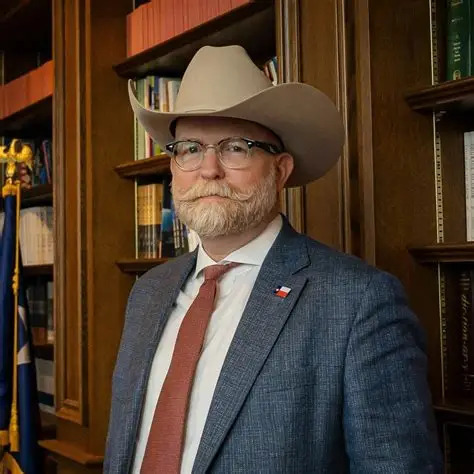
Joshua Treviño is the Chief Transformation Officer at the Texas Public Policy Foundation and Senior Fellow of the Western Hemisphere Initiative at the America First Policy Institute. An American political commentator, Treviño was a speechwriter and an international-health professional in the administration of George W. Bush, and a United States Army officer. He talked to europeanconservative.com while attending a conference in Spain on Hispanidad, a cultural and political concept that refers to the shared heritage, language, history, and identity of Spanish-speaking peoples, especially those with roots in Spain and Latin America.
There have been many positive changes, but the results will come in the long run. There are many elements to immigration policy reform, such as border security or deportations, but there is a fundamental and deeper factor, claimed especially by Vice President Vance: What is the meaning of the country, the meaning of the nation? So, you have to do the operational part in protecting the border, deporting illegals, or dealing with the damage that illegal labor does to American wages and jobs, to get to the point where you can really adjudicate what the immigration system is for, which in itself asks what the nation is for.
This is a question that has been avoided for a century of government by progressives in the United States and also in Europe. I just visited the UK, where the government is exceptionally repressive at this point, and there are a number of propositions circulating there in which the diagnosis is that the UK means nothing and that being English is in essence an inherently elastic category, like being American. The best example is France, where anyone can be French. It is the great lie that the French Left and republicanism told, that being French meant a set of political rights—a political proposition disconnected from history, heritage and real participation in the community. After almost two centuries, this experiment is coming to its natural end and its contradictions are evident.
It’s really an operational issue because there is no other alternative, but it is true that all this requires a strong state, capable of making decisions and with a national agenda. Ethnically, I am half Mexican, but there are different Mexican populations in the United States, and there are some, mainly recent immigrants, who are very radicalized and believe they have rights to the land. There are many more, including in my native state, Texas, who understand very clearly that the United States and its constitution must be defended, and that includes deporting illegals.
What the Left did not expect when they ignited the riots in Los Angeles was that the Trump administration would respond so forcefully because they are not used to standing up to a superior force. Also, politically, people liked to see the Trump administration, the government they elected, take back the country on their behalf, on behalf of Americans.
This is an interesting lesson for Europeans: it will not be easy to drive out the tens of thousands of radical Islamists who have settled on the continent, but it can be done if you lose your fear. When I was in the UK, I was shocked to come out of Mass on a Sunday night and see Islamist protesters with Palestinian flags basically insulting us for being Christians. There has to be a price for such behavior, and the ideal price is to catch them and send them back.
The point is that we should not have imported these people, that is the mistake we have made: we have divorced citizenship from meaning and unintentionally ended up in an extremely dangerous bifurcation where someone may be formally and technically an American, but is not fundamentally one. We see it in Zohran Mamdani [the Muslim Socialist chosen as Democratic nominee in the New York City mayoral primary] or Rashida Tlaib [a Progressive Palestinian-American U.S. congresswoman known for her vocal advocacy for Palestinian rights], and this is not an anti-immigrant sentiment: my own children are [immigrants], but they are imbued with the catechism of the United States; these people have never been despite having papers that say they are Americans.
There has been a lot of ignorance regarding Trump’s position, which is interesting because he has been very clear about his approach to wanting peace and being against war, but he has also been very clear since before the war that it is strength that generates lasting peace. It is often forgotten, especially by the isolationist side, that the reason Ukraine survived the initial Russian invasion was because President Donald Trump, in the years before, changed Obama’s policy and sent Javelin to Ukraine, with which the Ukrainians were able to stop the Russian advance. I don’t think Trump has moved from that fundamental understanding and that is why his statements about sending more weapons to Ukraine are consistent with what he did in his first term and are also consistent with what he did now.
Yes, I think there is. People often forget that things have happened over the last thirty years, but to me the key is in the coalition that Trump has put together: it is working class; it is ethnically diverse; it is dispersed across the country, but has a lot of strength in the Rust Belt states; it favors military force, although it is more skeptical of the use of that force; it is nationalistic and defends the America First agenda, and so on.
The question is: Who has generated such a coalition? In my memory, it is very similar to Richard Nixon’s coalition. But going even further back, it is very similar to the original Republican coalition of 1850-1860. It is very easy to look and see the “Free Soil, Free Labor, Free Men” principles of that party in today’s Republican coalition. I think the connection is very deep and that those who see a discontinuity, and I say this with all due respect, often start their analysis in the 1990s and that makes it impossible to have an understanding of what the Trump movement, the Republican Party, and the conservative movement represent.
My father is of Spanish descent and my mother is English, and to keep talking in terms of 16th-century enemies is stupid. When you think of Hispanidad in the record of thousands of years of history, you have to consider Spain and the Spanish as one of the most important cultures that has ever existed and with a significant importance for all mankind. Those who pretend to take that idea to the Russians are betraying their own heritage because it is an idea that can stand on its own and does not need foreign leadership to do so.
Hispanidad is above all a cultural bloc, and the attempt to try to enforce it from a geopolitical perspective or to create any kind of unitary policies will fail for the mere fact that Latin Americans will never accept Spanish leadership. For example, in Mexico the anti-Spanish sentiment is pathological and I would say quite hypocritical because every time a Mexican makes a lot of money he or she moves to Spain, as former Mexican presidents have also done.
We are not in the Golden Age, there is no war between Elizabeth of England and King Philip; the only way forward is to work together, we cannot buy this hostility which is completely false.