Matt Goodwin
@MCC_Brussels on X, 10 March 2026
Matt Goodwin is a British conservative political commentator and a presenter at GB News who recently unsuccessfully stood for election in the constituency of Gorton and Denton in a by-election following his nomination by Nigel Farage’s party, Reform UK.
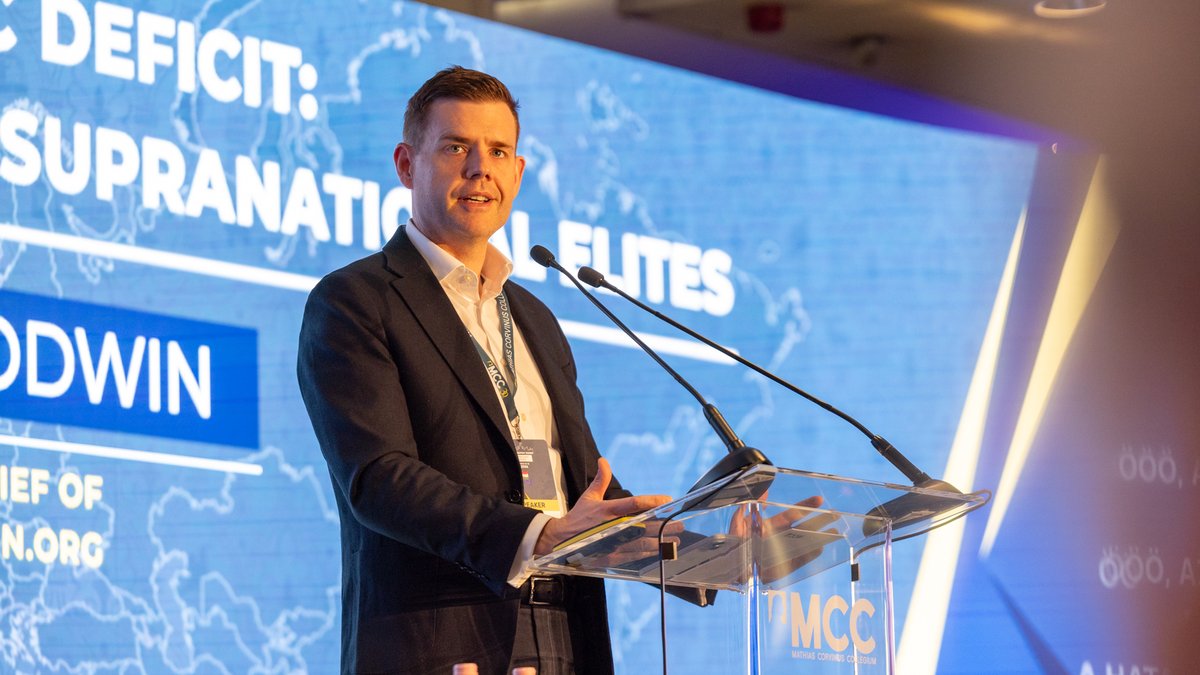
We spoke to Matt Goodwin on the sidelines of the MCC Budapest Summit on Reclaiming the West about the new reality in British politics, how a Reform UK-led government would tackle immigration, and how migration has transformed Britain into unrecognisability.
This was a parliamentary by-election in a very traditional Labour-held seat in an area of the country that had been Labour for 100 years. I stood as a Reform candidate and finished second, beating Labour into third. But the Greens won the by-election, and they did so largely, I would argue, through sectarian voting and mobilising Muslim block voting.
On the night of the election, we had an official report, an independent, impartial report by an organisation called Democracy Volunteers, who were let into the polling stations by the Electoral Commission, which is the official public body for monitoring elections. And what they observed was that in 68% of polling stations, there was evidence of family voting, which is illegal under British law, and it’s coercive voting, whereby a father or a husband essentially tells the rest of the family how to vote. They estimate that more than 12% of all voters in Gorton and Denton were influenced by family voting, which was up from about 3% at the 2023 local election.
So you’re looking at a situation where about one in eight voters were influenced by Muslim bloc voting, sectarianism. And we’ve known for decades that Labour have been openly mobilising clan-based networks in communities, but this time around it was the Greens.
I’d observed this on the campaign trail as a candidate because I’d seen leaflets in Urdu, leaflets in Punjabi, Ramadan cards, campaigning outside of mosques. The Greens basically threw everything at this campaign from the prism of being a sectarian political party.
So I think Gorton and Denton actually tells us a great deal about the wider pressures that are now bearing down on democracy in Britain. As we continue to experience mass immigration and demographic change, we are essentially importing political practices that look more at home in Lebanon or Sierra Leone or Pakistan than they do in Britain, the home of individual liberty and parliamentary democracy. So I am actually deeply, deeply concerned about the direction of travel.
What we should be doing, and what a Reform government should be doing, is clamping down on family voting, restricting postal voting to the elderly and the disabled, and we need to also end the practice of Commonwealth voting. Commonwealth voting is when you can vote in UK elections even when you are not a British citizen. About half of all voters in the area of Longsight, which was the most diverse part of the Gorton and Denton seat, were born abroad. Now, we either believe in notions of citizenship and national belonging and community, or we don’t. And I would argue that putting your democracy in the hands of people who weren’t even born in your country, and many of whom will not even be British citizens, is not the way democracy is designed to be.
Well, it’s a symbol of where the nation is heading. It is already happening in many other areas. We have sectarian, Muslim, pro-Gaza MPs in the House of Commons already. It is likely that we will see the same thing that we saw in Gorton and Denton play out in Birmingham, Bradford, Blackburn, Oldham, Manchester, London, and beyond.
The genie is out of the bottle. The question is, what are we going to do about it? The answer, aside from ending mass immigration and dramatically slowing the pace of demographic change, is a comprehensive package of electoral reforms. Because, to put it simply, we will not save our country unless we fix our democracy. And our democracy is being corrupted by the importing of cultures and practices that really have no place in modern Britain.
Well, Gorton and Denton was only the second time since 1945 that two parties other than Labour and the Tories finished in the top two spots at a parliamentary by-election. So we are seeing the rise of a new politics, a realigned politics. The Tories were nowhere to be seen, and we beat Labour into third place in one of their safest seats. So we are seeing some truly historic trends.
I think that this will continue because the old parties who have led us into this mess are intellectually, politically, electorally bankrupt. I think it’s over for those parties. The Labour Party is now under enormous pressure not just from the Greens but the independent Muslim pro-Gaza MPs and, to some extent, from what remains of the Jeremy Corbyn problem. Reform is now dominating the right of the spectrum. Restore Britain is a non-entity; it’s not a serious proposition.
Leave the European Convention on Human Rights, the ECHR. That would allow us to deport foreign criminals, and it would allow us to deport illegal migrants who are arriving on the small boats.
Repeal Tony Blair’s Human Rights Act, which enshrines the ECHR into domestic UK law.
Leave the post-1945 refugee conventions that were also used to essentially create and empower an activist class of lawyers.
Process asylum seekers offshore, away from the British people and away from the hotels and accommodation that they’re being forced to pay for.
Dramatically reshape our immigration policy.
End the era of low-skill, low-wage migration from outside of Europe that is culturally incompatible with our country and is undermining our country. If you’ve arrived post-2020 and you’re not making a net fiscal contribution to the country and you’re not speaking English, your visas will not be renewed and you’ll have to leave.
This is a fundamentally different proposition from the Uniparty, the Tories and Labour. And it is also about creating an environment that is very hostile to people who are not contributing to our national community.
Reform has said it will end social housing for people who are not British. They would dramatically slash foreign aid, overseas aid. No more welfare benefits for people who are not British. We are currently spending £10 billion a year on welfare benefits for people who aren’t British, and we’re spending £6 billion a year subsidising social housing for people who aren’t British. There’s £16 billion right there that can go straight into frontline public services, the NHS, schools, those sorts of things.
This is going to be ultimately about presenting to the people a different choice. You can carry on down this road of giving money to people who aren’t really from our community or have no intent, no serious desire to uphold and respect our community. Or you can start believing and supporting the principle of national preference. which is we put our own people first unashamedly, unequivocally. We say if you speak the language, you contribute financially and economically, you play by the rules, then Britain is going to support you the whole way. What we’re not going to do is keep supporting people who are not even from our community and who often, sometimes, hate who we are. We’re going to push back against that very hard.
I think we have a problem with integration across all communities. There are obviously lots of people from minority backgrounds who share our Christian heritage, who believe in Britain, and who are integrated. I think it is also true we have a lot of people who are consciously withdrawing themselves from what Roger Scruton would have called our home, our shared sense of “we.”
Much of the ruling class decided in 2010 that multiculturalism had failed. David Cameron said it. Nicolas Sarkozy said it in France, Angela Merkel said it in Germany. Nobody then created a successor to multiculturalism. And we’re now in this absurd situation where somebody like Suella Braverman can say a year ago that multiculturalism has failed, but the conversation is not ready to handle that. The public square is full of people who screech and scream whenever anybody challenges multiculturalism.
We’re still in a policy reality with multiculturalism that is pro-minority, anti-majority. So what it’s saying is if you belong to a minority identity, we will support you, we will defend you, we will promote you. But if you’re from the majority, we will stigmatise you. We will make it clear we think it’s problematic if you’re flying your flag, if you’re expressing pride in who you are. And it’s that two-tier multiculturalism that has run its course. That is what is dividing our society.
What I want to see us do as a country is get to a place where we celebrate the majority. Being British and English, speaking this language, having this culture which is based on individual liberty and free speech, and we’re not going to compromise it with blasphemy laws, Sharia courts, cousin marriage, expressing support for radical violent Islamists. If we are serious about maintaining who we are, we have to start drawing some lines around that community and say the era of tolerating people who don’t tolerate us has to come to an end.
That also will mean ultimately revisiting the question of citizenship, namely, who are we? I don’t believe you can become British or English simply by stepping foot on our territory and holding a piece of paper. Being part of the community also requires an emotional bond to who we are. It requires a form of integration, but it also requires believing in what Roger Scruton called the delicate spirit that defines a nation.
We have lots of people, unfortunately, who have been imported into our country who have no serious desire to respect or recognise that delicate spirit of who we are. They don’t respect free speech, women’s rights, our national history, our Christian foundations, our belief in individual liberty.
I think we’re entering a point where we are going to move away from multiculturalism and move into assimilation. That is ultimately the transition we’re going to have to make if we’re going to keep a country that we recognise as being the country that we come from and that our ancestors cultivated and crafted over generations.
Well, there’s a long list of things that you could be doing that we’re not doing. As an example: if you hold dual nationality and you’re involved in association with the grooming gangs, or you’re charged with child sexual exploitation, you should be deported. We should strip those people of British citizenship; they have dual nationality; they can go back to Pakistan or wherever they come from.
With regard to other people, what I’m saying is we create a hostile environment for people who are not integrating and playing by our rules. No more translation services in public services like the NHS and schools. We ban cousin marriage. We start to disrupt the clan-based networks that are feeding into politics and our culture. We ban and shut down Sharia courts. We have much greater monitoring and investigations into charities and their funding and Islamist networks in particular.
We perhaps start doing what the Danes are doing, and we start having forced mixing at school level with children, so we’re not having schools with 70-80% Muslim kids in them. We’re actually having mixed schools, and we’re not allowing segregation. Perhaps even adopting what the Danes have done with housing and saying we’re no longer going to have segregated neighborhoods that are composed almost entirely of Muslim households.
There’s a whole string of things we could be doing to make it clear that the era of excessive tolerance, of what Gad Saad would call “suicidal empathy,” the era of us destroying our nation in the name of showing empathy to others, has to come to an end. Because it’s the only way ultimately we will preserve who we are and what we’re about.
Many people, I think, can feel that the moment we’re in is actually no more just about policy. We are now in this civilisational moment whereby, within one generation, the place that we know of as Britain will not be Britain. If you just look at the demographic projections, by 2063 the white Brits will be a minority, by the 2070s the foreign-born will be an overwhelming majority of 60% plus, and by 2100, one-quarter of all adults and a third of young people will follow Islam. Now that nation, you can call it Britain, call it England, but it’s not going to look like anything we currently recognise.
That is not fear-mongering. It’s not scaremongering. It is using the government’s own demographic data and saying this is where we are. Since 1997, since the beginning of Tony Blair’s government, we have had more immigration into Britain in every single year than we had during the entire period between the Anglo-Saxons in the 5th century and the end of the Second World War. That is how historic and unprecedented what we are living through really is.