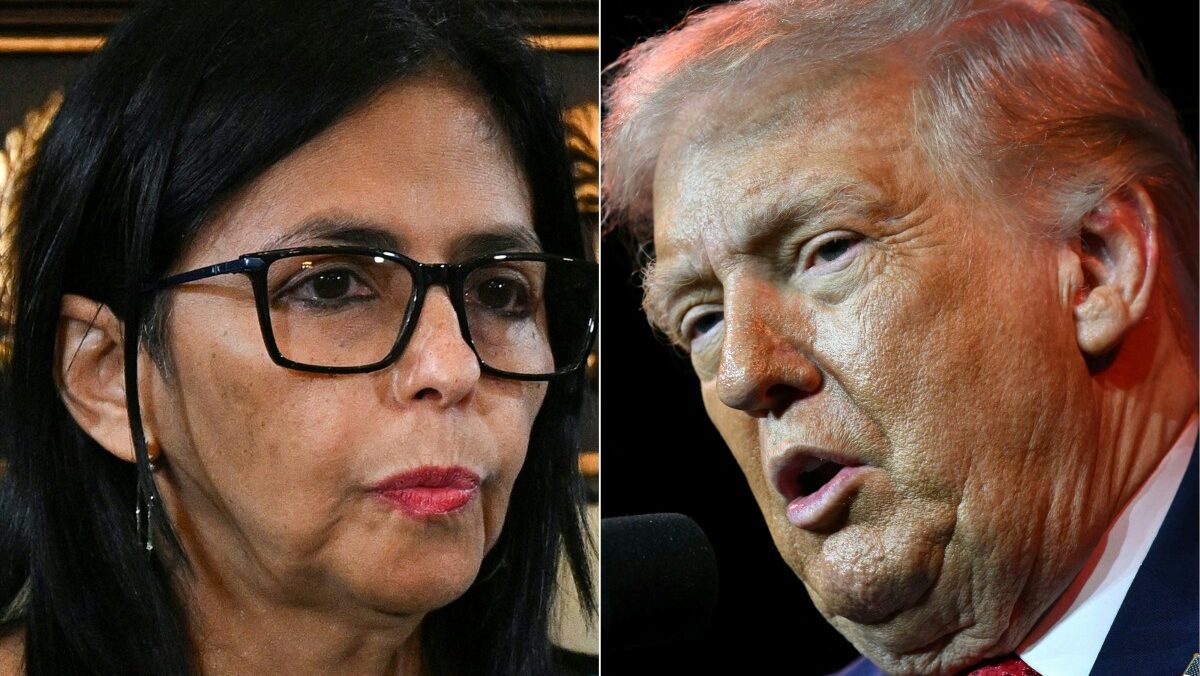
Venezuela’s Vice-President Delcy Rodríguez in Caracas on January 5, 2026 and U.S. President Donald Trump in Washington, DC, on January 6, 2026.
FEDERICO PARRA / AFP
Alejandro Peña Esclusa is a writer, analyst, and political consultant. He is a renowned expert on the Sao Paulo Forum, about which he has written four books. He was persecuted, imprisoned, and forced into exile by the Venezuelan regime.
On January 3, the United States carried out a large-scale military attack against Venezuela, capturing President Nicolás Maduro and his wife, Cilia Flores, in Caracas. We discuss what this military intervention means, and its consequences, for Venezuela and for the entire continent.
On the Left, from what I have seen, demonstrations have been organized in which the same discourse, the same lies, are repeated by people who are completely unaware of what has happened in Venezuela. For twenty-six years, there have been massive human rights violations, murders of young people, and all kinds of crimes that are well-documented by international organizations and have been denounced by Venezuelans living abroad. During all those years, the Left has remained silent. And now, when Maduro has been captured, they talk about the violation of international law.
Not to mention the numerous reports that point to Maduro as the head of a drug trafficking network, the Cartel of the Suns, responsible for shipping 20% of the cocaine consumed in the Western world. Venezuelan General Hugo “El Pollo” Carvajal, one of the founders of the cartel who is currently imprisoned in the United States, defined Maduro’s government as a “narco-terrorist organization,” and there was a $50 million reward for Maduro for drug trafficking. So we see that the Left is shamelessly defending a drug trafficker.
The United States is energy independent and does not need Venezuelan oil for its domestic market. However, it does not produce much heavy crude oil, which is what is extracted in Venezuela, and buys it from countries such as Mexico and Canada. Venezuelan oil can indeed lower the price of gasoline in the United States, but reducing this operation to an interest in oil is absurd.
Maduro is a drug trafficker who has turned Venezuela into a platform for the enemies of the United States: China, Russia, and Iran, and for all kinds of terrorist groups, including Islamic terrorists. He has been promoting illegal immigration to the United States and other countries, and his policies are responsible for a third of the population fleeing Venezuela. In short, he is a combination of everything that threatens the United States.
The reality is that what the United States has done was the only alternative. We Venezuelans tried all peaceful means: dialogue, concessions, protests that were met with gunfire, and we went to elections that were later stolen from us. We Venezuelans could not decide our future because the regime’s weapons prevented us from doing so.
Yes, I am convinced that this was the case because of the impeccable way in which the capture was carried out. They knew exactly where Maduro was and had all the information. Naturally, this causes a lot of fear within the regime.
I do not trust Delcy Rodríguez at all because she is part of the regime’s structure. I understand that the Trump administration believes that someone from the Cártel de los Soles, from Chavismo, should be in charge of dismantling its own structure and finally handing over power. There are several alternatives here. Delcy Rodríguez may want to deceive the United States, but President Trump has already threatened her with suffering the same fate as Maduro if she does not cooperate. Another possibility is that Delcy wants to but cannot because she does not have complete control and there are leaders such as Diosdado Cabello who do not want to negotiate with the United States. The truth is that, so far, there have been no significant changes, and the regime continues to behave like a dictatorship.
The truth is that things are already happening. Apparently, the FARC is moving to Colombia, and there are reports that Cubans are removing their people from the country after 32 Cubans from Maduro’s inner circle were killed. In other words, those who felt protected by Maduro are leaving Venezuela. On the other hand, Colombian President Gustavo Petro feels threatened and is acting erratically, calling for demonstrations and doing practically the same thing Maduro did.
Maduro has all the information on the Cártel de los Soles’ relationship with other leaders of the Sao Paulo Forum and even with Spanish politicians such as José Luis Rodríguez Zapatero and Pablo Iglesias, so his arrest could cause a real political earthquake.
In general, there is great joy at Maduro’s capture. We consider this to be an act of justice because Maduro has caused enormous damage to the country and suffering to many people. But at the same time, we are aware that the problem is not solved. There is no certainty or confidence that Delcy Rodríguez will be able to carry out what I have called a surrender process, that is, that the Cartel of the Suns will hand over power. There are no guarantees that this will happen.
At this point, political prisoners should have been released and there should be no more arrests, but the regime continues to put people in jail. What is happening is that the economy is paralyzed, there is a shortage of food and medicine, and there is already a humanitarian crisis. There must be changes, and soon, to restore the economy and public services. Delcy Rodríguez has only a few days to show that she is willing to surrender and hand over power. That’s why I don’t know if this transition will work. In the long run, the leader recognized by the Venezuelan people is María Corina Machado, but for her and many other exiles like me to return to Venezuela, all armed groups must first be dismantled, including the military involved in criminal activities, because her safety and ours is not guaranteed.