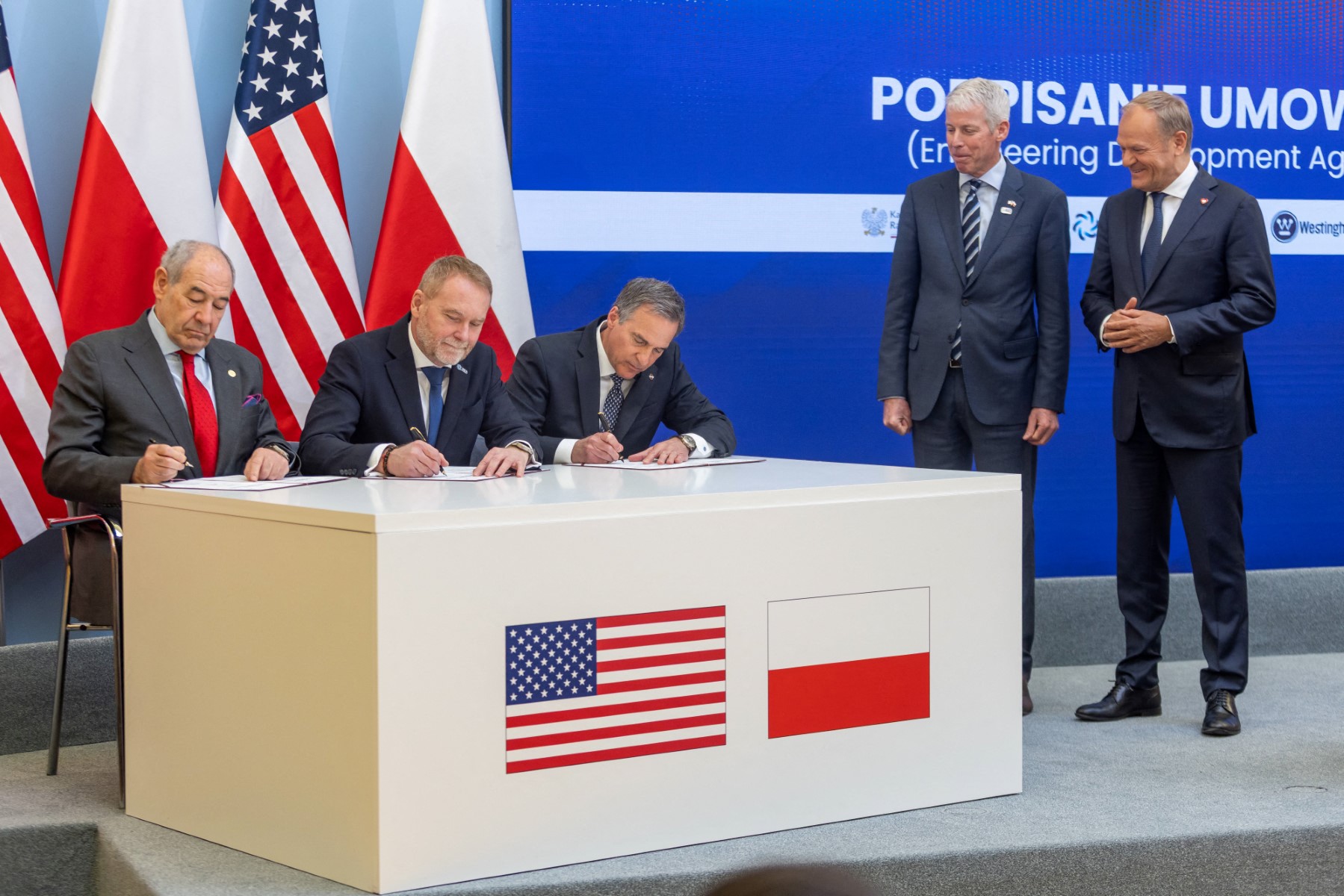
Polish Prime Minister Donald Tusk (R) and U.S. Secretary for Energy Chris Wright (2R) watch as representatives from Bechtel Corporation’s Craig Albert (C), Polskie Elektrownie Jadrowe’s Piotr Piela (2L), and Westinghouse Electric’s Dan Lipman (L) sign an agreement related to the construction of Poland’s first nuclear power station.
Wojtek RADWANSKI/AFP.
Construction of Poland’s first nuclear power plant is set to begin following the European Commission’s approval of a €14.2 billion (60 billion PLN) state aid package. The project—located on the northern Baltic Sea coast—will feature three reactors with a total capacity of 3.75 gigawatts (GW) and is scheduled to start operating in the second half of the 2030s.
Polish state-owned company Polskie Elektrownie Jądrowe (PEJ) will lead the construction, collaborating with U.S. firms Westinghouse, which provides the technology, and Bechtel as the main contractor. The European Commission confirmed that Poland meets European Union requirements, noting such measures as reducing the direct price support period from 60 to 40 years and requiring any excess profits to be shared with the state.
The aid package will cover about 30% of the total project cost, with the remainder financed through loans from domestic and foreign financial institutions, fully guaranteed by the state. U.S. financing bodies, including the International Development Finance Corporation and the Export-Import Bank, have already pledged support.
The project plays a central role in Poland’s strategy to decarbonise electricity production on which to date, under the Tusk government, limited progress has been made. Despite plans for energy transition, over half of the country’s electricity currently comes from coal—the highest share in the EU.
The plant will also complement a second planned nuclear facility under the Polish Nuclear Power Programme (PPEJ), with a combined capacity of 6 to 9 GW.
The European Commission approved the project under EU state aid rules, confirming that the plant will receive a two-way contract for difference to ensure stable revenues over 40 years. Poland has notified the Commission that the total capital expenditure is expected to reach around €42 billion (178 billion PLN), with the state covering debt guarantees and providing an equity injection.