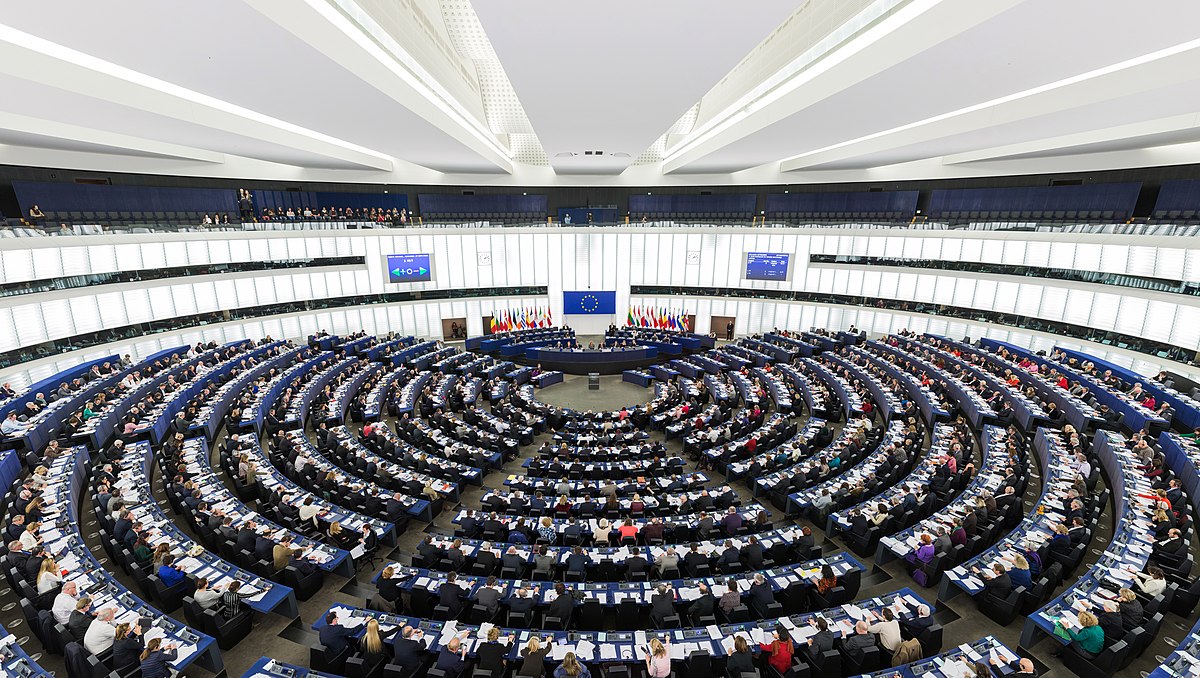
The Hemicycle of the European Parliament in Strasbourg during a plenary session.
On Thursday, November 13, the European Parliament (EP) adopted its position on the European Commission’s proposal to amend the European Union Climate Law, establishing a new intermediate and binding climate target for 2040: a 90% reduction in net greenhouse gas (GHG) emissions compared to 1990 levels.
MEPs also want the Commission to review progress every two years, taking into account the latest scientific data, technological developments, and the EU’s global competitiveness.
The review would assess, among other concerns, the status of net carbon removals across the EU compared with what is needed to reach the 2040 goal. They will also assess any emerging challenges and opportunities to strengthen industrial competitiveness. It would also consider energy price trends and their impact on businesses and households.
Depending on the outcome of this review, the Commission could propose amendments to the EU Climate Law, which might include revising the 2040 target or introducing new measures to reinforce the supporting framework—for example, to safeguard competitiveness, prosperity, and social cohesion within the Union.
The text was adopted by 379 votes to 248, with 10 abstentions, revealing significant divisions within the EP.
Anna Zalewska (PiS/ECR), right-wing Polish MEP, posted on X:
The Green Deal is accelerating! Brussels has decided to extinguish the fire consuming the European economy with gasoline.
The proposal has drawn heavy criticism, particularly from the right-wing political groups.
Mateusz Morawiecki, conservative former Polish PM slammed the adopted proposal as “suicide of the European economy.”
Austrian MEP Roman Haider (FPÖ/PfE) also described it as “a catastrophe for Europe.”
Czech MEP Ondřej Knotek (ANO/PfE) argued that Europe’s main global competitors are not following the same approach, thereby putting the EU at a competitive disadvantage.
In a statement shared on X ahead of the vote, the ESN group declared that it will stand firmly against Brussels’ overreach.
We support only what strengthens safety, prosperity, and national sovereignty.
Lukács Fux is currently a law student at Pázmány Péter Catholic University in Budapest. He served as an intern during the Hungarian Council Presidency and completed a separate internship in the European Parliament.