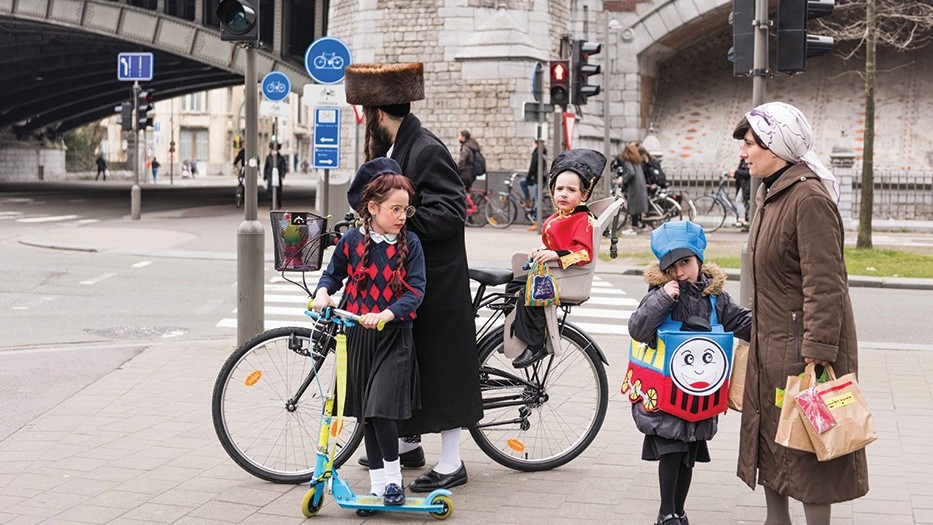
A Hasidic Jewish family dressed in costumes for Purim in Antwerp, Belgium, March 24, 2016.
jewishvoicesnj.org
The Mayor of Antwerp, Els van Doesburg, has confirmed that federal police officers will continue to assist the Antwerp Local Police Service in securing the city’s Jewish Quarter. The announcement follows Interior Minister Bernard Quintin’s earlier plan to withdraw federal officers from the area from January 1, 2026.
Speaking on VRT Radio 1, Mayor Van Doesburg stressed the importance of the federal police presence. “Security in the Jewish Quarter is ensured by federal officers together with officers from the local police service. It is a fifty-fifty split between the federal and local police. Withdrawing the federal police officers would mean that half of the total number of officers deployed would suddenly go,” she said.
Quintin defended his initial decision, stating that the federal police assignment had always been temporary, and that soldiers would soon be able to take over these duties under a new law. Following discussions, the minister agreed to maintain the current deployment until military personnel can be assigned.
Belgian authorities have confirmed that police protection for Jewish neighborhoods and sites in Antwerp will remain at current levels. Jewish communities have welcomed the decision as a key measure for community safety. The European Jewish Association (EJA) recalled that Jewish communities across Europe and elsewhere have been repeatedly targeted in terrorist attacks, referencing incidents in Brussels, Halle, Pittsburgh, Manchester, and most recently in Australia.
“These acts show that antisemitic violence is not local, isolated, or spontaneous, but part of a broader extremist threat that requires coordination, vigilance, and determination at all levels of government,” the association said.