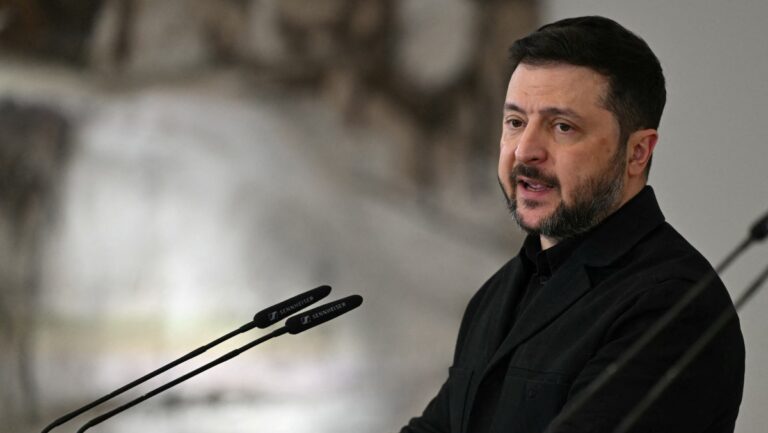
Belgium’s Interior Minister Bernard Quintin (2nd L), escorted by police, arrives at the Clemenceau metro station following a shooting, in Brussels on February 5, 2025.
Nicolas Tucat / AFP
Belgian Interior Minister Bernard Quintin announced that the country’s National Security Council is to hold an extraordinary meeting on Thursday, November 6th, after repeated drone incidents in Belgium’s airspace that raised serious security concerns.
In recent weeks, there has been an increase in the number of airspace intrusions not only in Belgium but also in several other European countries. Drone sightings were recorded in the Czech Republic, Estonia, Norway, Denmark, Germany, Poland, and Spain, among others.
On Tuesday, November 4th, arrivals and departures at Belgium’s busiest airport, Brussels, had to be suspended for several hours. The airspace had to be closed not only over the capital but also over Liège, leading to flight cancellations, delays, and diversions.
The chaos was not limited to these two areas, however. In the Flemish city of Diest, police and the military spotted four drones at a nearby military airport. Sightings of unidentified drones had occurred at several military bases over the weekend, too, including over the base where Belgium’s F-16 fighter jets are stationed and where—according to reports—American nuclear weapons are stored.
Belgian Defense Minister Theo Francken told a parliamentary committee on November 5th that the incidents in Belgium appeared to have been coordinated to cause disruption, with large drones flying in formation.
This is consistent with hybrid techniques seen in other countries. This is not just someone accidentally flying a drone over a military facility or airport. .. There are many signs that this was organized in a very structured way.
The Belgian government has not said who it believes is responsible for the drone incursions. Francken told members of parliament that Belgium does not intend to invoke Article 4 of NATO, which allows members of the transatlantic alliance to consult on security threats.