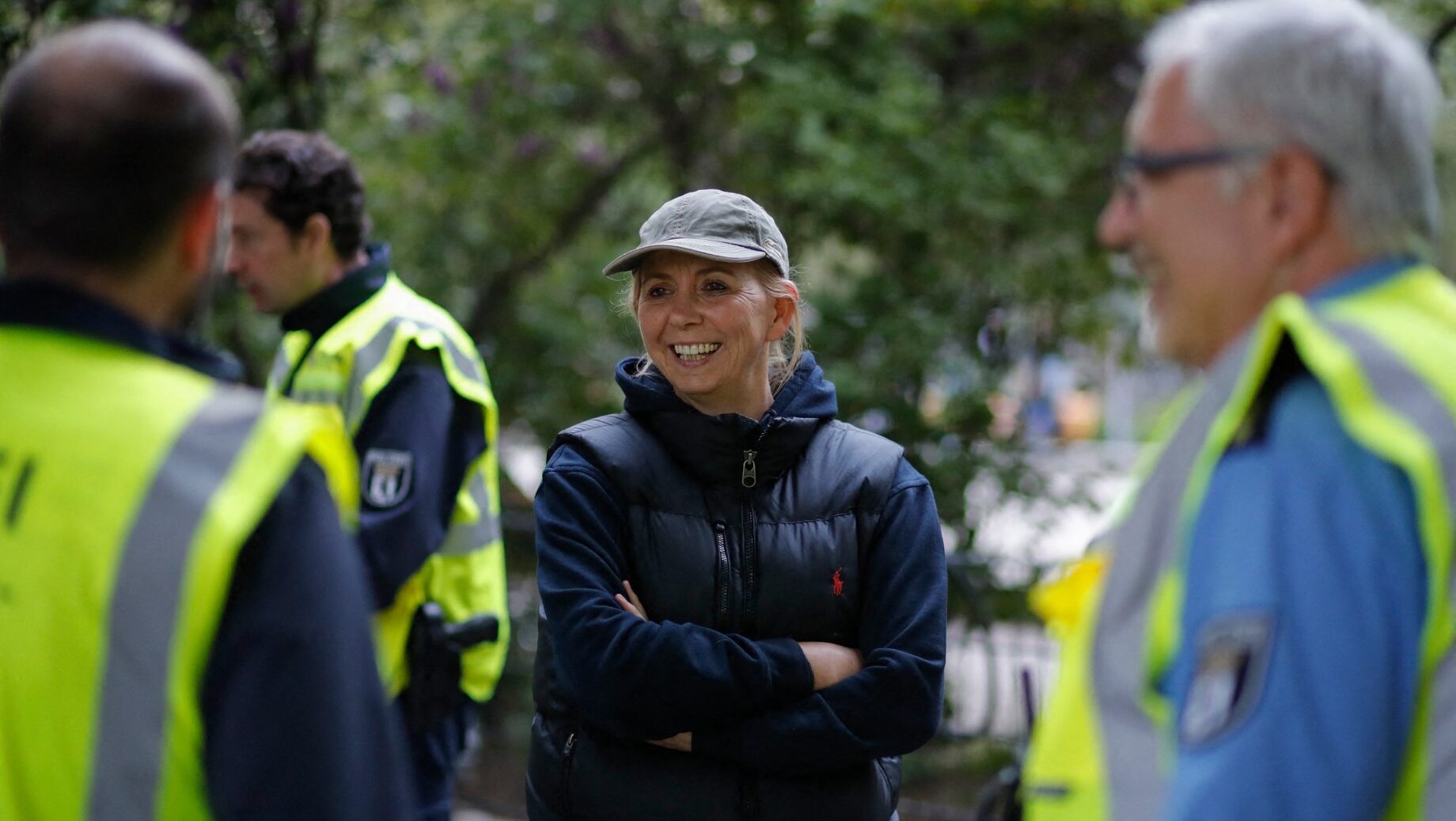
Berlin’s Police Chief Barbara Slowik (C) in 2020.
Odd ANDERSEN / AFP
Berlin’s police chief has warned that far-left extremists continue to pose a serious and sustained threat to the German capital’s critical infrastructure, following an arson attack on the power grid that left around 100,000 people without electricity and heating for days.
Barbara Slowik, Berlin’s police president, said the attack underscored a real and ongoing danger from loosely connected far-left networks targeting essential services. Speaking to Welt am Sonntag, she urged institutions and the public to prepare for the possibility of further sabotage.
Slowik said the attack was not carried out by a single organised group but by “loose structures” operating under changing names to obscure responsibility and frustrate investigations. An anonymous online claim of responsibility was published under the name “Volcano Group,” a label that has been used for more than a decade by far-left saboteurs and does not refer to any fixed organisation.
She welcomed the decision to transfer the investigation to the Federal Prosecutor General and the Federal Criminal Police Office, saying the scale and professionalism of the attacks had exceeded the capacities of a state-level authority. According to security officials, the perpetrators demonstrated detailed knowledge of sensitive points in Berlin’s energy infrastructure and left few forensic traces.
Following the attack, police stepped up visible and covert protection at particularly vulnerable facilities. Slowik stressed, however, that such measures were only a temporary solution. She called on energy providers and other operators of critical infrastructure to strengthen their own security, warning that the blackout had shown “how vulnerable our supply systems are.”
Rejecting speculation about foreign involvement, Slowik said the attacks were overwhelmingly the work of domestic extremists who use Berlin as a base.
Acknowledging the limits of law enforcement, Slowik said it was impossible to prevent every attack and urged greater resilience across society. “Everyone should be prepared,” she said, “including for the possibility that the next attack affects us all.”