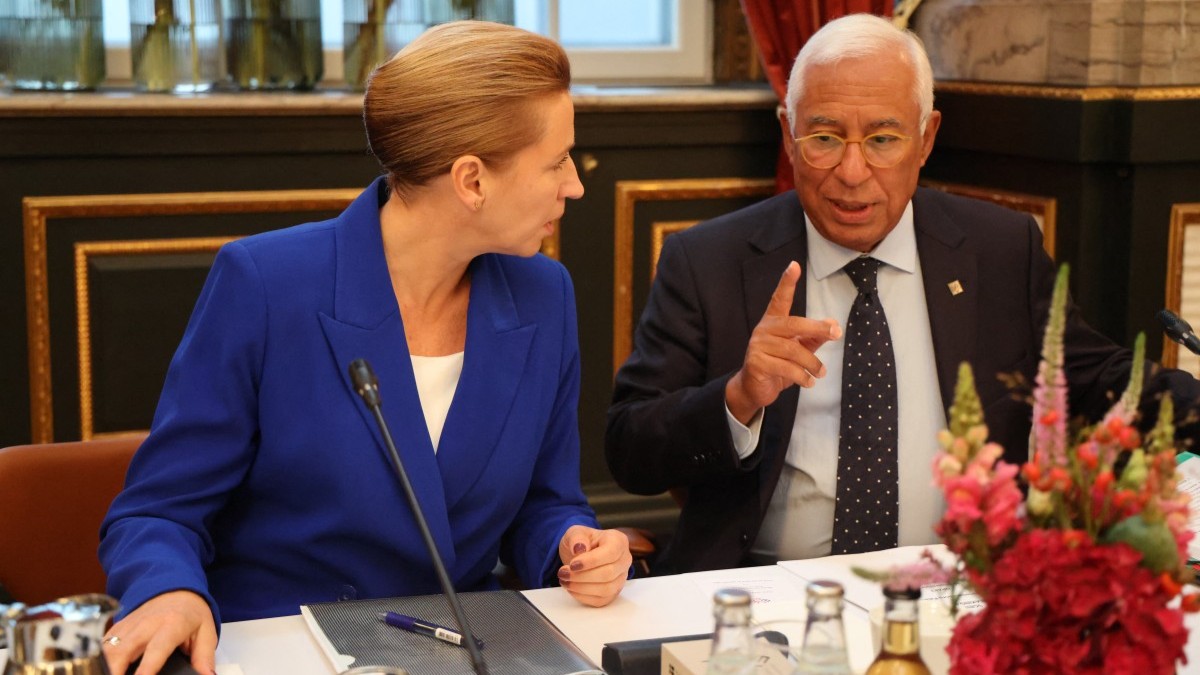
Denmark’s Prime Minister Mette Frederiksen (L) and European Council President António Costa talk prior to the start of an Informal Meeting of EU Heads of State and Government at Christiansborg Palace in Copenhagen on October 1, 2025.
Ludovic Marin / AFP
European Union leaders meeting informally in Copenhagen on Wednesday, October 1st voiced “broad support” for new defence initiatives, including a “European drone wall”—while debating a controversial plan to use frozen Russian assets to fund loans for Ukraine.
The gathering, hosted by Danish Prime Minister Mette Frederiksen, came after a series of airspace violations above four EU member states. Frederiksen argued that Europe must learn from Ukraine’s battlefield innovations:
We need to strengthen our production of drones, of anti-drone capabilities … to neutralise intrusion from outside.
European Commission President Ursula von der Leyen described the incursions as “part of hybrid war tactics” that required “a strong and determined reaction.” The Commission is expected to present a defence roadmap, Readiness 2030, later this month, setting capability targets for member states.
Alongside defence, leaders considered a Commission proposal for a so-called “reparations loan” to Kyiv, worth up to €140 billion and backed by Russia’s frozen assets, largely held at Euroclear in Belgium. Von der Leyen stressed the scheme “does not seize the assets” but would allow Ukraine to repay only once Moscow agrees to compensation.
Belgian Prime Minister Bart De Wever has raised legal and financial concerns about Brussels bearing disproportionate risk.
Support for Ukraine’s EU accession was also discussed. Frederiksen noted that one member state continues to oppose opening negotiations. Hungarian Prime Minister Viktor Orbán confirmed his veto, saying he resisted attempts to bypass Budapest, while also warning that without urgent reforms on competitiveness and energy, “the EU economy will collapse to its knees.”