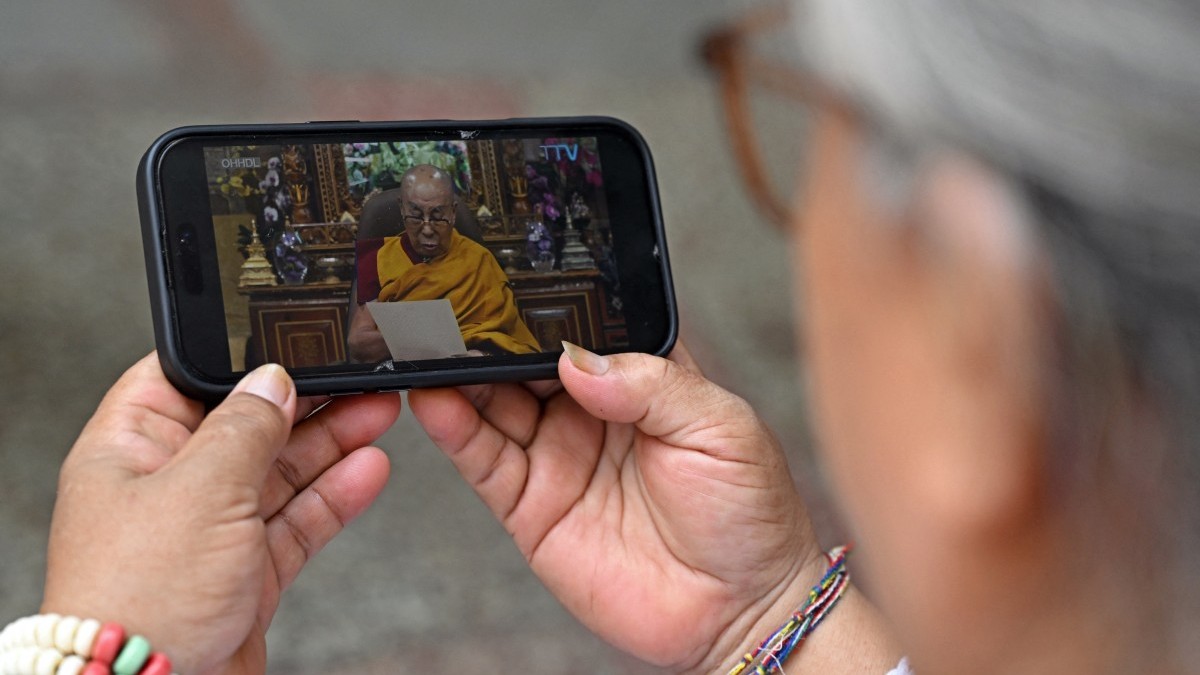
A Tibetan woman watches a video broadcast of Tibetan spiritual leader the Dalai Lama on her phone in Delhi, India on July 2, 2025.
Arun Sankar / AFP
The exiled spiritual leader of Tibet confirmed on Wednesday, July 2nd, that he will have a successor when he dies, reassuring Buddhist followers around the globe that the 600-year-old institution of the Dalai Lama will continue.
It is a landmark decision for Tibetans, many of whom had feared a future without a leader, as well as for global supporters who see the Dalai Lama as a symbol of non-violence, compassion and the enduring struggle for Tibetan cultural identity under Chinese rule.
According to Tibetans, Tenzin Gyatso is the 14th reincarnation of the Dalai Lama.
The Dalai Lama is lauded by his followers for his tireless campaign for greater autonomy for Tibet, a vast high-altitude plateau in China about the size of South Africa.
He and thousands of other Tibetans have lived in exile in India since Chinese troops crushed an uprising in the Tibetan capital Lhasa in 1959.
The charismatic Nobel Peace Prize-winning Buddhist had previously said the institution of Dalai Lama would continue only if there was popular demand.
He said on Wednesday that he had received multiple appeals over the past 14 years from the Tibetan diaspora, Buddhists from across the Himalayan region, Mongolia and parts of Russia and China, “earnestly requesting that the institution of the Dalai Lama continue.”
“In particular, I have received messages through various channels from Tibetans in Tibet making the same appeal,” he said in a video broadcast at the start of a meeting of religious leaders in the Indian Himalayan town where he has lived for decades.
“In accordance with all these requests, I am affirming that the institution of the Dalai Lama will continue,” he added.
The announcement was made ahead of his 90th birthday on July 6.
The Dalai Lama said that responsibility for identifying the 15th Dalai Lama “will rest exclusively” with the India-based Gaden Phodrang Trust, the office of the Dalai Lama.