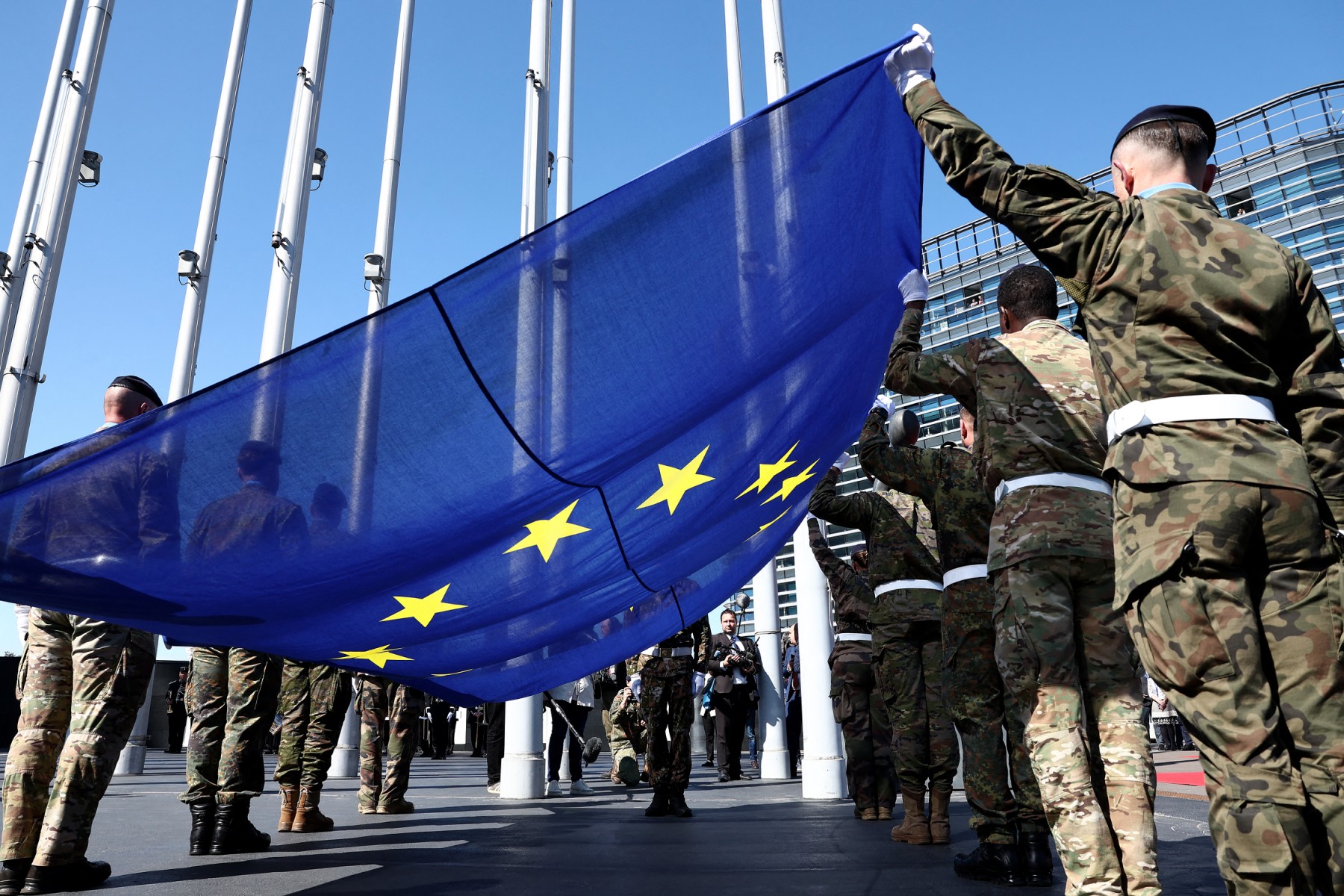
Eurocorps soldiers carry a European Union flag during the commemoration of the 80th anniversary of the end of World War II in Europe, as part of a plenary session at the European Parliament in Strasbourg, eastern France on May 7, 2025.
FREDERICK FLORIN / AFP
Balázs Orbán, the Political Director to the Hungarian Prime Minister, recently posted a sharp rebuke on X to a burgeoning proposal for European defense, by framing the initiative as a fundamental failure of governance.
Orbán stated:
The liberal elite’s two fixations—mass migration & permanent war—have now fused into one dangerous experiment: turning migrants into soldiers to “boost Europe’s defence.” Instead of admitting that mass migration has created deep security and integration failures across Europe… Instead of acknowledging that reckless escalation has pushed the continent toward prolonged instability… They now suggest arming those they previously failed to integrate. Hungary rejects both obsessions. No migration quotas. No war agenda. Only the peace and security of the Hungarian people.
This objection highlights a growing rift as Europe faces a parallel manpower crisis that policymakers are only beginning to address. In 2025, major powers such as France, Germany, and the United Kingdom continue to fall significantly short of recruitment goals, with more than 20% of professional soldier positions remaining unfilled. This shortage is compounded by a demographic winter; births in the European Union have fallen to historic lows, shrinking the pool of potential recruits just as geopolitical threats—chiefly the from Russia-Ukraine war—demand larger, more capable forces.
While high-tech weaponry is essential, the war in Ukraine has proven that it cannot substitute for “boots on the ground.” In response, some suggest a “service-to-citizenship” pathway, mirroring a successful U.S. model that has naturalized over 800,000 service members since World War I.
Supporters of the pathway argue that young, motivated migrants possess the linguistic skills and technical expertise needed for modern defense, viewing military service as the ultimate integration tool where shared sacrifice replaces shared ancestry. However, as the political center shifts, Europe remains deeply torn between viewing migration as a strategic asset for the economy or a fundamental threat to national stability.