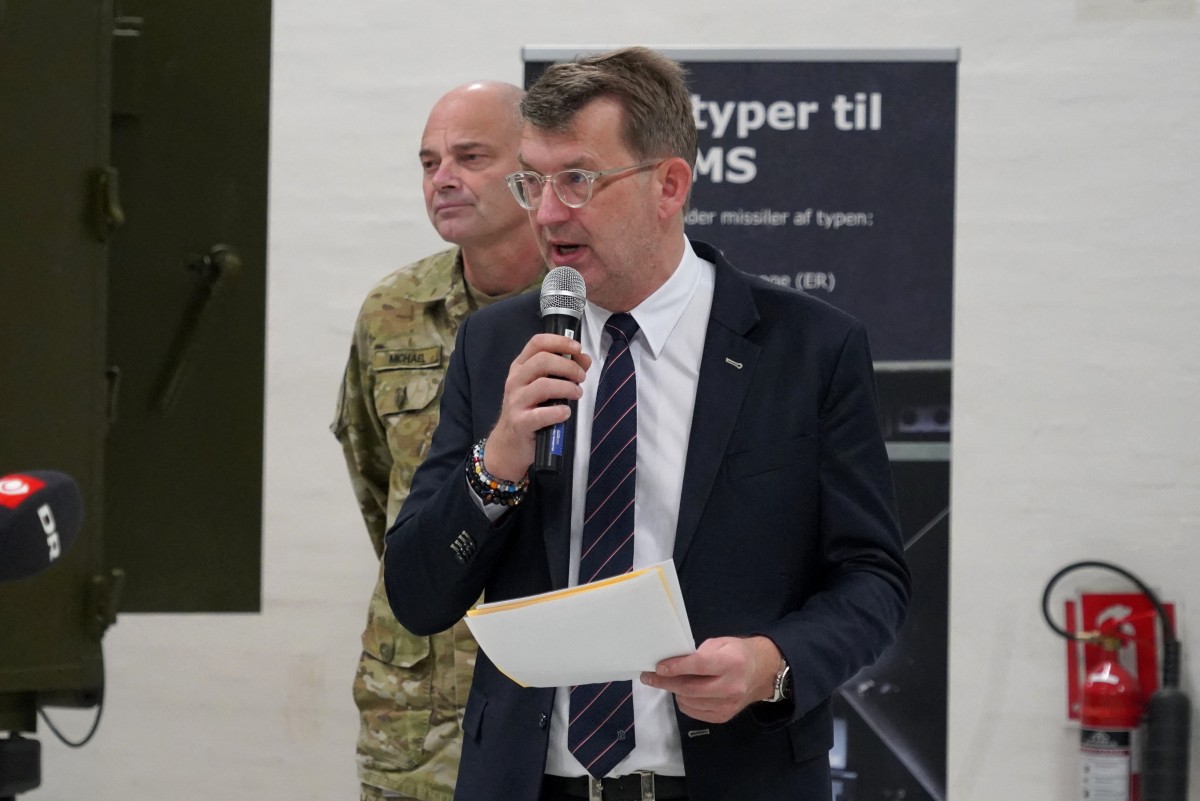
Danish Minister of Defense Troels Lund Poulsen delivers a speech during an event to unveil Denmark’s new NASAMS ground-based air defense system at the Skalstrup air base, Roskilde, Denmark, on December 17, 2025.
James Brooks/AFP.
Thursday, December 18th saw Denmark accuse two hacker groups linked to the Russian state of carrying out two cyberattacks, one on a Danish water treatment plant in 2024 and one on local elections last month.
The Defence Minister Troels Lund Poulsen told a press conference that his government plans to summon the Russian ambassador over the matter.
Water pipes exploded in the 2024 incident—attributed to pro-Russian group Z-Pentest—in which household water supply was briefly affected, he claimed.
The country’s environmental agency at the time said the attack was quickly detected, but “underscored that cyberattacks can affect security of supply.”
The second attack occurred on the eve of Denmark’s municipal and regional elections in November, when the websites of several political parties, municipalities, public institutions, and a defence company were inaccessible due to a cyberattack claimed by the Russian hacker group NoName057.
“We are very confident that these are pro-Russian groups linked to the Russian state,” said the head of Denmark’s military intelligence agency (FE), Thomas Ahrenkiel.
FE stated that the Russian state uses both NoName057 and Z-Pentest “as instruments of its hybrid war” against the West:
The aim is to create insecurity in the targeted countries and to punish those that support Ukraine…. Russia’s cyber operations form part of a broader influence campaign intended to undermine Western support for Ukraine.
Denmark is one of Ukraine’s most ardent supporters, as seen earlier this month with a ceremony breaking ground for the construction of a Ukrainian arms factory on Danish soil.
In late September, unidentified drones flew over several Danish airports and the Skrydstrup air base—where Ukrainian pilots are trained on F-16 fighter jets.
Danish Prime Minister Mette Frederiksen pointed the finger at Moscow for the incursions, saying Russia posed “a threat to Europe’s security.”