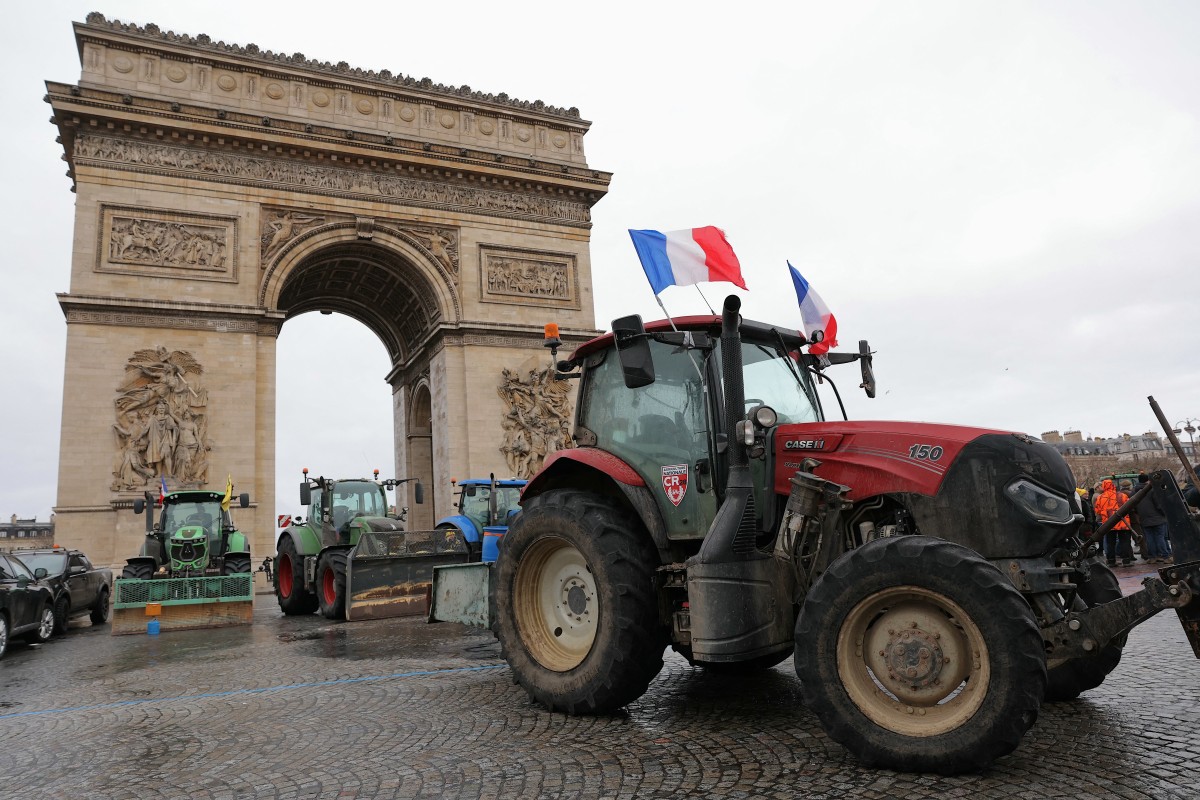
Tractors are seen parked in front of the Arc de Triomphe during a demonstration of French agricultural union Coordination Rurale (CR) as part of a nationwide day of protests and actions called by several farmers unions to push the French government to block the Mercosur trade deal and protest against its handling of the nodular dermatitis (CND) epidemic, in Paris on January 8, 2026.
Thomas Samson/AFP
Farmers in Belgium, Germany, and France organized protests this week against the European Union’s free trade agreement with Mercosur countries, including Argentina, Brazil, Paraguay, and Uruguay. The demonstrations, involving tractors and road blockades, highlighted concerns over unfair competition and potential harm to European agriculture.
In Belgium, the General Farmers’ Union planned to block major intersections in Flanders on Thursday, while Walloon counterparts prepared similar actions on Thursday evening and Friday morning. German and Austrian farmers joined the Brussels protest at Central Station on Thursday, repeating disruptions seen in December, when 13 people were arrested. The Confederation of Belgian Beet Growers described the agreement as a “threat to European agriculture,” particularly for sugar, beef, and poultry sectors.
Meanwhile, in Germany, farmers blocked motorway ramps across Brandenburg and Mecklenburg-Vorpommern. Police reported unregistered protests on several motorway driveways and deployed 300 officers to manage traffic. Organizers cited the Mercosur agreement as a threat to domestic farming due to anticipated competition from South American imports, echoing similar actions from 2024 related to the removal of tax relief on agricultural diesel.
In France, tractors entered Paris before dawn on Thursday, January 8th, with some pausing at the Eiffel Tower and Arc de Triomphe. The protest, led by the Rural Confederation union, carried banners stating “No to Mercosur.” Ludovic Ducloux, co-head of a union chapter, said, “We said we’d come up to Paris—here we are.” The French government warned against “illegal” protest actions but acknowledged farmers’ concerns about the deal.