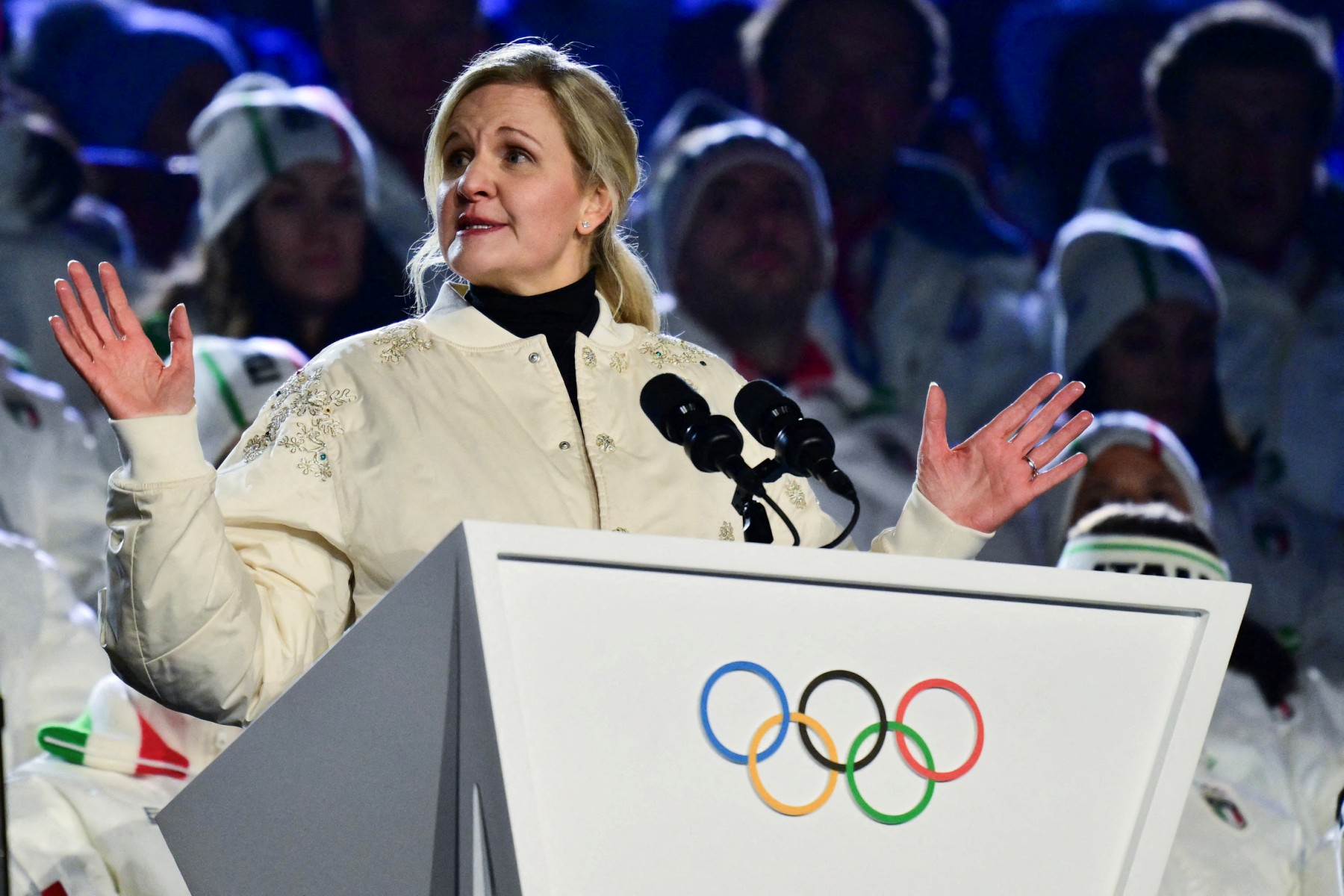
President of the International Olympic Committee Kirsty Coventry delivers a speech at the closing ceremony of the Milano Cortina 2026 Winter Olympic Games at the Verona Arena in Verona, northern Italy, on February 22, 2026.
Stefano RELLANDINI / AFP
In a definitive break from the “inclusion-first” framework of recent years, the International Olympic Committee (IOC) has announced that eligibility for women’s events at the 2028 Los Angeles Games will now be strictly conditional on chromosomal status.
Under the first major policy shift of Kirsty Coventry’s presidential tenure, the female category will be reserved exclusively for athletes of female sex who do not carry the SRY gene. The IOC president stated
At the Olympic Games even the smallest margins can be the difference between victory and defeat. So it is absolutely clear that it would not be fair for biological males to compete in the female category. In addition, in some sports it would simply not be safe.
This move effectively revives a practice abandoned in 1999, reinstating a biological “hard line” that will ban both transgender women and many intersex athletes from female competition.
The policy is notably non-retroactive, ensuring that the results of the 2024 Paris Games—most significantly the gold medal won by Algerian boxer Imane Khélif—remain unchallenged.
However, the road to Los Angeles will be vastly different; every female athlete will be required to undergo a “one-off” SRY screening via a cheek swab or saliva test. While the IOC frames this as a necessary step to protect the “fairness and safety” of women’s sport, the implementation itself may face a legal minefield.