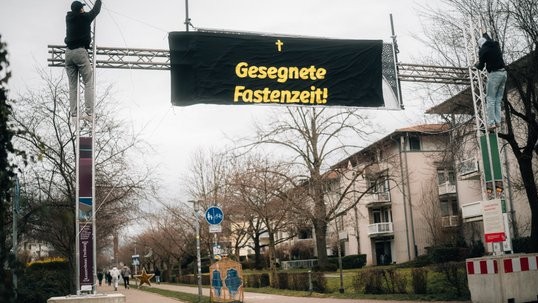
Identitarian activists covering the Ramadan display with a banner reading “Blessed Lent” in Freiburg, Germany, on February 22, 2026
@IBSchwaben_ on X, February 22, 2026
The city of Freiburg’s recent decision to prioritize Islamic visibility has ignited a sharp debate over cultural identity and the use of public funds. In a direct response to the city’s inaugural Ramadan lighting installation at Seepark, members of the Identitarian Movement (Identitäre Bewegung) covered the displays with a banner proclaiming “Blessed Lent,” pointingly reclaiming the space for the traditional Christian season.
The protest, which included the placement of a Christian cross over the state-funded Muslim symbols, was characterized by the movement as a defense of national heritage. Maximilian Märkl, federal spokesman for the Identitarian Movement (IB), voiced the group’s stance on X, asserting “Islam does not belong to Germany!” and accusing local authorities of misusing taxpayer money to promote what he termed “symbols of submission.”
While Mayor Martin Horn and the city administration defended the project as a “signal for harmonious coexistence” and an effort to honor religious diversity, the move has drawn criticism for its one-sidedness. Despite the Islamic month of fasting coinciding with the Christian Lenten season—which began on Ash Wednesday—the city’s public outreach and “diversity” initiatives notably omitted any mention of the praying Christians who make up the traditional fabric of the community.
This incident in Freiburg highlights a growing friction between official “integration” policies and those who feel that the state is increasingly neglecting Germany’s historical Christian character in favor of multicultural symbols. A similar trend is unfolding in Frankfurt, where the city has prioritized expensive Ramadan displays costing taxpayers €100,000, while reports have surfaced of teachers unilaterally prohibiting primary school students from drinking water in class to accommodate the Islamic fast.