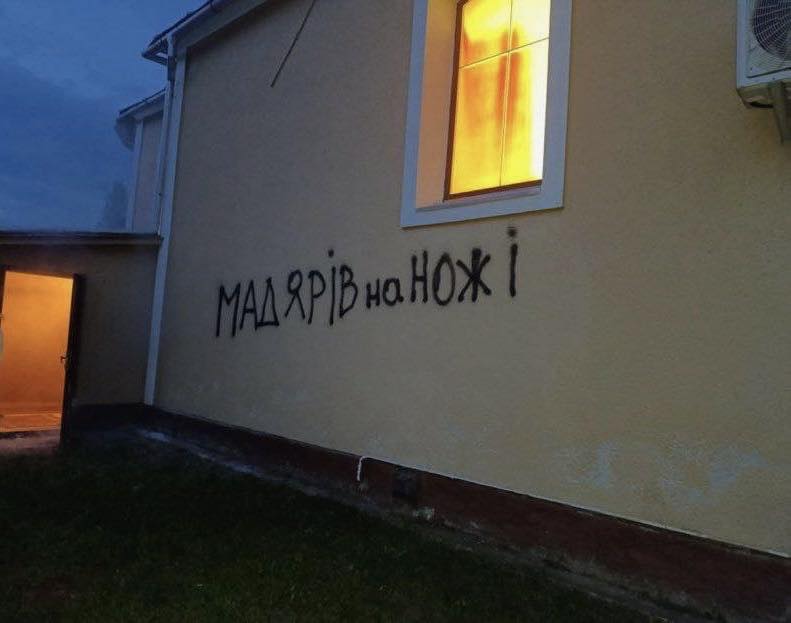
Graffiti reading “Hungarians to the knives” is sprayed on the side of the church
Photo: Viktor Orbán on Facebook, 17 July 2025
Tensions between Hungary and Ukraine have flared again, with Budapest summoning Ukraine’s ambassador for the second time in recent weeks—this time over the arson of a Greek Catholic church in Transcarpathia and a threatening anti-Hungarian slogan scrawled at the scene.
The church, located in the village of Palágykomoróc, was set ablaze and defaced with the message “knife to the Hungarians.” Hungarian Prime Minister Viktor Orbán posted an image of the burning building on social media, drawing public attention to what officials are calling a targeted hate crime.
Foreign Minister Péter Szijjártó condemned the attack in strong terms, calling it a “brutal and open” assault on Hungary’s minority community in Ukraine. “It’s completely unacceptable that a country hoping to join the EU allows this kind of violence against its Hungarian citizens,” he said. “This wasn’t just an attack on a church—it was an attack on the entire community.”
Szijjártó also lashed out at EU leaders, accusing them of turning a blind eye while Ukraine’s membership bid moves forward. “While Brussels fast-tracks Ukraine’s accession, threats against the Hungarian community are only getting worse,” he warned.
This latest diplomatic protest follows another recent flashpoint: the death of József Sebestyén, a Transcarpathian man of Hungarian origin who was allegedly beaten to death by Ukrainian military recruiters during forced conscription.
In response, the Hungarian government has banned three senior Ukrainian officials from entering the country and is pushing for them to be added to the EU sanctions list. Those named include the chief of staff of Ukraine’s Ground Forces, the commander of the Western Operations Command, and the head of the Defence Ministry’s mobilisation department.
Szijjártó described their actions as part of a system of “violence and torture” used in recruitment, citing evidence documented by the Council of Europe. State Secretary Zoltán Kovács also weighed in online, highlighting the seriousness of the allegations.
The Hungarian foreign minister didn’t rule out further consequences, warning that if relations with Kyiv break down entirely, Ukraine could find itself in real trouble—reminding reporters that Hungary is currently its largest supplier of electricity.