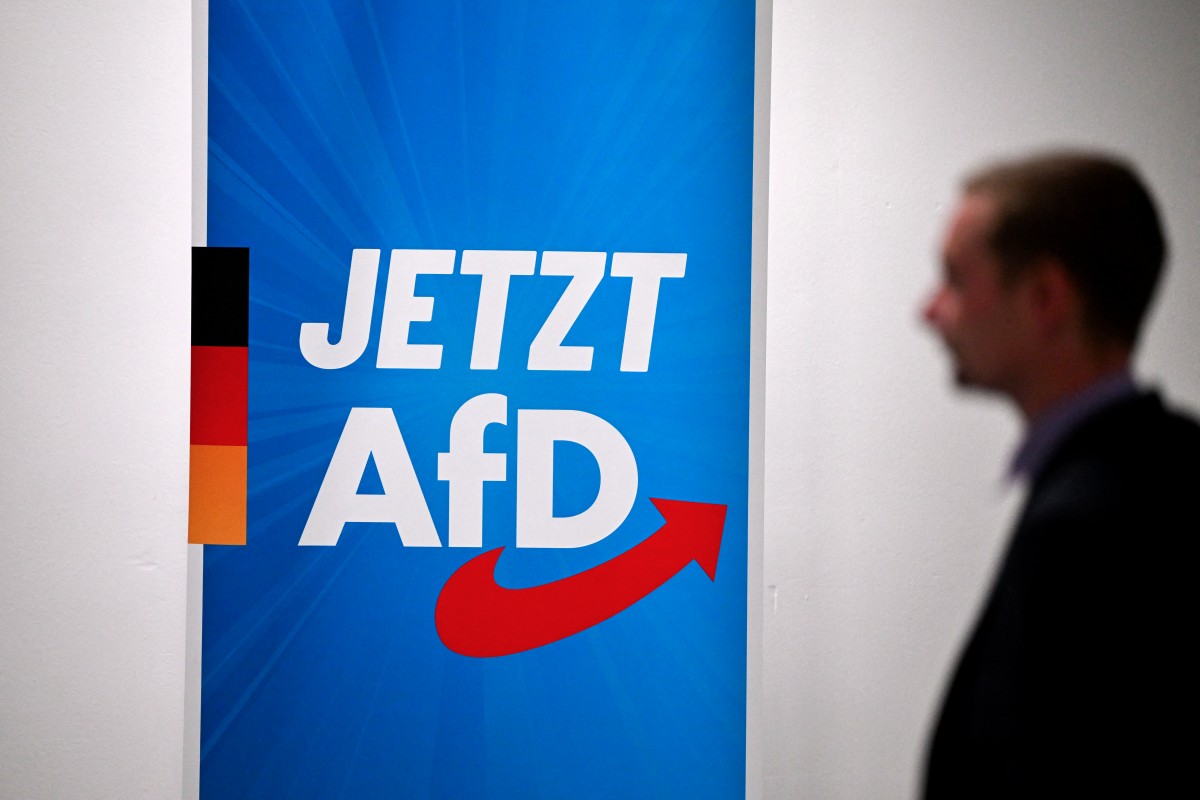
A participant walks past an AfD banner as he enters an Alternative for Germany convention venue at the exhibition halls in Giessen, western Germany.
KIRILL KUDRYAVTSEV/AFP.
The governing “democratic” parties in Lower Saxony—SPD, Greens, and CDU—have passed a law establishing a new Parliamentary Control Body, effectively excluding Alternative for Germany (AfD) from oversight of the Office for the Constitution.
Previously, the AfD was entitled to a seat under proportional representation rules. Under the new system, members are appointed by a parliamentary majority, meaning that none of the AfD candidates will be represented, leaving the governing parties in full control.
AfD group leader Klaus Wichmann condemned the move as a violation of democratic rights:
SPD, Greens, and CDU acted exclusively in party politics. The AfD should be part of a body in which it sits legitimately.
This argument reflects how AfD support has nearly doubled to 20% since the October 2022 election.
The Social Democrats (SPD) and CDU have argued that the decision is necessary to prevent parties observed by the Office for the Protection of the Constitution from overseeing the very institution tasked with monitoring them. Deputy SPD member Sebastian Zinke harumphed that
It cannot be that those who are observed control the Constitution at the same time.
Greens representative Evrin Camuz described the AfD as a “hybrid threat,” while CDU deputy Carina Hermann asserted that “constitutional enemies have no place in the control body.”
A recent ARD-DeutschlandTrend special survey points to shifting public sentiment: nearly half of CDU/CSU voters now favour case-by-case collaboration with the AfD, with an additional 10% expressing general support for closer cooperation. Across Germany, the governing parties are desperate as the AfD opens up a record lead over the CDU/CSU, topping 27% in a recent Insa poll and leading the Union by 2.5 points. Despite this surge, the SPD and CDU/CSU continue their “Brandmauer” strategy, refusing cooperation with the AfD.