Jonathan Nackstrand / AFP
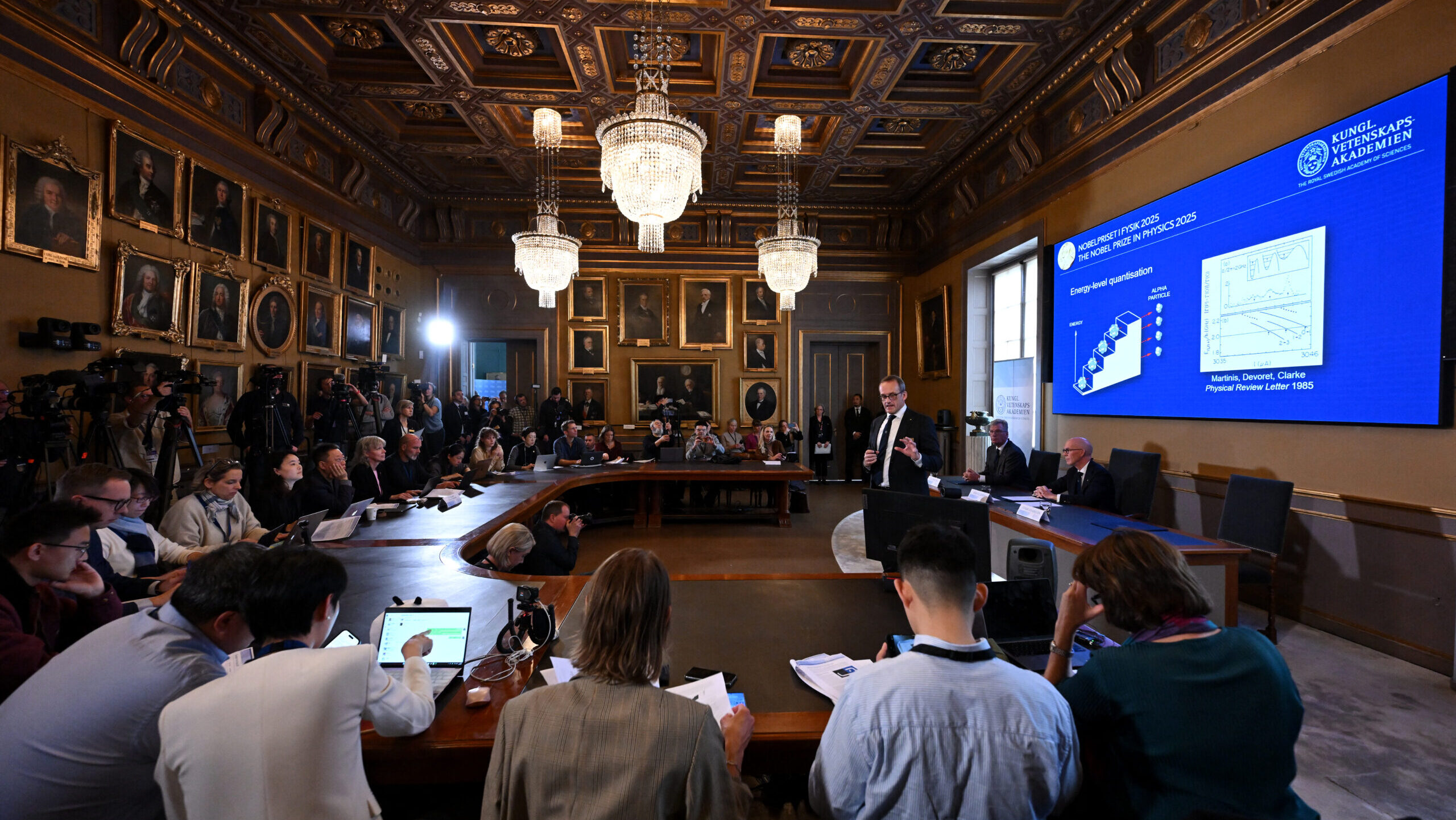
Briton John Clarke, Frenchman Michel Devoret, and American John Martinis won the 2025 Nobel Prize in Physics for their pioneering work on quantum mechanics.
The Nobel jury recognized the trio for its
discovery of macroscopic quantum mechanical tunnelling and energy quantisation in an electric circuit.
Their experiments in the 1980s demonstrated that quantum tunnelling—usually only seen at tiny scales—can occur in larger systems using superconductors. This made the strange properties of the quantum world tangible in objects large enough to hold in a human hand.
The discoveries pave the way for next-generation quantum technologies, including quantum computers, cryptography and sensors. Olle Eriksson, chair of the Nobel Committee, highlighted the enduring surprises and practical importance of quantum mechanics.
Clarke told the Nobel press conference by telephone:
My feelings are that I’m completely stunned. Of course it had never occurred to me in any way that this might be the basis of a Nobel Prize.
Three years ago, the physics Nobel Prize was awarded jointly to Alain Aspect (France), John F. Clauser (United States), and Anton Zeilinger (Austria), “for experiments with entangled photons, establishing the violation of Bell inequalities, and pioneering quantum information science.” The trio are now seen as the three pioneers of quantum mechanics.