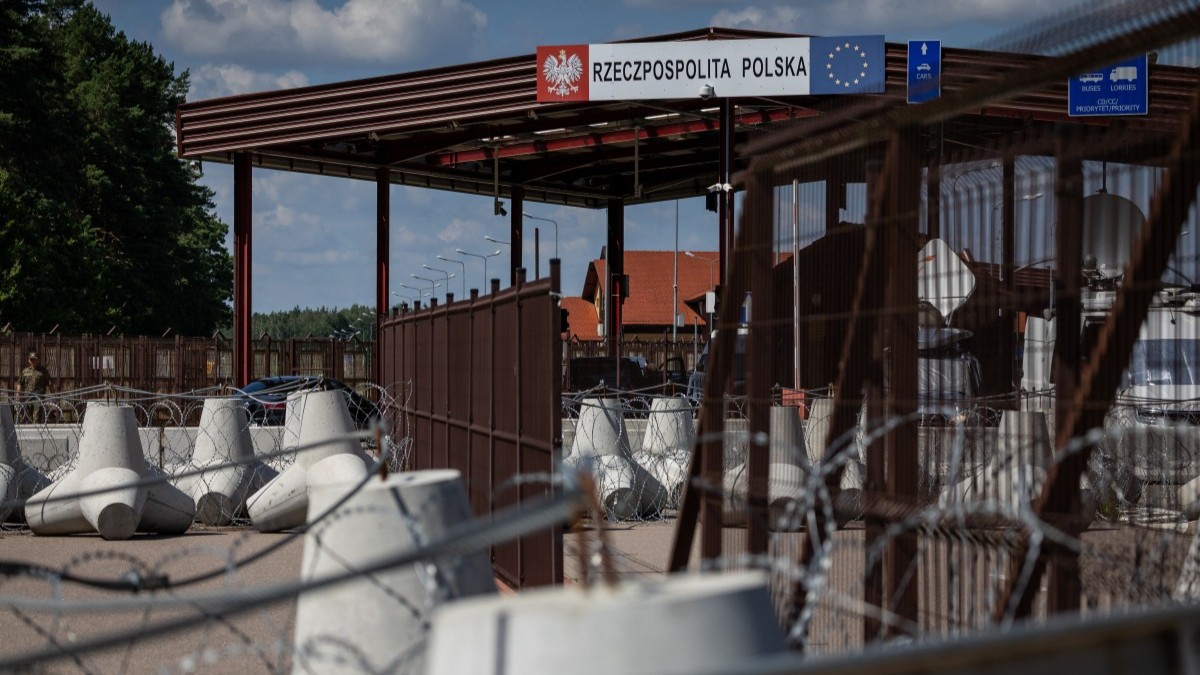
A sign reads “Republic of Poland” at the border crossing of the Polish-Belarusian country border with barbed wire and a fence in Polowce-Pieszczatka, Poland on July 21, 2025.
Wojtek Radwanski / AFP
The Tusk government has announced plans to build a 700-kilometer-long defensive structure, dubbed the ‘Eastern Shield,’ along its eastern borders with Russia and Belarus. The initiative, aimed at protecting both Poland and the broader NATO and EU frontiers, will include physical barriers, high-tech surveillance systems, and digital infrastructure.
As NATO’s largest relative contributor, Poland sees the Eastern Shield as a strategic bulwark on the alliance’s eastern flank. According to the Polish government, the fortifications will go beyond traditional border walls, incorporating anti-tank obstacles, sensor networks, and real-time monitoring systems.
Military leaders emphasise that the goal is not just to block enemy forces, but to slow and channel their movement, buying time for a coordinated defence. Critics, however, argue that static defences are outdated and ineffective against modern military threats.
The estimated cost of the project is 10 billion zlotys (around €2.4 billion), with potential co-financing from the European Union’s SAFE security program.
While officials stress the importance of enhancing national security, some voices have raised concerns that the project may fail to protect civilians and could lead to restrictions on civil liberties in the name of security.
Over the weekend, Polish and allied aircraft were scrambled to secure the country’s airspace following Russian airstrikes in Western Ukraine. Poland’s military command said air defense systems and radar units were placed on high alert as a precautionary measure.