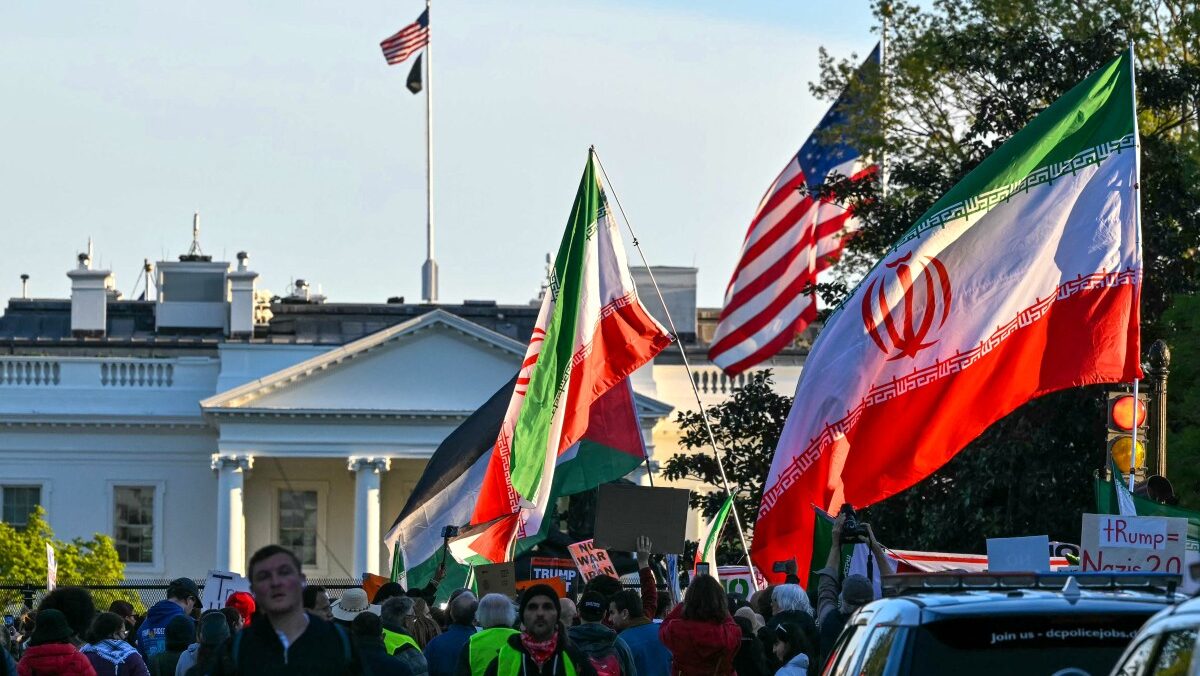
Demonstrators wave Iranian flags during a protest against US military action in Iran near the White House in Washington, D.C., on April 7, 2026.
MANDEL NGAN / AFP
U.S. president Donald Trump announced a delay and double-sided ceasefire between the U.S. and Iran on Tuesday night, mere hours before his threatened “Power Plant Day, and Bridge Day” attack was supposed to take place. The announcement came after conversations with Prime Minister Shehbaz Sharif and Field Marshal Asim Munir of Pakistan.
On Tuesday morning, the U.S. president had declared on Truth Social that “A whole civilization will die tonight, never to be brought back again.” His comment garnered support as well as explanations—from people like former CIA operative Sarah Adams, who said, “This kind of negotiation isn’t about sounding reasonable. It’s about making escalation cost more than restraint”—but also strongly denouncing comments from people like ethicist and MD Calum Miller, who simply called Trump’s statement “Evil beyond words” and said, “Christians cannot support this.”
On Tuesday night, Trump says he will pause planned strikes on Iran for two weeks after talks with Pakistan’s leadership, conditioning the move on Tehran reopening the Strait of Hormuz. He said a ten-point plan provided by Iran was “a workable basis on which to negotiate.”
Iran, in an official response from foreign minister Abbas Araghchi, said if attacks on his country were halted, “safe passage through the Strait of Hormuz will be possible via Iran’s Armed Forces and with due consideration of technical limitations.”
According to two White House sources quoted by Reuters, Israel has also agreed to the two-week ceasefire and to suspend its bombing campaign on Iran. Prior to Trump’s public announcement, Israeli PM Benjamin Netanyahu had reportedly actively urged the U.S. president against pursuing a ceasefire, warning that a truce would carry significant strategic risks, potentially allowing Iran to regroup or embolden its proxies.