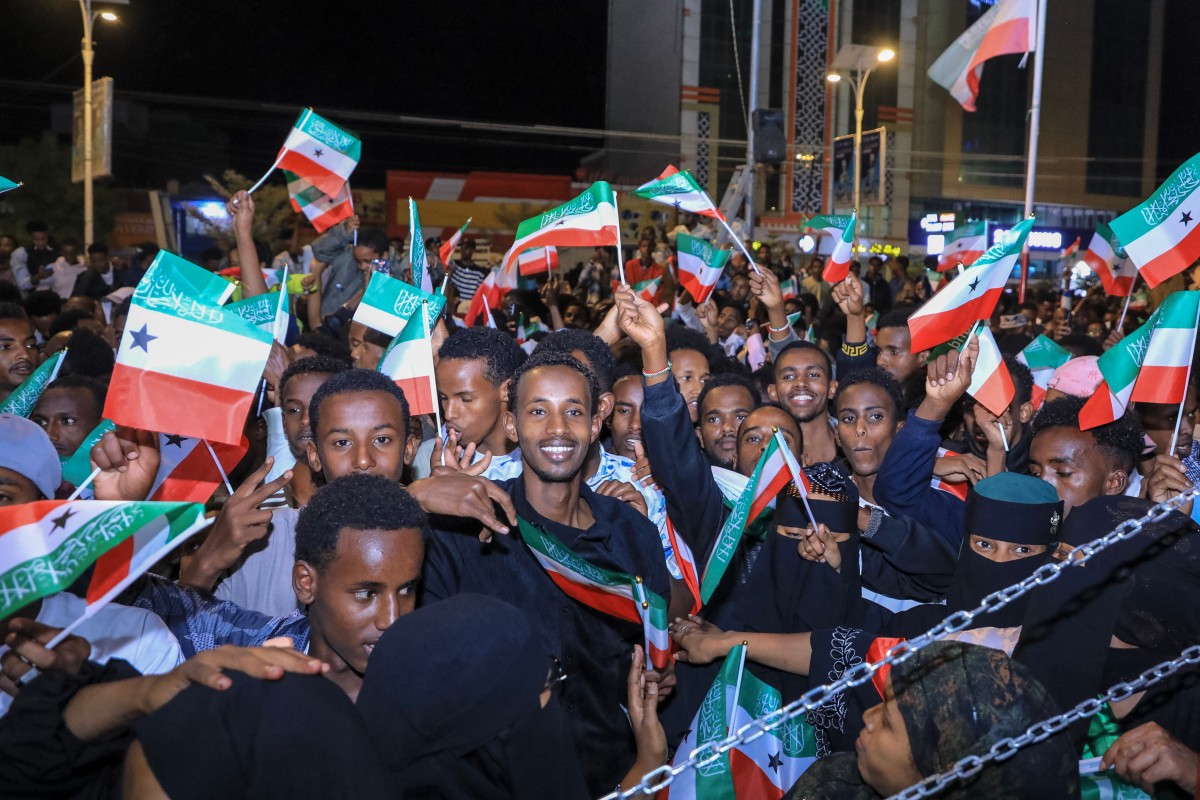
Residents wave Somaliland flags as they gather to celebrate Israel’s announcement recognising Somaliland’s statehood in downtown Hargeisa, on December 26, 2025.
FARHAN ALELI / AFP.
Almost alone among U.N. member states, Israel has formally recognized the self-declared republic of Somaliland, prompting a noisy diplomatic crisis, triggering an emergency United Nations Security Council meeting, and prompting warnings from regional governments about the risk of destabilizing the Horn of Africa.
The historic step has served to smoke out a number of Israel’s international enemies, with recognition of Somaliland’s sovereignty leading to charged rhetoric. Israeli prime minister Benjamin Netanyahu said the move was “in the spirit of the Abraham Accords,” describing it as part of a broader effort to expand Israel’s ties in the Muslim world.
However, Sunday, December 28th saw Somalia’s President Hassan Sheikh Mohamud denounce Israel’s move as a “naked invasion,” accusing Israeli PM Netanyahu of committing the “greatest abuse” of Somalia’s sovereignty in the country’s history and referring to Israel as an “enemy.”
This followed a joint statement issued on Saturday by 21 Arab and African countries and the Organization of Islamic Cooperation, which rejected the Israeli policy. The signatories included Egypt, Iran, Qatar, Saudi Arabia, and Turkey. Bahrain, Morocco, and the United Arab Emirates—the three Arab states that normalized relations with Israel in 2020—did not sign the statement.
The Qatari Foreign Ministry posted on X, formerly Twitter, stating
The State of Qatar categorically rejects the mutual recognition announcement between the Israeli occupation authorities and the Somaliland region.
The U.N. Security Council is scheduled to convene an emergency session on Monday, December 29th to discuss Israel’s recognition policy, with members expected to condemn it. The announcement came just days before Somalia is due to assume the rotating presidency of the council.
Somaliland is seen as an alternative to the radical Muslim government of Somalia—and the terror organizations running the country. With increasing U.S. focus on the failure of the Somali state, diplomatic activity towards Somaliland may provide a way forward.
The move follows Ethiopia reaching a then-unique deal with Somaliland in 2023, agreeing to use its port to gain access to the Red Sea, bypassing the Somali government entirely.