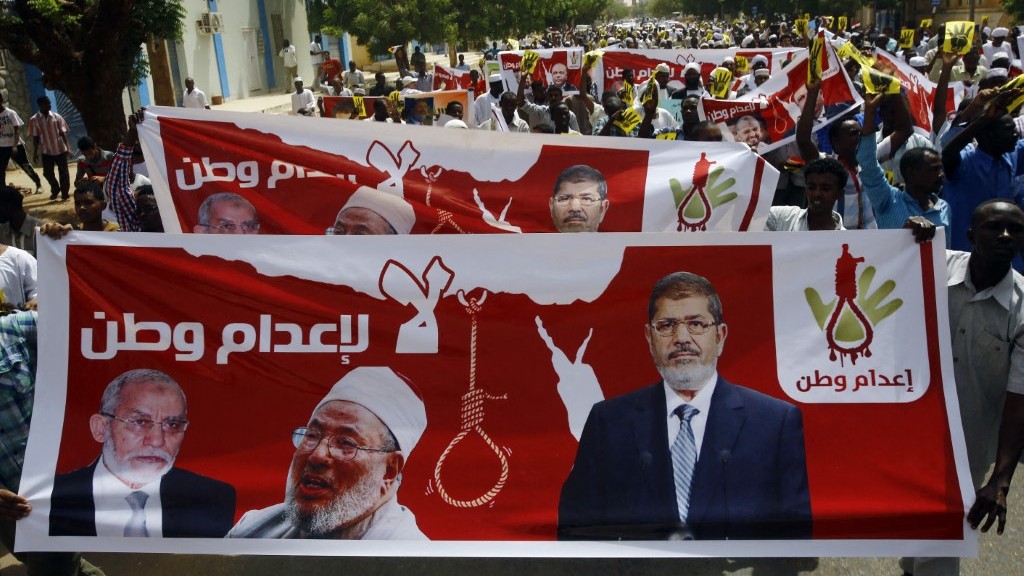
Hundreds of Sudanese Islamists hold posters bearing portraits of Egypt’s ousted president Mohamed Morsi (R), Egyptian Muslim Brotherhood leader Mohamed Badie (L) and prominent Qatar-based cleric Yusuf al-Qaradawi as they march towards a United Nations office in central Khartoum on May 22, 2015.
ASHRAF SHAZLI / AFP
The United States announced that it will designate the Muslim Brotherhood in Sudan as a terrorist organization, accusing the Islamist group of violence against civilians and close ties to Iran.
The designation will take effect in one week, according to a statement from the U.S. State Department.
Washington said the Sudanese branch of the Muslim Brotherhood has played a significant role in the ongoing conflict in Sudan and has actively undermined efforts to reach a peaceful resolution.
U.S. officials also accused the group of receiving support from Iran, particularly from the terrorist group Islamic Revolutionary Guard Corps (IRGC). According to the statement, the Sudanese Muslim Brotherhood has contributed more than 20,000 fighters to the war in Sudan, with many reportedly receiving training and assistance from the IRGC.
The move follows a broader effort by Washington to target branches of the Muslim Brotherhood globally. Earlier this year, the United States designated several other Brotherhood-linked groups as terrorist organizations, including branches operating in Egypt, historically one of the movement’s most significant bases.
Both Iran, governed by Shiite clerics, and the Sunni Muslim Brotherhood have supported Sudan’s army during the conflict, according to U.S. officials.
Meanwhile in the United Kingdom, the fallout from Ayatollah Ali Khamenei’s death has sparked protests on university campuses. Research by the Henry Jackson Society found that Islamic student societies at at least 27 British universities have shared tributes and organised vigils mourning the Iranian leader, with some posts describing him as a “martyr.”
The commemorations of the world’s most brutal dictators have been organised by Ahlul-Bayt Islamic societies operating at the universities.