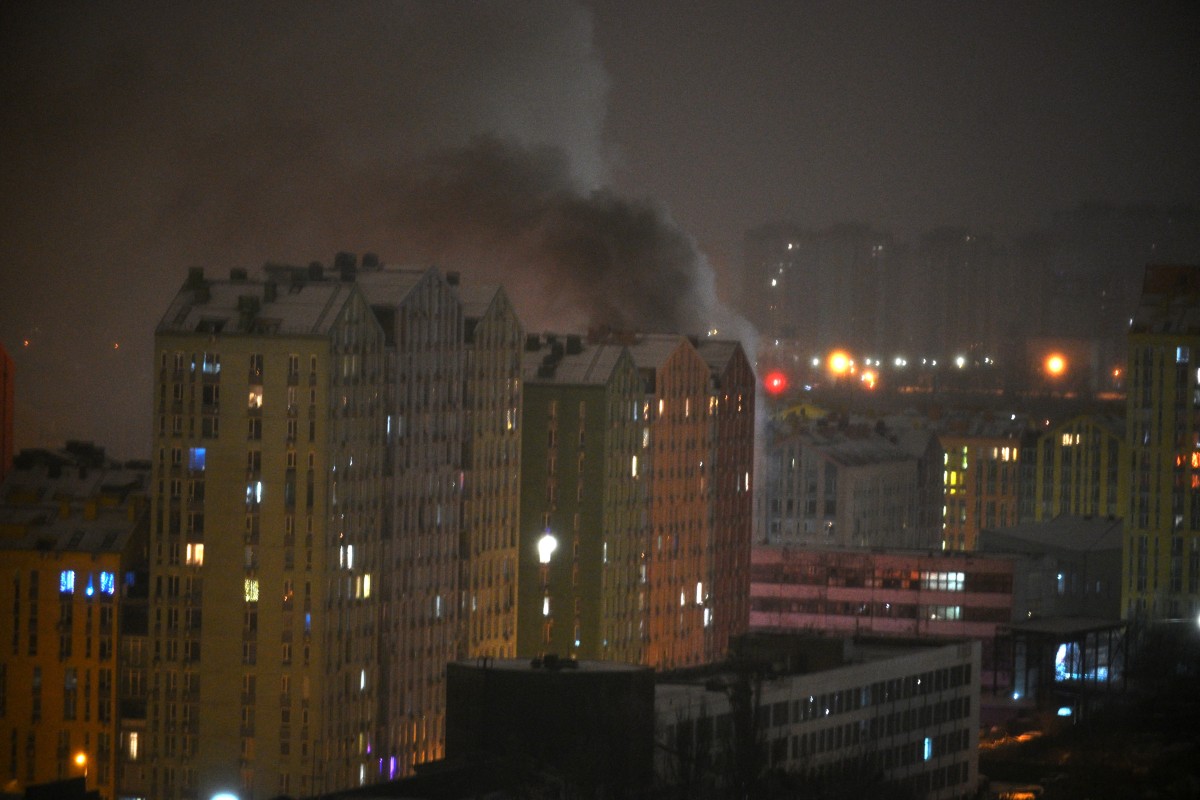
Smoke rises from a building after Russia launched an attack with drones and missiles on Kyiv on January 9, 2026, amid the Russian invasion of Ukraine. Russian strikes on Ukraine’s capital and its suburbs killed at least three people, Kyiv’s mayor said Friday, as the air force issued a countrywide missile warning. The attack on Kyiv ignited fires and damaged apartment buildings, with “three dead and 13 wounded,” according to Mayor Vitali Klitschko.
EUGENE KOTENKO/AFP.
Ukrainian military intelligence has identified American and European microchips in Russia’s latest missile-like drone, the Geran-5, highlighting how Western technology continues to appear in Russian weaponry despite sanctions.
This specific Geran-5, downed by Ukrainian forces in January 2026 near Kyiv Oblast and Dnipro, is a fast, long-range UAV resembling a winged missile, unlike the delta-winged Shahed-type drones previously copied by Russia. It can reach speeds of 500–600 km/h, making it significantly harder to intercept than earlier models such as the Geran-2.
Analysis of a recovered UAV revealed microchips from U.S. companies Texas Instruments, CTS Corporation, Monolithic Power Systems, and a German chip from Infineon Technologies. While manufacturing dates were verified for only two chips, one from February 2024 and another from September 2025, it indicates these components were produced well after the start of the conflict. Ukrainian officials stress that such Western components are essential for Russia’s production of drones and missiles.
Western chips reportedly enter Russia through complex networks of intermediaries, primarily based in China, Hong Kong, and other Asian countries. Companies such as Moscow-based Niokr-Trade acquire microchips from Chinese distributors and supply them to Russian arms manufacturers, circumventing sanctions.
Dutch-made microchips also continue to appear in Russian weapons, with 379 components recovered by Ukrainian forces, most produced after the 2022 European Union export ban. German companies, meanwhile, have paid nearly €1.72 billion in taxes to Russia since the conflict began, while Around 250 German firms remain active in the Russian market, producing goods ranging from food to building materials.