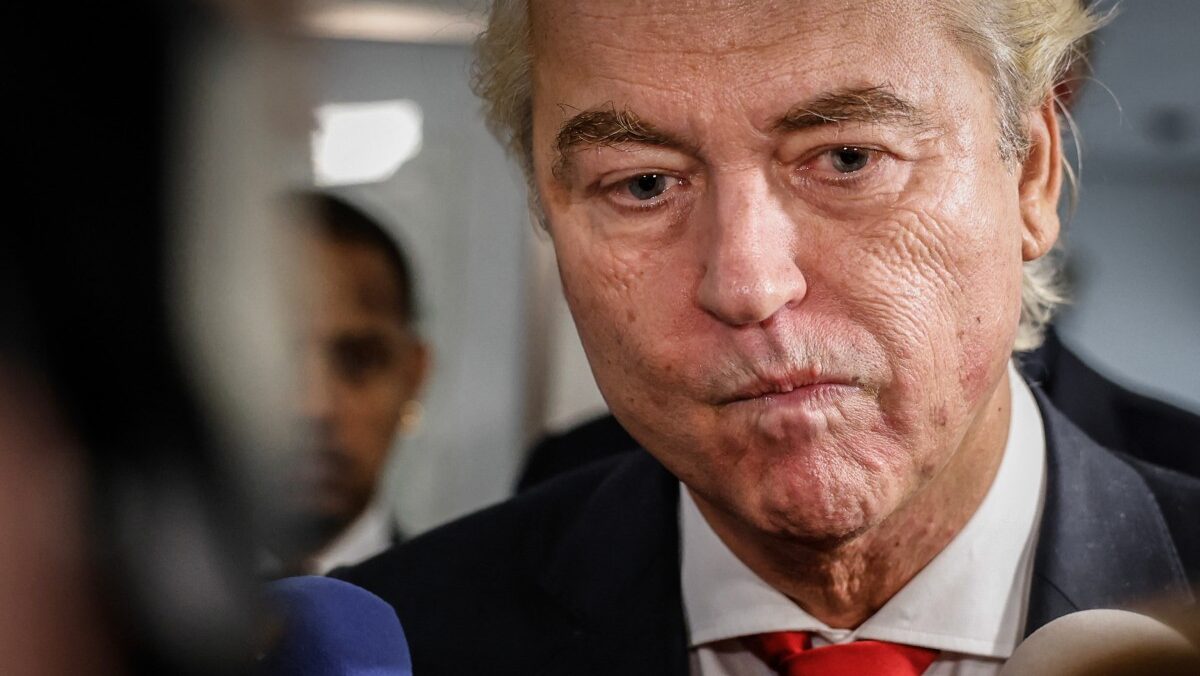
PVV leader Geert Wilders reacts as he delivers remarks to journalists outside the PVV faction room at the Lower House, the day after the Dutch parliamentary election vote, in The Hague, on October 30, 2025.
SIMON WOHLFAHRT / AFP
In a shocking turn of events, the largest right-wing party in the Netherlands, the Partij voor de Vrijheid (PVV), led by Geert Wilders, has been dealt another major blow. After a disappointing election result in which the party lost 11 seats, seven out of the remaining 26 members of parliament announced on Wednesday that they are breaking with the PVV. The MPs will form a new parliamentary group under the name Group Markuszower, named after Gidi Markuszower, one of the most prominent figures behind the split.
Markuszower is joined by Annelotte Lammers, who was number four on the PVV candidate list; Nicole Moinat; Shanna Schilder, who placed third on the list; René Claassen, number seven; Hidde Heutink, number fifteen; and Tamara ten Hove, number twenty. Together, they represent a significant portion of the PVV’s parliamentary faction.
The split followed shortly after the MPs sent a sharply worded letter to Wilders, in which they blamed him for the party’s electoral defeat. According to the letter, the PVV lost the election “because Wilders had lost interest.” The MPs also criticized Wilders’ attitude toward the formation of a centrist minority coalition. Wilders was the only party leader who refused to participate in a formal meeting with the leaders of the prospective government.
Wilders publicly defended his stance on X, where he made clear that he has no intention of cooperating with a coalition he sees as harmful to the country. “So I will not be having coffee with Jetten, Yesilgoz, and Bontenbal. It’s up to the other party leaders to decide whether they want to do so, but the PVV will not cooperate in any way with the destruction of the Netherlands. The shorter Jetten’s term as prime minister, the better!”
Beyond criticism of Wilders’ political strategy, the departing MPs also demanded far-reaching internal reforms. They argued that MPs should have more influence over the party line and more freedom to express themselves publicly. In addition, they called for a fundamental change in the PVV’s party structure. At present, the PVV has no formal members, with the Wilders Foundation being the only official member of the party.
This issue has gained urgency as coalition party D66 is preparing legislation that would require all political parties to adopt a democratic internal structure. Such a law could indirectly force the PVV to disband or radically transform. The defecting MPs also stated that Wilders exercised excessive control over the party’s direction, arguing that democratization of the PVV was unavoidable.
After a brief internal confrontation, the MPs formally left the party, leading to the creation of Group Markuszower. The split has triggered fierce reactions from within the PVV. MP Dion Graus lashed out at the defectors, comparing them to rats. “Every fine ship has mutineers and rats. We are now rid of the traitors.”
Former PVV minister for Migration Marjolein Faber emphasized her loyalty to Wilders and the party, stating, “I am and I will remain part of the PVV.”
It remains unclear whether the former PVV MPs intend to establish a new political party or pursue a different course. Speculation about possible mergers with other right-wing parties has largely been dismissed. JA21 and FVD, both of which gained momentum in the last election, have made clear that the defectors are not welcome.
JA21 leader Joost Eerdmans, who himself split from FvD in 2020, commented that “they are not looking for defectors at the moment.” FvD leader Lidewij de Vos also closed the door firmly, saying, “I have a wonderful group of seven people and it will remain just as it is.”
The only other potential option, the farmer-citizen movement BBB, has also responded cautiously. While the party has not completely ruled out contact, it has stated that it is out of the question for PVV members to simply join its ranks.
As a result, Group Markuszower is expected to remain an independent parliamentary group for the foreseeable future. This could slightly increase the chances of right-wing influence on policy, as the group has indicated it wants to take a more constructive approach toward the coalition in order to reach agreements.
Rob Jetten, leader of the progressive D66 party, election winner and most likely the next prime minister, reacted with cautious optimism. “If a new political group joins that wants to work together constructively, that certainly offers opportunities. The question, of course, is what the substantive course will be. We will have to find that out in the coming weeks and months.”