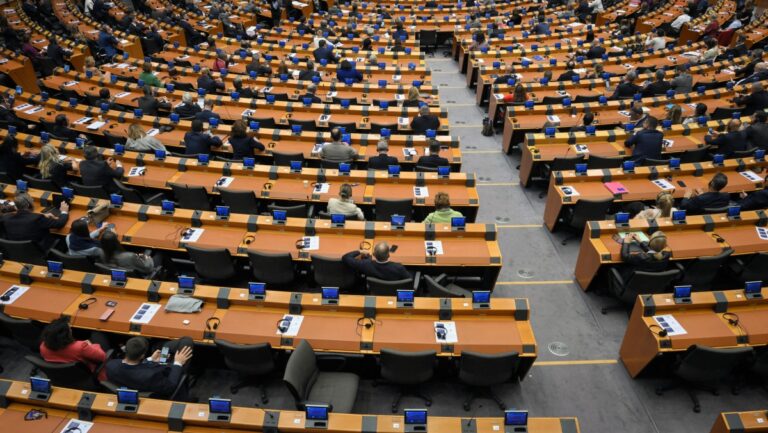
AfD co-leaders Alice Weidel and Tino Chrupalla give a statement after the first parliamentary group meeting of their party on February 25, 2025.
Photo: Tobias Schwarz / AFP
The right-wing populists Alternative für Deutschland (AfD) is suing Germany’s domestic intelligence agency, BfV, after it designated the party as a “right-wing extremist” organization, opening the door for constant police surveillance or even banning.
Suspiciously issued just after AfD took over the ruling CDU in the polls and became Germany’s most popular party, BfV’s decision was clearly “politically motivated” and represents a “severe blow to German democracy,” AfD co-presidents Alice Weidel and Tino Chrupalla said in a statement last Friday. They promised to keep fighting for the freedom of expression and challenge the ruling with all legal tools available.
On Monday, May 5th, AfD acted on this promise and took action against the spy agency at an administrative court in Cologne, where BfV is headquartered.
The party’s legal team argues that the decision interferes with Germany’s democratic processes, restricts AfD’s constitutional right to criticize government policies (such as those pertaining to migration), and publicizing it hurts the party’s image and electoral chances.
Therefore, they demand that BfV suspend the “extremist” classification and refrain from surveilling AfD officials until there’s a definitive court ruling.
Meanwhile, it seems this newest attack on AfD has already backfired, as the party gained over 1,000 new membership applications in just three days, “a new record,” according to a statement issued by Weidel.
1.000 Mitgliedsanträge in 3 Tagen: Das dürfte ein neuer Rekord sein, der darüber hinaus zeigt, wie hoch der Zuspruch für unsere AfD wirklich ist. Herzlich Willkommen in der Alternative für Deutschland! Jetzt selbst Mitglied werden: https://t.co/F7iRzubEeq pic.twitter.com/KN99KDKbGy
— Alice Weidel (@Alice_Weidel) May 5, 2025
AfD also received support from conservatives all over Europe and the U.S., including from Vice President JD Vance, who predicted back in February that Berlin would try to ban the party if its popularity continued to grow. It has, and “now the bureaucracy wants to destroy it,” Vance wrote on social media.
U.S. Secretary of State Marco Rubio was even more direct, calling on Berlin to undo the classification and adding that allowing such measures of surveillance against a democratically elected opposition means that Germany is “not a democracy, but a tyranny in disguise.”
The German foreign ministry replied to Rubio by saying that the decision was the result of a “thorough and independent” investigation—not really, as BfV is supervised by the internal ministry, under the control of the socialist SPD which has been trying to ban AfD for years—and adding that “independent courts” will have the final say.
This last part at least would be reassuring, if not for the countless examples showing how Berlin has weaponized its judiciary in recent years to crush dissent, going as far as sentencing journalists and politicians to prison for memes criticizing the government and the lack of free speech.
Right! The spy agency works for the ruling government, which is responsible for illegal mass migration, sky-rocketing criminal rates, highest taxes, highest energy prices. Since the AfD is the strongest party in polls now, they want to suppress the opposition & freedom of speech. https://t.co/MZ7uhsNckw
— Alice Weidel (@Alice_Weidel) May 2, 2025