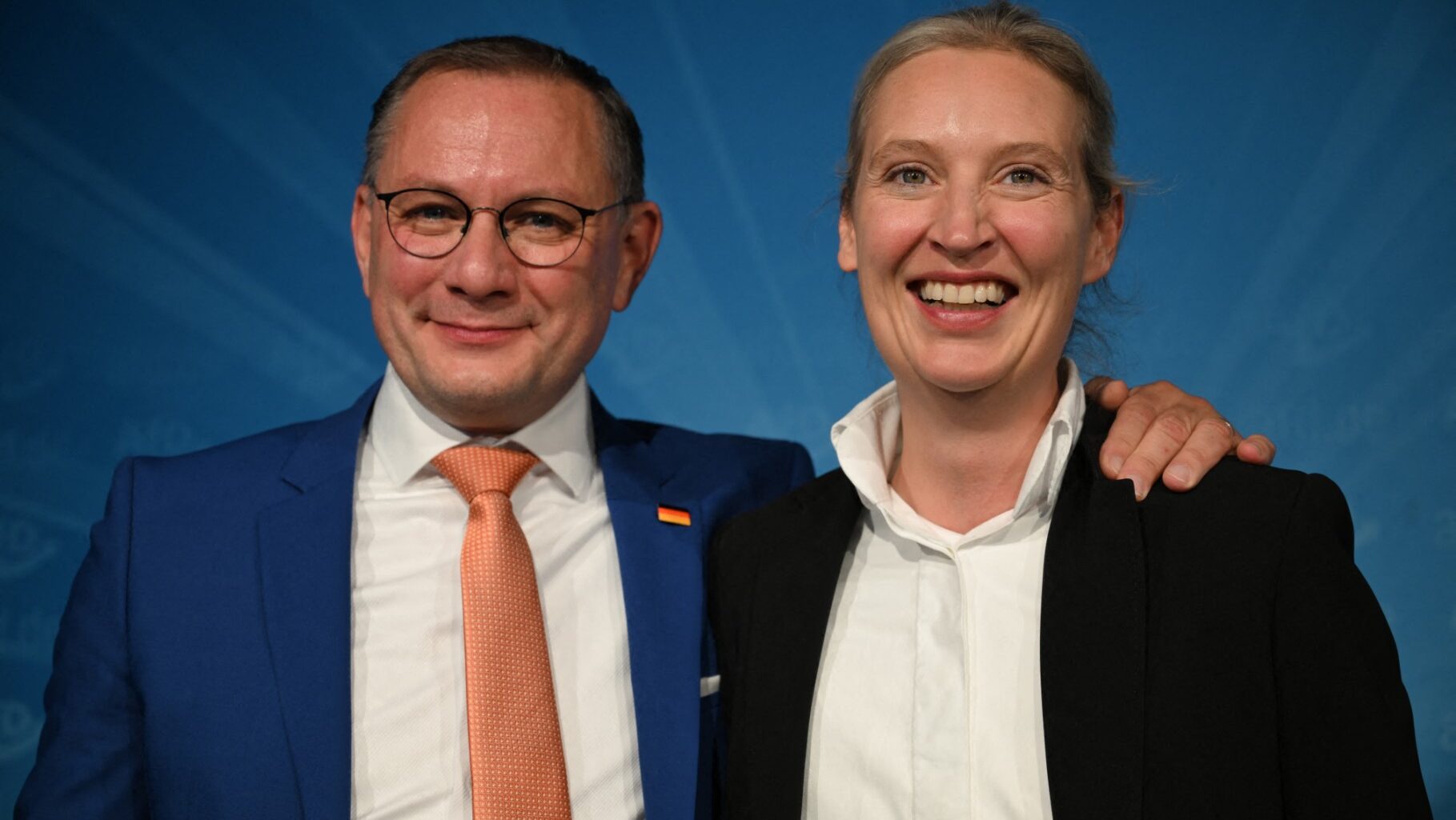
AfD co-leaders Tino Chrupalla and Alice Weidel
RALF HIRSCHBERGER / AFP
While the right-wing Alternative for Germany (AfD) is celebrating a major legal victory, its political opponents have not given up their efforts to get the party banned.
Thursday’s court decision by a Cologne court temporarily halts the Federal Office for the Protection of the Constitution (BfV)—Germany’s domestic intelligence agency—from branding the party a “confirmed right-wing extremist organization” pending the outcome of the main proceedings.
AfD co-chair Alice Weidel celebrated the decision as “a great victory not only for AfD, but also for democracy and the rule of law.” In a statement, she argued that the court not only prevented the BfV from maintaining the “confirmed right-wing extremist” classification but also indirectly put a stop to what she described as “ban fanatics.”
Nicht nur darf der Bundesverfassungsschutz die AfD nicht mehr als "gesichert rechtsextrem" führen, das Verwaltungsgericht Köln schob mit seinem Beschluss auch den Verbotsfanatikern indirekt einen Riegel vor. Ein großer Sieg nicht nur für die AfD, sondern auch für Demokratie und… pic.twitter.com/Ppddsok8go
— Alice Weidel (@Alice_Weidel) February 26, 2026
In the same vein, co-chair Tino Chrupalla stated that the ruling shows that “one cannot eliminate an opposition party in this way either.” He said the court order bolsters the party’s candidates in Baden-Württemberg and Rhineland-Palatinate ahead of the upcoming regional elections in March, although he acknowledged that it is an “interim success” pending the main proceedings.
However, the ruling has not halted political efforts to pursue a ban. The deputy chairman of the Green parliamentary group, Konstantin von Notz, recalled that “the path through the courts remains open.”
The SPD’s legal affairs spokesperson in the Bundestag, Carmen Wegge, reiterated that she considers AfD “hostile to the Constitution” and argued that its possible banning should be examined before the Federal Constitutional Court.
In similar terms, Thuringia’s interior minister, Georg Maier (SPD), insisted that he remains convinced that AfD is contrary to the Constitution and even advocated examining a ban on certain regional branches, such as the one in his own federal state.
Die Linke leader Jan van Aken also downplayed the scope of the ruling: “The court did not assess the inhumane incitement of AfD … we must first wait for the main proceedings.” He said the court did not vindicate the party but only issued a temporary procedural decision.
However, some political figures questioned the strategy of relying on the courts to deal with AfD. Federal Interior Minister Alexander Dobrindt (CSU) acknowledged the ruling and stressed that AfD is still classified as a “suspected case.” But he warned that a ban faces steep legal hurdles, arguing, “AfD must be voted out of office, not banned.”
In a similar line, BSW leader Sahra Wagenknecht described the decision as a “slap in the face” for the BfV.
The Cologne court claimed that there are indications of anti-constitutional tendencies within parts of AfD. But it concluded that the party as a whole cannot presently be classified as “confirmed extremist,” as a general anti-constitutional character has not been sufficiently established.
Politically, the ruling gives the party leadership valuable breathing space at a crucial electoral moment. At the same time, it underscores how difficult it is to deploy the most far-reaching tools of Germany’s “militant democracy” against an opposition party.