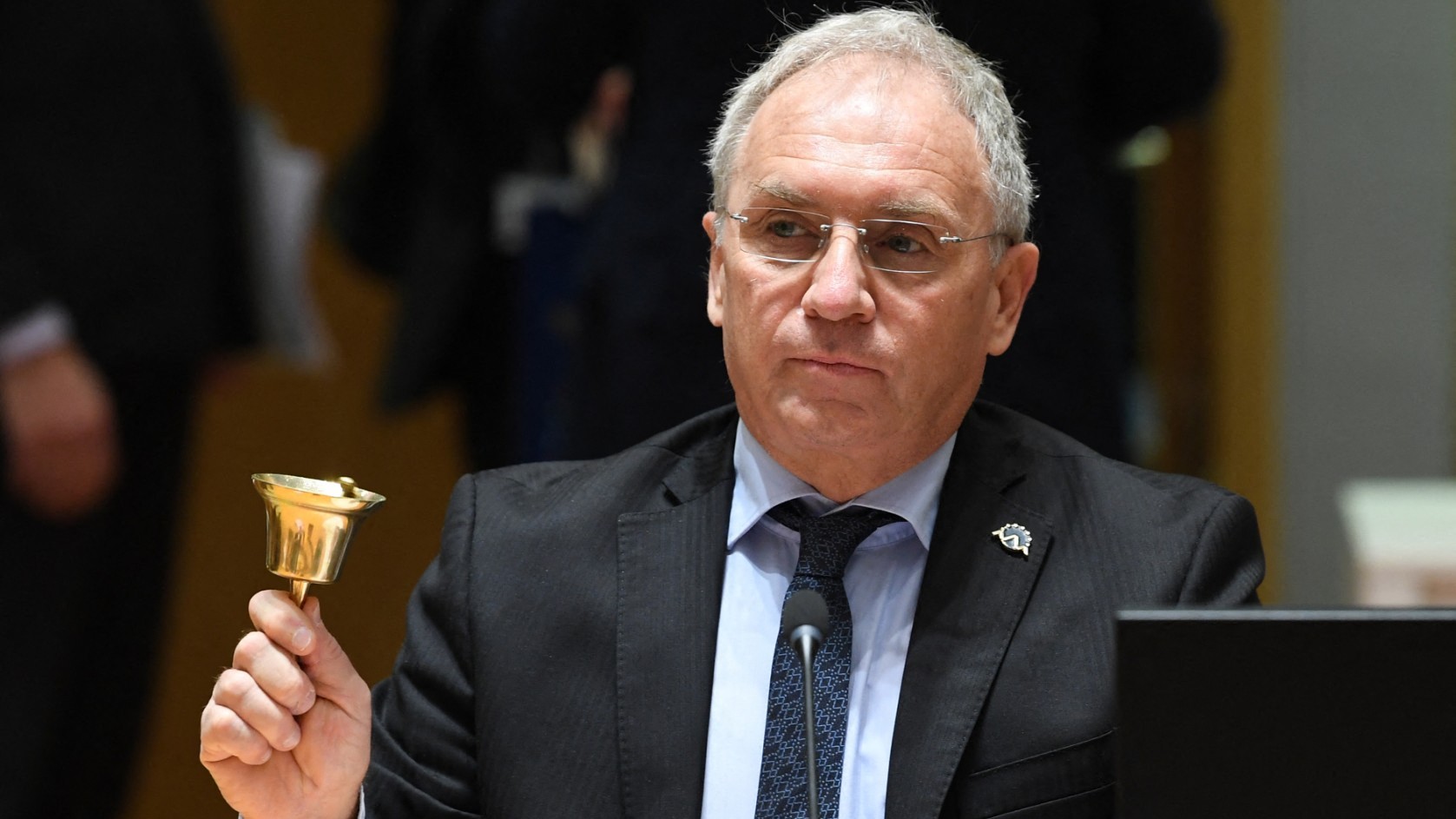
Slovenian Interior Minister Aleš Hojs rings the bell during a Justice and Home Affairs Ministers Council meeting at the EU headquarters in Brussels on December 9, 2021.
John Thys / AFP
Slovenia’s political climate has been rocked by a surprise early-morning raid on Tuesday, September 30th on the home of Aleš Hojs, former interior minister and current vice-president of the opposition conservative Slovenian Democratic Party (SDS).
The operation, led by the Specialised State Prosecutor’s Office rather than the police, comes just six months before parliamentary elections and has triggered an outcry from opposition figures who denounce the move as politically motivated lawfare.
Hojs, who served under former prime minister Janez Janša between 2020 and 2022, hinted at political motives behind the raid in a social media post.
Soon after, SDS leader Janša accused the left-wing government of Robert Golob of intimidating the opposition at a time when his Freedom Movement is struggling in the polls.
⚠️‼️ Early morning today, just a few months before the general elections in Slovenia, @govSlovenia, on the pretext of a ridiculous excuse, sent the Police to search the house of the Vice president of the #SDS, Mr. Aleš Hojs @aleshojs.
— Janez Janša (@JJansaSDS) September 30, 2025
The @strankaSDS is leading convincingly in… pic.twitter.com/QSEbfIsaPl
Janša’s party colleague Nejc Brence argued the raid showed that
the weaker the polls look, the more dangerous the government becomes.
Even former police chief Anton Olaj warned that the operation bore the hallmarks of a political vendetta, noting that judicial independence in Slovenia had been eroded in recent years.
The suspicion of politicisation is heightened by the fact that the Specialised State Prosecutor’s Office is headed by Darja Šlibar, whose daughter is a senior figure in Golob’s Freedom Movement.
The exact reason for the investigation is, at the time of writing, not yet known, but conservative outlet Demokracija believes the case is “suspicious.” Hojs said that the search is being conducted on suspicion that he collaborated with a criminal clan, but that he does not know on what basis.
This is far from the first time Slovenian conservatives have faced courtroom battles at sensitive political moments.
The infamous ‘Patria’ trial saw Janša imprisoned in 2014 on corruption charges, but the ruling was later annulled by the Constitutional Court for lack of sufficient evidence. More recently, the ‘Trenta’ case—centred on a decades-old property sale—was revived a few years ago, but the former three-time prime minister was acquitted earlier this year.
In an interview with europeanconservative.com last year, SDS MEP Branko Grims accused Slovenia’s “deep state” of systematically abusing the judiciary to weaken the opposition, likening the tactic to similar cases elsewhere in Europe, such as the case of Italy’s Matteo Salvini who has had to go on trial for enforcing border controls during his stint as interior minister.
Yet in each case, EU institutions have remained conspicuously silent.
In Slovenia, that silence has been compounded by seemingly active complicity. The SDS party has accused former European Commissioner for Transparency, Věra Jourová, of having influenced a court decision, making it possible for Slovenia’s Brussels-aligned government to take over the country’s public broadcaster.
The timing of Tuesday’s raid inevitably raises the spectre of political interference. Janez Janša’s SDS is leading opinion polls ahead of the April 2026 election: the party is projected to receive 23% of the votes, while PM Robert Golob’s Freedom Movement has slumped to 17%—down from the 34% it got at the 2022 elections.