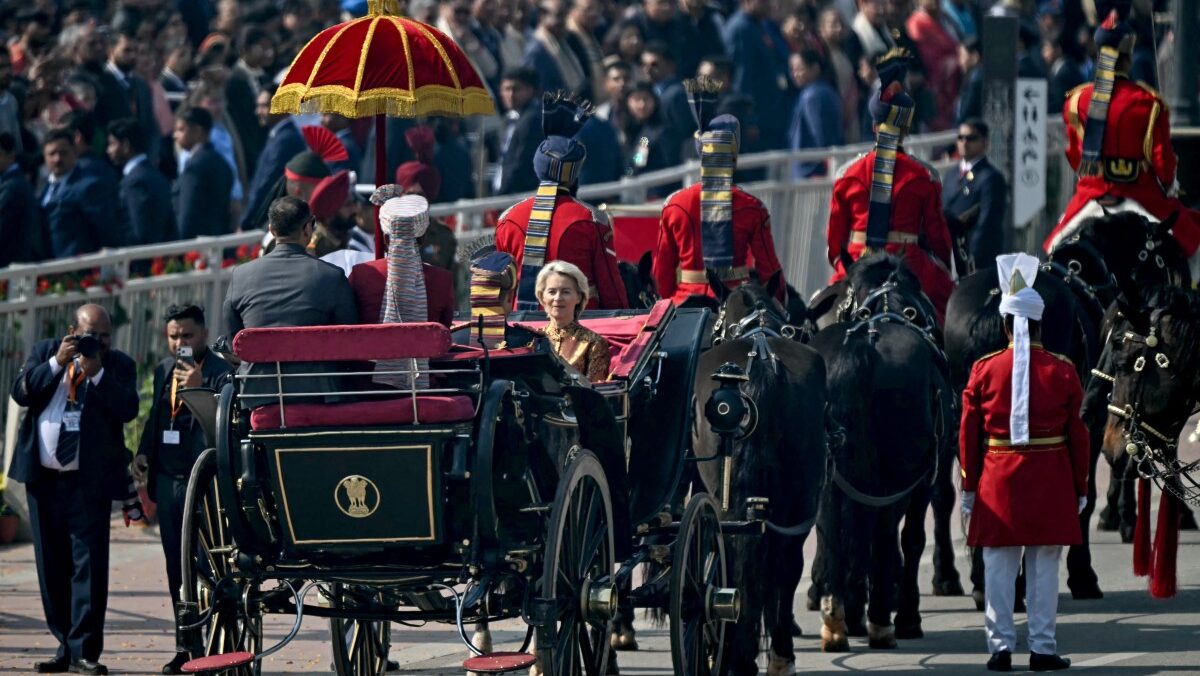
Ursula von der Leyen (C) attends India’s 77th Republic Day parade at Kartavya Path in New Delhi on January 26, 2026.
Sajjad HUSSAIN / AFP
After months of bitter argument over the EU–Mercosur trade deal, Brussels is pressing ahead with another big trade push—this time with India.
The European Commission presents the talks as an attempt to reduce Europe’s reliance on China and to show it can still negotiate major international agreements.
But familiar worries are returning among farmers, businesses and national governments who fear yet another deal pushed for strategic reasons, even though the economic benefits for most Europeans remain uncertain.
In several member states and among farming groups, there is a sense of déjà vu. Once again, the Commission appears to be moving quickly, driven by rising tensions with China and uncertainty in global trade, while those likely to feel the long-term effects are left wondering how much their concerns have shaped the talks.
At its core, the EU–India deal is less about immediate growth and more about where Europe wants to stand in the global economy. India is a fast-growing G20 economy with a huge domestic market and a rising middle class. For European exporters—especially in machinery, car parts, chemicals, pharmaceuticals and services—it remains a difficult place to do business, with high tariffs and heavy regulation limiting access.
Even without a new agreement, trade between the two sides is already substantial. Goods trade stands at around €120–135 billion a year, making India the EU’s ninth-largest trading partner.
European firms face average tariffs of around 9% on industrial goods, with much steeper charges on cars, wine and spirits, and some chemical products. Cutting even part of these barriers would mean billions of euros in savings and a clear advantage for European companies in a market they have long struggled to enter on equal terms.
Still, the economic gains are likely to be modest. Commission forecasts point to small increases in EU GDP spread over many years, not a sudden surge in growth or jobs. Most of the benefits would go to specific sectors—car components, machinery, pharmaceuticals, medical devices and services—where large firms are already well placed to expand. Smaller companies and poorer regions are likely to see far less immediate benefit, reinforcing the belief that EU trade deals mainly benefit large corporations.
From the Commission’s point of view, the logic is simple: lower barriers, open doors for European companies, and tie India more closely to Europe’s trade rules and standards at a time when relations with China are tense and the global trade environment is increasingly uncertain.
This is not a deal that will transform Europe’s economy overnight. Any gains will come slowly, and many sectors may see little benefit at all.
One major difference from the Mercosur talks is that agriculture has largely been left out. Sensitive products—beef, poultry, sugar, dairy, and much of basic farming—are either excluded or tightly limited. On paper, this has reassured European farmers and helps explain why the deal has not triggered large-scale protests.
Even so, unease remains. Farming groups are less worried about a sudden wave of Indian imports than about the broader trend of EU trade policy and what it means for Europe’s own food production. The pattern feels familiar: stricter environmental and welfare rules at home, paired with trade deals abroad that may gradually weaken Europe’s farming base.
For many in rural areas, the concern is not what the deal allows today, but what similar agreements could demand in future negotiations. If farming is protected now because it is politically sensitive, what happens if pressure grows later or new concessions are sought?
Politically, the EU–India deal is far less explosive than Mercosur. There is no clear group of countries lining up to block it, and governments that took a hard line on South American imports have so far stayed quiet on India.
Opposition instead comes in scattered forms. Green and left-wing groups argue that India’s heavy reliance on coal clashes with Europe’s climate goals. Human-rights and digital-rights organisations warn about data protection, surveillance and patent rules, especially their impact on access to medicines. Some industrial sectors, meanwhile, are quietly watching for signs of tougher competition once the final details become clear.
This fragmented pushback may allow Brussels to move fast, but it also risks repeating a familiar mistake: focusing on headline announcements while overlooking who actually gains and who loses, only for political opposition to harden once the real economic and social costs become clear.