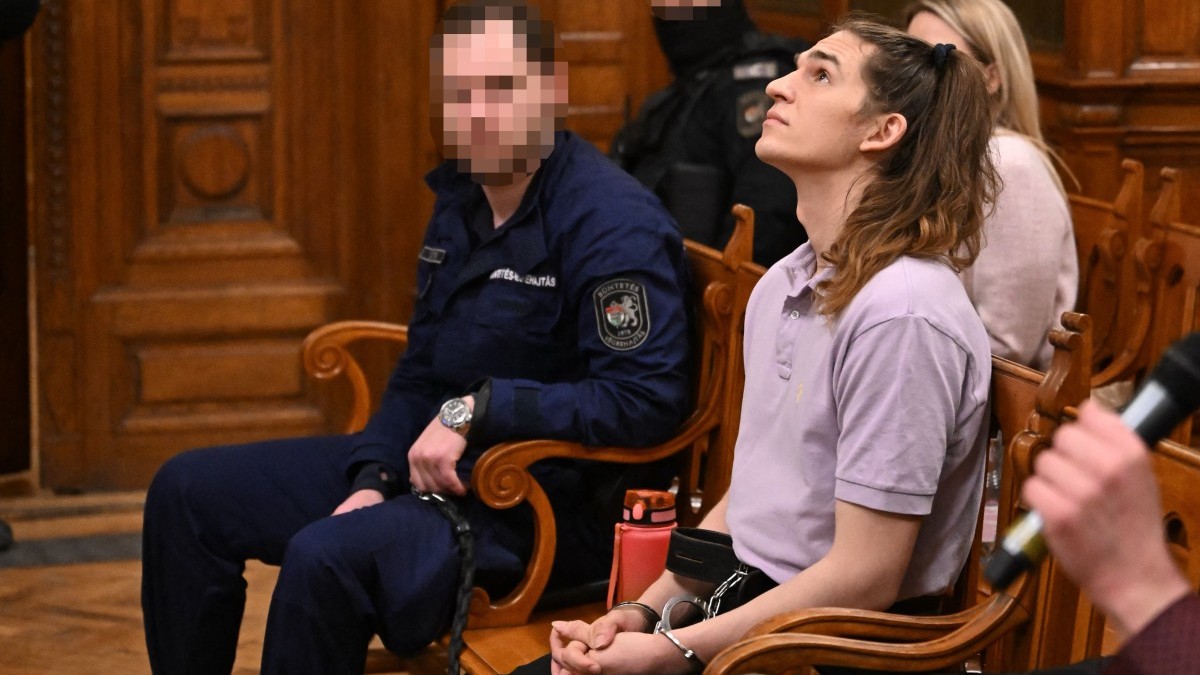
Defendant Maja T., member of the German Antifa group ‘Hammerbande’, sits in the courtroom in Budapest on February 4, 2026, ahead of his sentencing.
ATTILA KISBENEDEK / AFP
On Wednesday, February 4th, the Budapest-Capital Regional Court sentenced German far-left activist ‘Maja T.’—born Simeon T.—to eight years in prison for his role in a series of brutal, ideologically motivated attacks carried out in Budapest in February 2023.
The court found that Maja T. took part in organised, premeditated assaults during the so-called Day of Honour commemorations in the Hungarian capital, when groups of masked attackers stalked victims they deemed ‘right-wing,’ ambushing them from behind and beating them with batons, metal rods, and other weapons.
Several victims suffered broken bones and head injuries, with some attacks continuing even after the victims were lying defenceless on the ground. Investigators concluded that the violence was capable of causing life-threatening injuries.
Hungarian authorities identified Maja T. as a member of the extremist Hammerbande (Hammer Gang), a far-left network that travelled from Germany to Hungary with the explicit purpose of carrying out political violence.
Maja T. was arrested in Berlin in December 2023 and extradited to Hungary in June 2024.
The court rejected requests for house arrest, citing a risk of flight, and ultimately imposed an eight-year custodial sentence for grievous bodily harm and participation in a criminal organisation.
The ruling concludes one of the most politically charged cross-border criminal cases in recent European history and has, unsurprisingly, immediately reignited a fierce political backlash from the European Left, many of whom have sought to recast the convicted attacker as a victim.
Italy’s far-left MEP Ilaria Salis, herself accused of participating in the violence in Budapest but shielded by parliamentary immunity, wrote ahead of the verdict that the case was a sham trial, claiming Hungary was a country “where antifascism is considered terrorism.”
Germany’s far-left Die Linke party echoed the line, stating that “this ruling is a disgrace to the independence of the Hungarian judiciary,” and adding that “a renewed and fair trial in Germany” was required.
The Left group in the European Parliament went further, insisting, “Anti-fascism is not terrorism, it is a democratic duty.”
Such claims are symptomatic of a European Left for which violence is a justified tool. Left-wing politicians have shown little interest in the victims, focusing instead on Maja T.’s self-declared ‘non-binary’ identity and allegations about prison conditions. Maja T. has complained about “inhuman treatment,” and supportive politicians have described his detention as “psychological torture,” although Hungarian authorities insist that conditions comply with the law and that enhanced security measures were justified by the seriousness of the offences.
Incidentally, Wednesday’s ruling drew praise from the opposite end of the political spectrum. The AfD parliamentary group in Saxony simply posted: “Thank you, Hungary!”
Jürgen Elsässer, editor-in-chief of the right-wing Compact magazine, welcomed what he called “a clear message” against left-wing extremism, writing: “Unlike in Germany, there is no soft justice for left-wing extremists in Hungary.”
While German officials have previously lobbied for Maja T.’s transfer back to Germany, Budapest has consistently maintained that crimes committed on Hungarian soil must be tried under Hungarian law.
Ahead of the Wednesday ruling, German police warned of possible nationwide unrest in the event of a guilty ruling. According to an internal e-mail from the Federal Criminal Police Office, retaliatory crimes, riots, arson attacks, and assaults on Hungarian diplomatic missions were considered likely.